

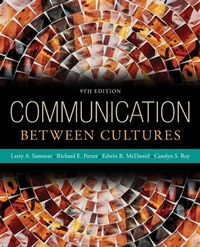
Communication Between Cultures
9th Edition
Published on 1. January 2016
Book
Paperback/Softback
432 pages
978-1-285-44462-8 (ISBN)
Description
Emphasizing the roles that family, religion, and history play in intercultural communication, COMMUNICATION BETWEEN CULTURES, 9E helps you increase your understanding and appreciation of different cultures while developing practical skills for improving your communication with people from other cultures. Bringing chapter concepts to life, the text is packed with the latest research and compelling examples that help you take a look at your own assumptions, perceptions, and cultural biases so you can see the subtle and profound ways culture affects communication. The ninth edition also includes insightful discussions of the impact of globalization, a new chapter on intercultural communication competence, and extensive coverage of new technology.
More details
Edition
9th edition
Language
English
Place of publication
Belmont, CA
United States
Publishing group
Cengage Learning, Inc
Target group
College/higher education
Dimensions
Height: 231 mm
Width: 184 mm
Thickness: 22 mm
Weight
704 gr
ISBN-13
978-1-285-44462-8 (9781285444628)
Copyright in bibliographic data and cover images is held by Nielsen Book Services Limited or by the publishers or by their respective licensors: all rights reserved.
Schweitzer Classification
Other editions
New editions
Larry Samovar | Richard Porter | Edwin McDaniel
Communication Between Cultures
Book
03/2024
10th Edition
Wadsworth Publishing Co Inc
€99.00
Shipment within 10-20 days
Persons
Larry Samovar, Emeritus Professor at San Diego State University, received his Ph.D. from Purdue University, where he taught for five years. He was also an invited scholar at Nihon University in Japan. As an early pioneer in the field of intercultural communication, he has been a guest speaker at many universities in the United States. In addition, Dr. Samovar has worked as a communication consultant in both the private and public sectors. He has written and/or edited 14 textbooks -- totaling 45 editions. Many of his publications have been translated into foreign languages and are used in 11 countries. As an active researcher he has presented more than 100 scholarly papers and conducted numerous seminars and workshops at international, national and regional conferences. His publication list is extensive and encompasses books and articles on intercultural communication, small group communication, interpersonal communication and public speaking. Richard E. Porter is Professor Emeritus in the Department of Communication Studies at California State University, Long Beach. He earned his Ph.D. from the University of Southern California. Dr. Porter developed his interest in intercultural communication in 1967 before there was an established field of study. His and other pioneers' early work in the field laid the basic structural foundation used by many later scholars as the field developed and expanded. For 30 years he created and taught undergraduate and graduate courses in intercultural communication. Dr. Porter is the co-author and editor of four books with 24 editions that deal with the subject of intercultural communication. Edwin (Ed) R. McDaniel received his Ph.D. from Arizona State University. He is currently a Member-at-Large of the Japan-U.S. Communication Association and a member of the Thunderbird Educator Network at the Thunderbird School of Global Management. He is also a retired Professor of Intercultural Communication at Aichi Shukutoku University in Nagoya, Japan, and has been a Japan ICU Foundation Visiting Scholar at the International Christian University in Tokyo. In addition, Dr. McDaniel has taught at San Diego State University, CSU San Marcos, and Thunderbird. In May 2013, he was an invited speaker at the China Cultural Industry Forum (CIF) in Beijing. He is the co-author/co-editor of numerous books on intercultural communication. His articles and book chapters have been published in China, Germany, Korea, and Japan, as well as the United States. Before beginning his academic career, Dr. McDaniel was in government service for over 20 years, during which time he lived and traveled in more than 40 countries. Carolyn Sexton Roy has been a member of the History Department at San Diego State University since 1989. Her doctoral studies in Colonial Latin American history were conducted at the University of California, Los Angeles. A well-practiced presenter of papers at regional, national and international conventions, she has been published numerous times. She has traveled extensively in Latin America. A Fulbright Fellowship enabled her to conduct research for an extended period and salvage an archive in Parral, Chihuahua, Mexico. Her linguistic skills -- particularly applied to Latin America -- facilitate her high level of understanding of intercultural communication.
Content
1. Intercultural Communication: A Requirement for the Interdependent Global Society.
2. Communication and Culture: The Voice and the Echo.
3. The Deep Structure of Culture: Lessons from the Family.
4. Worldview: Cultural Explanations of Life and Death.
5. Cultural History: Precursor to the Present and Future.
6. Cultural Values: Roadmaps for Behavior.
7. Culture and Identity: Situating the Individual.
8. Verbal Messages: Exchanging Ideas Through Language.
9. Nonverbal Communication: The Messages of Action, Space, Time, and Silence.
10. Intercultural Communication in Contexts: Application in Business, Education, and Healthcare.
11. The Challenges of Intercultural Communication: Managing Differences.
2. Communication and Culture: The Voice and the Echo.
3. The Deep Structure of Culture: Lessons from the Family.
4. Worldview: Cultural Explanations of Life and Death.
5. Cultural History: Precursor to the Present and Future.
6. Cultural Values: Roadmaps for Behavior.
7. Culture and Identity: Situating the Individual.
8. Verbal Messages: Exchanging Ideas Through Language.
9. Nonverbal Communication: The Messages of Action, Space, Time, and Silence.
10. Intercultural Communication in Contexts: Application in Business, Education, and Healthcare.
11. The Challenges of Intercultural Communication: Managing Differences.