

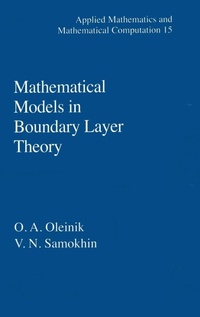
Mathematical Models in Boundary Layer Theory
1st Edition
Published on 25. May 1999
Book
Hardback
528 pages
978-1-58488-015-8 (ISBN)
Description
Since Prandtl first suggested it in 1904, boundary layer theory has become a fundamental aspect of fluid dynamics. Although a vast literature exists for theoretical and experimental aspects of the theory, for the most part, mathematical studies can be found only in separate, scattered articles. Mathematical Models in Boundary Layer Theory offers the first systematic exposition of the mathematical methods and main results of the theory.
Beginning with the basics, the authors detail the techniques and results that reveal the nature of the equations that govern the flow within boundary layers and ultimately describe the laws underlying the motion of fluids with small viscosity. They investigate the questions of existence and uniqueness of solutions, the stability of solutions with respect to perturbations, and the qualitative behavior of solutions and their asymptotics. Of particular importance for applications, they present methods for an approximate solution of the Prandtl system and a subsequent evaluation of the rate of convergence of the approximations to the exact solution.
Written by the world's foremost experts on the subject, Mathematical Models in Boundary Layer Theory provides the opportunity to explore its mathematical studies and their importance to the nonlinear theory of viscous and electrically conducting flows, the theory of heat and mass transfer, and the dynamics of reactive and muliphase media. With the theory's importance to a wide variety of applications, applied mathematicians-especially those in fluid dynamics-along with engineers of aeronautical and ship design will undoubtedly welcome this authoritative, state-of-the-art treatise.
Beginning with the basics, the authors detail the techniques and results that reveal the nature of the equations that govern the flow within boundary layers and ultimately describe the laws underlying the motion of fluids with small viscosity. They investigate the questions of existence and uniqueness of solutions, the stability of solutions with respect to perturbations, and the qualitative behavior of solutions and their asymptotics. Of particular importance for applications, they present methods for an approximate solution of the Prandtl system and a subsequent evaluation of the rate of convergence of the approximations to the exact solution.
Written by the world's foremost experts on the subject, Mathematical Models in Boundary Layer Theory provides the opportunity to explore its mathematical studies and their importance to the nonlinear theory of viscous and electrically conducting flows, the theory of heat and mass transfer, and the dynamics of reactive and muliphase media. With the theory's importance to a wide variety of applications, applied mathematicians-especially those in fluid dynamics-along with engineers of aeronautical and ship design will undoubtedly welcome this authoritative, state-of-the-art treatise.
More details
Series
Language
English
Place of publication
Oxford
United States
Publishing group
Taylor & Francis Inc
Target group
College/higher education
Professional and scholarly
Professional
Dimensions
Height: 240 mm
Width: 161 mm
Thickness: 33 mm
Weight
954 gr
ISBN-13
978-1-58488-015-8 (9781584880158)
Copyright in bibliographic data and cover images is held by Nielsen Book Services Limited or by the publishers or by their respective licensors: all rights reserved.
Schweitzer Classification
Other editions
Additional editions
V.N. Samokhin
Mathematical Models in Boundary Layer Theory
E-Book
05/2018
1st Edition
Routledge
€264.99
Available for download
V.N. Samokhin
Mathematical Models in Boundary Layer Theory
E-Book
05/2018
1st Edition
Routledge
€264.99
Available for download
Person
Samokhin, V.N.
Content
con>CONTENTS: The Navier-Stokes Equations and Prandtl's System of the Boundary Layer. Stationary Boundary Layer: The Mises Variables. Stationary Boundary Layer: Crocco's Variables. Non-Stationary Boundary Layer. Boundary Layer Formation. Finite Difference Method. The Diffraction-Type Problems for the Prandtl System. Boundary Layer of Non-Newtonian Fluids. Boundary Layer In Magnetic Hydrodynamics. Homogenization Methods in the Boundary Layer Problems.