

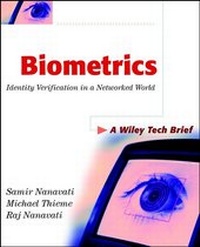
Biometrics
Identity Verification in a Networked World
Published on 12. April 2002
Book
Paperback/Softback
XX, 300 pages
978-0-471-09945-1 (ISBN)
Unfortunately, price unknown
Article exhausted; check different version
Description
An insight into the biometric industry and the steps for successful deployment
Biometrics technologies verify identity through characteristics such as fingerprints, voices, and faces. By providing increased security and convenience, biometrics have begun to see widespread deployment in network, e-commerce, and retail applications. This book provides in-depth analysis of biometrics as a solution for authenticating employees and customers. Leading authority, Samir Nanavati explores privacy, security, accuracy, system design, user perceptions, and lessons learned in biometric deployments. He also assesses the real-world strengths and weaknesses of leading biometric technologies: finger-scan, iris-scan, facial-scan, voice-scan, and signature-scan. This accessible book is a necessary step in understanding and implementing biometrics.
Demystifies the complex world of optical networks for IT and business managers
Over the past few years, the cost of fiber optic networking has decreased, making it the best solution for providing virtually unlimited bandwidth for corporate LANs and WANs, metropolitan networks, Internet access, and broadband to the home. The only strategic book on optical networking technologies written from a real-world business perspective, Optical Networking demystifies complex fiber technologies for managers, and details the practical business benefits an optical network can offer. Debra Cameron explores established and emerging markets for optical networks as well as the enabling technologies, applications, network architectures, key deployment issues, and cost considerations. She also provides in-depth case studies of optical networks now in use in the United States and abroad.
Bei der Biometrik handelt es sich um automatisierte Technologien, die den menschlichen Körper vermessen, wie z.B. Fingerabdrücke, Gesicht und Iris, um so die Identität einer Person festzustellen. Schon lange hat die Biometrik die Phantasie von Science Fiction Fans beflügelt, aber erst seit kurzem wird sie in größerem Umfang eingesetzt, so z.B. von Bundeskriminalamt, Polizeibehörden, Banken und Finanzinstituten. Netzwerk-, Internet- und E-Commerce Anwendungen bilden die nächste Welle der Anwendungsmöglichkeiten. IT-Experten berichten, dass es sich bei ca. 50% aller Anrufe beim IT Help Desk um vergessene oder abgelaufene Passwörter handelt. Eine Identifizierung via Fingerabdruck z.B. würde so nicht nur die Anruffrequenz beim Help Desk erheblich senken, sondern auch die Kosten für die Netzwerkadministration. Dieses Buch bietet eine fundierte Analyse der Biometrik als Sicherheitslösung für die Authentifizierung von Mitarbeitern und Kunden. Autor Samir Nanavati gilt als führende Autorität auf diesem Gebiet und erörtert hier detailliert Fragen zu Datenschutz, Sicherheit, Erkennungsgenauigkeit, Systemdesign und Nutzerwahrnehmung sowie positive und negative Erfahrungen mit dem Einsatz biometrischer Technologien in der Praxis. Darüber hinaus geht Nanavati auch auf die Stärken und Schwächen führender Technologien ein, wie z.B. das Scannen von Fingerabdrücken, Iris, Gesicht, Stimme und Unterschrift. "Biometrics" ist ein verständlich geschriebener Leitfaden, der die Grundlagen der Biometriktechnologie und die Schritte zu ihrer Implementierung anschaulich erläutert.
Biometrics technologies verify identity through characteristics such as fingerprints, voices, and faces. By providing increased security and convenience, biometrics have begun to see widespread deployment in network, e-commerce, and retail applications. This book provides in-depth analysis of biometrics as a solution for authenticating employees and customers. Leading authority, Samir Nanavati explores privacy, security, accuracy, system design, user perceptions, and lessons learned in biometric deployments. He also assesses the real-world strengths and weaknesses of leading biometric technologies: finger-scan, iris-scan, facial-scan, voice-scan, and signature-scan. This accessible book is a necessary step in understanding and implementing biometrics.
Demystifies the complex world of optical networks for IT and business managers
Over the past few years, the cost of fiber optic networking has decreased, making it the best solution for providing virtually unlimited bandwidth for corporate LANs and WANs, metropolitan networks, Internet access, and broadband to the home. The only strategic book on optical networking technologies written from a real-world business perspective, Optical Networking demystifies complex fiber technologies for managers, and details the practical business benefits an optical network can offer. Debra Cameron explores established and emerging markets for optical networks as well as the enabling technologies, applications, network architectures, key deployment issues, and cost considerations. She also provides in-depth case studies of optical networks now in use in the United States and abroad.
Bei der Biometrik handelt es sich um automatisierte Technologien, die den menschlichen Körper vermessen, wie z.B. Fingerabdrücke, Gesicht und Iris, um so die Identität einer Person festzustellen. Schon lange hat die Biometrik die Phantasie von Science Fiction Fans beflügelt, aber erst seit kurzem wird sie in größerem Umfang eingesetzt, so z.B. von Bundeskriminalamt, Polizeibehörden, Banken und Finanzinstituten. Netzwerk-, Internet- und E-Commerce Anwendungen bilden die nächste Welle der Anwendungsmöglichkeiten. IT-Experten berichten, dass es sich bei ca. 50% aller Anrufe beim IT Help Desk um vergessene oder abgelaufene Passwörter handelt. Eine Identifizierung via Fingerabdruck z.B. würde so nicht nur die Anruffrequenz beim Help Desk erheblich senken, sondern auch die Kosten für die Netzwerkadministration. Dieses Buch bietet eine fundierte Analyse der Biometrik als Sicherheitslösung für die Authentifizierung von Mitarbeitern und Kunden. Autor Samir Nanavati gilt als führende Autorität auf diesem Gebiet und erörtert hier detailliert Fragen zu Datenschutz, Sicherheit, Erkennungsgenauigkeit, Systemdesign und Nutzerwahrnehmung sowie positive und negative Erfahrungen mit dem Einsatz biometrischer Technologien in der Praxis. Darüber hinaus geht Nanavati auch auf die Stärken und Schwächen führender Technologien ein, wie z.B. das Scannen von Fingerabdrücken, Iris, Gesicht, Stimme und Unterschrift. "Biometrics" ist ein verständlich geschriebener Leitfaden, der die Grundlagen der Biometriktechnologie und die Schritte zu ihrer Implementierung anschaulich erläutert.
Reviews / Votes
"...particularly relevant...questions are raised and useful answers given...the material is extensive...substantial and well-researched material..." (Computer Bulletin, May 2003)More details
Product info
Paperback
Series
Edition
1. Auflage
Language
English
Place of publication
New York
United States
Target group
College/higher education
Professional and scholarly
Illustrations
Photos: 38 B&W, 0 Color; Drawings: 18 B&W, 0 Color; Tables: 7 B&W, 0 Color
Dimensions
Height: 23.7 cm
Width: 19.1 cm
Thickness: 1.8 cm
Weight
567 gr
ISBN-13
978-0-471-09945-1 (9780471099451)
Schweitzer Classification
Other editions
Additional editions
E-Book
04/2002
Wiley
€28.99
Available for download
Persons
SAMIR NANAVATI is a founding partner of International Biometric Group, LLC, a biometric consulting and integration firm cofounded in 1996. Mr. Nanavati is cited frequently by several leading publications such as U.S. News & World Report, the New York Times, and The Industry Standard. He is also the author of fourteen analyses on the state of the biometric industry.
MICHAEL THIEME is a Senior Consultant with International Biometric Group. He has written extensively on a variety of biometric topics including IT security, deployment issues, and privacy. Mr. Thieme served on the Biometric Interoperability Subcommittee of the GSA Smart Access project and is also a member of the ANSI NIST B10.8 Biometric Subcommittee as well as a founder of the BioPrivacy Initiative.
RAJ NANAVATI is a cofounding partner at International Biometric Group, LLC. He lectures extensively on the technical, business, and policy issues associated with using biometrics. He has been quoted extensively in major media publications, including the New York Times, and has been featured on National Public Radio. He has also submitted testimony on biometrics to Congress.
MICHAEL THIEME is a Senior Consultant with International Biometric Group. He has written extensively on a variety of biometric topics including IT security, deployment issues, and privacy. Mr. Thieme served on the Biometric Interoperability Subcommittee of the GSA Smart Access project and is also a member of the ANSI NIST B10.8 Biometric Subcommittee as well as a founder of the BioPrivacy Initiative.
RAJ NANAVATI is a cofounding partner at International Biometric Group, LLC. He lectures extensively on the technical, business, and policy issues associated with using biometrics. He has been quoted extensively in major media publications, including the New York Times, and has been featured on National Public Radio. He has also submitted testimony on biometrics to Congress.
Content
Introduction.
Acknowledgments.
PART 1: BIOMETRIC FUNDAMENTALS.
Why Biometrics?
Key Biometric Terms and Processes.
Accuracy in Biometric Systems.
PART 2: LEADING BIOMETRIC TECHNOLOGIES: WHAT YOU NEED TO KNOW.
Finger-Scan.
Facial-Scan.
Iris-Scan.
Voice-Scan.
Other Physiological Biometrics.
Other Leading Behavioral Biometrics.
PART 3: BIOMETRIC APPLICATIONS AND MARKETS.
Categorizing Biometric Applications.
Citizen-Facing Applications.
Employee-Facing Applications.
Customer-Facing Applications.
Biometric Vertical Markets.
PART 4: PRIVACY AND STANDARDS IN BIOMETRIC SYSTEM DESIGN.
Assessing the Privacy Risks of Biometrics.
Designing Privacy-Sympathetic Biometric Systems.
Biometric Standards.
Index.
Acknowledgments.
PART 1: BIOMETRIC FUNDAMENTALS.
Why Biometrics?
Key Biometric Terms and Processes.
Accuracy in Biometric Systems.
PART 2: LEADING BIOMETRIC TECHNOLOGIES: WHAT YOU NEED TO KNOW.
Finger-Scan.
Facial-Scan.
Iris-Scan.
Voice-Scan.
Other Physiological Biometrics.
Other Leading Behavioral Biometrics.
PART 3: BIOMETRIC APPLICATIONS AND MARKETS.
Categorizing Biometric Applications.
Citizen-Facing Applications.
Employee-Facing Applications.
Customer-Facing Applications.
Biometric Vertical Markets.
PART 4: PRIVACY AND STANDARDS IN BIOMETRIC SYSTEM DESIGN.
Assessing the Privacy Risks of Biometrics.
Designing Privacy-Sympathetic Biometric Systems.
Biometric Standards.
Index.