

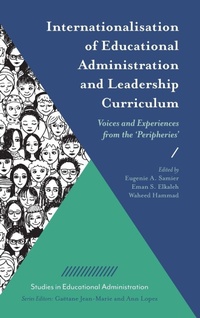
Internationalisation of Educational Administration and Leadership Curriculum
Voices and Experiences from the 'Peripheries'
Published on 23. August 2021
Book
Hardback
262 pages
978-1-83909-865-9 (ISBN)
Description
In light of a new wave of globalisation, cultural mobility, and criticism of Anglo-American domination, how must educational administrators and leaders respond to the challenges of internationalising their curricula and accommodating diversity?
This edited collection offers conceptual frameworks, models, theoretical approaches, and strategies that can inform and guide the development of a genuinely international curriculum. Offering an in-depth look at cases in countries such as Sweden, the US and UK, Turkey, Oman, Cameroon, the United Arab Emirates, Bahrain, and Australia, the authors investigate how factors such as institutional culture, faculty recruitment and development, learning styles, accreditation and standards, political orientation, policy, and availability of financial resources may either facilitate or inhibit the internationalisation of the curriculum. The collection also includes broader international issues of diverse humanisms, postcolonial issues, and corruption, fraud and abuse in internationalisation that has occurred that need to be addressed in educational administration and leadership curricula to improve internationalisation.
Acknowledging the need for a much broader set of cultural traditions within which educational administrators and leaders are equipped to function, this book provides a critical insight into how they might navigate the challenges of creating a truly international curriculum.
This edited collection offers conceptual frameworks, models, theoretical approaches, and strategies that can inform and guide the development of a genuinely international curriculum. Offering an in-depth look at cases in countries such as Sweden, the US and UK, Turkey, Oman, Cameroon, the United Arab Emirates, Bahrain, and Australia, the authors investigate how factors such as institutional culture, faculty recruitment and development, learning styles, accreditation and standards, political orientation, policy, and availability of financial resources may either facilitate or inhibit the internationalisation of the curriculum. The collection also includes broader international issues of diverse humanisms, postcolonial issues, and corruption, fraud and abuse in internationalisation that has occurred that need to be addressed in educational administration and leadership curricula to improve internationalisation.
Acknowledging the need for a much broader set of cultural traditions within which educational administrators and leaders are equipped to function, this book provides a critical insight into how they might navigate the challenges of creating a truly international curriculum.
More details
Series
Language
English
Place of publication
Bingley
United Kingdom
Target group
Professional and scholarly
Dimensions
Height: 235 mm
Width: 157 mm
Thickness: 19 mm
Weight
535 gr
ISBN-13
978-1-83909-865-9 (9781839098659)
Copyright in bibliographic data and cover images is held by Nielsen Book Services Limited or by the publishers or by their respective licensors: all rights reserved.
Schweitzer Classification
Other editions
Additional editions
Eugenie A. Samier | Eman A. Elkaleh | Waheed Hammad
Internationalisation of Educational Administration and Leadership Curriculum
Voices and Experiences from the 'Peripheries'
E-Book
08/2021
Emerald Publishing Limited
€92.49
Available for download
Persons
Eugenie A. Samier is a Reader in Educational Administration at the University of Strathclyde. Her research concentrates on interdisciplinary, international and comparative public and educational administration and leadership.;
Eman S. Elkaleh is a Lecturer of Management and Leadership and the Senior Admissions Coordinator at Zayed University, United Arab Emirates. Her research revolves around leadership from Islamic and cross-cultural perspectives and curriculum development.
Waheed Hammad is an Associate Professor in Educational Administration and leadership at Sultan Qaboos University, Oman, and Damietta University, Egypt. His research interests include educational administration and leadership and teachers and principals' professional development.
Eman S. Elkaleh is a Lecturer of Management and Leadership and the Senior Admissions Coordinator at Zayed University, United Arab Emirates. Her research revolves around leadership from Islamic and cross-cultural perspectives and curriculum development.
Waheed Hammad is an Associate Professor in Educational Administration and leadership at Sultan Qaboos University, Oman, and Damietta University, Egypt. His research interests include educational administration and leadership and teachers and principals' professional development.
Content
Chapter 1. Editors' Critical Introduction: Conceptions of Internationalisation Challenging Dominant Knowledge Traditions; Eugenie A. Samier, Eman ElKaleh, and Waheed Hammad
Section 1: Theoretical Foundations and Critiques
Chapter 2. Humanistic Knowledge Traditions that can Inform Educational Administration and Leadership Curricula: Ancient, Islamic, Confucian, Buddhist, and European Approaches; Eugenie A. Samier and Waheed Hammad
Chapter 3. Conceptions of Internationalisation Challenging Dominant Knowledge Traditions: Critical and Postcolonial Approaches to Educational Administration Curriculum and Pedagogy; Eugenie A. Samier
Chapter 4. Internationalisation Models and Strategies in Higher Education: A Conceptual Model for Internationalising the Curriculum; Eman S. ElKaleh
Chapter 5. Towards an Educational Administration Curriculum that Addresses Maladministration in Internationalised Higher Education; Peter Milley and Eliane Dulude
Section 2: Country Cases
Chapter 6. Aligning "International" Standards with "National" Educational Leadership Preparation Needs: The Case of a Masters' Programme in Oman; Waheed Hammad and Aisha Salim Ali Al-Harthi
Chapter 7. Mapping the Terrain of Training and Appointment of Educational Leaders in the Turkish Context: An Historical Perspective; Ali Cagatay Kilinc, Emre Er, and Kadir Beycioglu
Chapter 8. Rethinking Knowledge Hierarchies in Teaching Educational Leadership to International Students; Bev Rogers
Chapter 9. Educational administration and leadership in Greece and the UK: A comparative study on the interplay between the policy context and the relevant postgraduate courses in the two countries; Evangelia Papaloi, Kostas Dimopoulos, and Christos Koutsambelas
Chapter 10. To achieve Gender Equality in Organisations: A Swedish case on an Important Aspect of Educational Leadership; Ulrika Haake
Chapter 11. African Philosophies of Education and their Relevance in Developing an International Leadership Curriculum: A Guide for Educational Systems, Schools and School Leaders; Frederick Ebot Ashu
Section 1: Theoretical Foundations and Critiques
Chapter 2. Humanistic Knowledge Traditions that can Inform Educational Administration and Leadership Curricula: Ancient, Islamic, Confucian, Buddhist, and European Approaches; Eugenie A. Samier and Waheed Hammad
Chapter 3. Conceptions of Internationalisation Challenging Dominant Knowledge Traditions: Critical and Postcolonial Approaches to Educational Administration Curriculum and Pedagogy; Eugenie A. Samier
Chapter 4. Internationalisation Models and Strategies in Higher Education: A Conceptual Model for Internationalising the Curriculum; Eman S. ElKaleh
Chapter 5. Towards an Educational Administration Curriculum that Addresses Maladministration in Internationalised Higher Education; Peter Milley and Eliane Dulude
Section 2: Country Cases
Chapter 6. Aligning "International" Standards with "National" Educational Leadership Preparation Needs: The Case of a Masters' Programme in Oman; Waheed Hammad and Aisha Salim Ali Al-Harthi
Chapter 7. Mapping the Terrain of Training and Appointment of Educational Leaders in the Turkish Context: An Historical Perspective; Ali Cagatay Kilinc, Emre Er, and Kadir Beycioglu
Chapter 8. Rethinking Knowledge Hierarchies in Teaching Educational Leadership to International Students; Bev Rogers
Chapter 9. Educational administration and leadership in Greece and the UK: A comparative study on the interplay between the policy context and the relevant postgraduate courses in the two countries; Evangelia Papaloi, Kostas Dimopoulos, and Christos Koutsambelas
Chapter 10. To achieve Gender Equality in Organisations: A Swedish case on an Important Aspect of Educational Leadership; Ulrika Haake
Chapter 11. African Philosophies of Education and their Relevance in Developing an International Leadership Curriculum: A Guide for Educational Systems, Schools and School Leaders; Frederick Ebot Ashu