

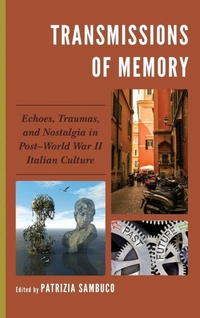
Transmissions of Memory
Echoes, Traumas, and Nostalgia in Post-World War II Italian Culture
Published on 19. March 2018
Book
Hardback
236 pages
978-1-68393-143-0 (ISBN)
Description
Transmissions of Memory: Echoes, Traumas and Nostalgia in Post-World War II Italian Culture discusses cultural products-films, poetry, fiction, architectural buildings, autobiographical writing, and social media-to individuate through them the dynamics of memory. The field of analysis is Italian culture from World War II to the contemporary times, and the volume has in a gendered approach one of its focuses, offering an encompassing view on cultural memory and highlighting the similarities between gendered revisitation and revisitation of the past. The volume is divided into three sections: cultural transmissions, fractured memories, and nostalgia. In the chapters herewith the study of memory through these forms hints at a sense of transformation and often enrichment or resilience, individual or collective, that values more the present and the future rather than the past.
More details
Language
English
Place of publication
Cranbury
United States
Publishing group
Associated University Presses
Dimensions
Height: 235 mm
Width: 157 mm
Thickness: 19 mm
Weight
540 gr
ISBN-13
978-1-68393-143-0 (9781683931430)
Copyright in bibliographic data and cover images is held by Nielsen Book Services Limited or by the publishers or by their respective licensors: all rights reserved.
Schweitzer Classification
Other editions
Additional editions
Transmissions of Memory
Echoes, Traumas, and Nostalgia in Post-World War II Italian Culture
E-Book
03/2018
1st Edition
Fairleigh Dickinson University Press,U.S.
€107.99
Available for download
Patrizia Sambuco
Transmissions of Memory
Echoes, Traumas, and Nostalgia in Post-World War II Italian Culture
E-Book
03/2018
1st Edition
Bloomsbury eBooks US
€107.99
Available for download
Persons
Patrizia Sambuco is an independent scholar and editor of Italian Women Writers 1800-2000: Boundaries, Borders and Transgression (Fairleigh Dickinson University Press, 2015).
Content
Acknowledgments
Introduction
Section I: Memory as Cultural Transmission
1. Calvino, Eco and the Transmission of World Literature, Martin McLaughlin
2. Montale's Xenia: Between Myth and Poetic Tradition, Adele Bardazzi
3. Repressed Memory and Traumatic History in Alberto Moravia's The Woman of Rome, Charles L. Leavitt IV
4. Reconstructing the Maternal: Transmission of Memory, Cultural Translation and Transnational Identity in Igiaba Scego's La mia casa e dove sono, Maria Cristina Seccia
Section II: Trauma and Divided Memory
5. At the Edge. Divided Memory on Italy's Borders. The Case of Trieste and the Foibe di Basovizza, John Foot
6. Remembering War. Memory and History in Claudio Magris's Blameless, Sandra Parmegiani
7. Blood, Sand and Stone: Trieste's Transcultural Memories, Katia Pizzi
8. The Trauma of Liberation: Rape, Love and Violence in Wartime Italy, David W. Ellwood
9. Between Past and Present, Self and Other: Liminality and the Transmission of Traumatic Memory in Elena Ferrante's La f
Introduction
Section I: Memory as Cultural Transmission
1. Calvino, Eco and the Transmission of World Literature, Martin McLaughlin
2. Montale's Xenia: Between Myth and Poetic Tradition, Adele Bardazzi
3. Repressed Memory and Traumatic History in Alberto Moravia's The Woman of Rome, Charles L. Leavitt IV
4. Reconstructing the Maternal: Transmission of Memory, Cultural Translation and Transnational Identity in Igiaba Scego's La mia casa e dove sono, Maria Cristina Seccia
Section II: Trauma and Divided Memory
5. At the Edge. Divided Memory on Italy's Borders. The Case of Trieste and the Foibe di Basovizza, John Foot
6. Remembering War. Memory and History in Claudio Magris's Blameless, Sandra Parmegiani
7. Blood, Sand and Stone: Trieste's Transcultural Memories, Katia Pizzi
8. The Trauma of Liberation: Rape, Love and Violence in Wartime Italy, David W. Ellwood
9. Between Past and Present, Self and Other: Liminality and the Transmission of Traumatic Memory in Elena Ferrante's La f