

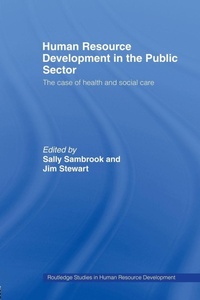
Human Resource Development in the Public Sector
The Case of Health and Social Care
1st Edition
Published on 6. October 2008
Book
Paperback/Softback
448 pages
978-0-415-48806-8 (ISBN)
Description
Across Europe and the world, countries are attempting to develop their health and social policies and practices to address the global challenge of increasing demand and pressurized supply, created by ageing populations, emerging technologies and finite resources (financial and human).
This text provides examples of attempts to develop HRD practices in health and social care contexts within France, Ireland, The Netherlands, Romania, Russia, the UK and the USA. Thus, the book is European and international in both scope and appeal.
This text provides examples of attempts to develop HRD practices in health and social care contexts within France, Ireland, The Netherlands, Romania, Russia, the UK and the USA. Thus, the book is European and international in both scope and appeal.
More details
Series
Language
English
Place of publication
London
United Kingdom
Publishing group
Taylor & Francis Ltd
Target group
College/higher education
Product notice
Paperback (UK-B)
Illustrations
20 s/w Abbildungen, 20 s/w Zeichnungen, 33 s/w Tabellen
33 Tables, black and white; 20 Line drawings, black and white; 20 Illustrations, black and white
Dimensions
Height: 234 mm
Width: 156 mm
Thickness: 24 mm
Weight
679 gr
ISBN-13
978-0-415-48806-8 (9780415488068)
Copyright in bibliographic data and cover images is held by Nielsen Book Services Limited or by the publishers or by their respective licensors: all rights reserved.
Schweitzer Classification
Other editions
Additional editions
Sally Sambrook | Jim Stewart
Human Resource Development in the Public Sector
The Case of Health and Social Care
E-Book
01/2007
Routledge
€64.49
Available for download
Sally Sambrook | Jim Stewart
Human Resource Development in the Public Sector
The Case of Health and Social Care
E-Book
01/2007
Routledge
€64.49
Available for download
Sally Sambrook | Jim Stewart
Human Resource Development in the Public Sector
The Case of Health and Social Care
Book
12/2006
Routledge
€282.70
Article not available at the moment
Persons
Jim Stewart is Professor of Human Resource Development at Nottingham Trent University, UK.
Sally Sambrook is Visiting Research Fellow in Human Resource Management at Nottingham Trent University, UK.
Sally Sambrook is Visiting Research Fellow in Human Resource Management at Nottingham Trent University, UK.
Content
1. Introduction Section 1: HRD and Organisational Issues 2. Multiple Discourses of HRD 3. A Preliminary Exploration into the Context and Processes of Organisational Learning and Corporate Entrepreneurship within Welsh NHS Trust Hospitals 4. HRD and Organizational Commitment in Health and Social Care Section 2: Management Development in the Health and Social Care Context 5. Becoming a Manager in the NHS - Learning Styles and Discourses 6. Environmental, Organisational and Individual Influences on Line Managers Roles as Facilitators of Learning in Social Care Voluntary Organisations 7. Managerial and Leadership Effectiveness within the UK Healthcare Sector 8. Management Development in Healthcare Section 3: HRD and Workplace Learning 9. Tailoring Learning Programmes to Every-day Learning: Customisation Strategies of HRD Practitioners in Health Care 10. What and How do Nurses Learn on the Job? 11. Workplace Learning in UK Hospices 12. Competence-Based Development in Public Hospitals: France and the UK Compared 13. HRD and Continuing Professional Development of Physical Therapists Section 4: Evaluating Learning and Training in the Health and Social Care Context 14. The Limitations of In-Service Training in Social Services 15. Evaluating Health Education and Training in Romania 16. What can HRD offer Russian Social Care Work? An Experiment in Action Learning in Siberia 17. Making an Impact Through Integrating Learning Methodologies - A Large Scale, Collaborative, Systems Based Learning Network in the NHS 18. Action Learning in the American Healthcare Context 19. Conclusions