

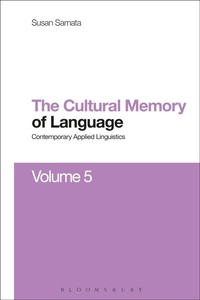
Cultural Memory of Language
Contemporary Applied Linguistics Volume 5
Published on 20. November 2014
Book
Hardback
200 pages
978-1-4725-8373-4 (ISBN)
Description
"I can't even speak my own language," were the words overheard in a college staffroom that triggered the writing of this book. Calling something 'my own' implies a personal, proprietorial relationship with it. But how can it be your own if you cannot speak it?
The Cultural Memory of Language looks at unintended monolingualism - a lack of language fluency in a migratory cultural situation where two or more languages exist at 'home'. It explores family history and childhood language acquisition and attrition. What is the present everyday experience of language use and life between two cultures? Examining interview data, Samata uncovers a sense of inauthenticity felt by people who do not fully share a parent's first language. Alongside this features a sense of concurrent anger, and a need to assign blame. Participation in the language, even to the extent of phatic or formulaic phraseology, occasions feelings of authentic linguistic and cultural inclusion. The book thus uncovers appreciable (and measurable) benefits in positive self-image and a sense of well-being. Looking at how people view language is essential - how they view the language they call their own is even more important and this book does just that in a qualified applied linguistic environment.
The Cultural Memory of Language looks at unintended monolingualism - a lack of language fluency in a migratory cultural situation where two or more languages exist at 'home'. It explores family history and childhood language acquisition and attrition. What is the present everyday experience of language use and life between two cultures? Examining interview data, Samata uncovers a sense of inauthenticity felt by people who do not fully share a parent's first language. Alongside this features a sense of concurrent anger, and a need to assign blame. Participation in the language, even to the extent of phatic or formulaic phraseology, occasions feelings of authentic linguistic and cultural inclusion. The book thus uncovers appreciable (and measurable) benefits in positive self-image and a sense of well-being. Looking at how people view language is essential - how they view the language they call their own is even more important and this book does just that in a qualified applied linguistic environment.
Reviews / Votes
Delivered in a style that is highly engaging, as well as thought provoking, The Cultural Memory of Language offers a fascinating insight into the experience of people who do not share the first language of their parents (PL1). Samata takes the reader on a journey that combines academic insight with a personal connection to the project. That current of personalisation, which recurs throughout the research, is a refreshing perspective that brings [her scholarship] to life ... [This book] is written in a style that informs the specialist, as well as the intelligent general reader, and provides a highly useful addition to an under-researched area. * Language in Society * A very moving, ethnographically sensitive and theoretically supported study of four immigrants who have little or no knowledge of the language of their parents but feel a strong cultural affiliation to that language. Its cross-disciplinary orientation, grounded in insights from language attrition studies, social psychology, sociolinguistics, cultural memory studies and distributed language studies, combined with a highly reflexive research stance can serve as a model of applied linguistic research for doctoral students and researchers alike. -- Claire Kramsch, Professor of German and Affiliate Professor of Education, University of California at Berkeley, USA This book represents the long-awaited contribution of applied linguistics to cultural memory studies. A wonderfully interdisciplinary study and a fascinating read. -- Astrid Erll, Professor of Anglophone Literatures and Cultures, Goethe-University Frankfurt am Main, Germany This brilliant interdisciplinary book focuses on individuals who have (partly) forgotten or not fully acquired the parental language, and who face the sometimes unexpected social and psychological consequences. Gripping stuff! -- Jean-Marc Dewaele, Professor in Applied Linguistics and Multilingualism, Birkbeck College, University of London, UKMore details
Series
Language
English
Place of publication
London
United Kingdom
Publishing group
Bloomsbury Publishing PLC
Target group
College/higher education
Professional and scholarly
Dimensions
Height: 240 mm
Width: 161 mm
Thickness: 15 mm
Weight
470 gr
ISBN-13
978-1-4725-8373-4 (9781472583734)
Copyright in bibliographic data and cover images is held by Nielsen Book Services Limited or by the publishers or by their respective licensors: all rights reserved.
Schweitzer Classification
Other editions
Additional editions
E-Book
11/2014
1st Edition
Bloomsbury Academic
€42.99
Available for download
E-Book
11/2014
1st Edition
Bloomsbury Academic
€42.99
Available for download
Person
Susan R. Samata, Birkbeck College, University of London, UK
Content
1. Introduction: defining and delimiting the question
2. The research context
3. The wider cultural context
4. The methodological approach
5. The interviews and their interpretation
6. Conclusions: A complex but optimistic picture.
Bibliography
Index
2. The research context
3. The wider cultural context
4. The methodological approach
5. The interviews and their interpretation
6. Conclusions: A complex but optimistic picture.
Bibliography
Index