

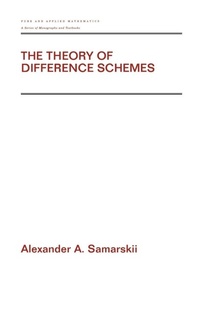
The Theory of Difference Schemes
1st Edition
Published on 29. March 2001
Book
Hardback
788 pages
978-0-8247-0468-1 (ISBN)
Description
The Theory of Difference Schemes emphasizes solutions to boundary value problems through multiple difference schemes. It addresses the construction of approximate numerical methods and computer algorithms for solving mathematical physics problems. The book also develops mathematical models for obtaining desired solutions in minimal time using direct or iterative difference equations. Mathematical Reviews said it is "well-written [and] an excellent book, with a wealth of mathematical material and techniques."
Reviews / Votes
"Illustrated with helpful examples of practical implementations of general stability."-ZDM: The International Journal on Mathematics Education
"...well written ... delivers more than one may expect. ... an excellent book, with a wealth of mathematical material and techniques."
-Mathematical Reviews
"...an extensive theoretical survey."
-Zentralblatt MATH
More details
Language
English
Place of publication
Bosa Roca
United States
Publishing group
Taylor & Francis Inc
Target group
Professional and scholarly
Dimensions
Height: 240 mm
Width: 161 mm
Thickness: 46 mm
Weight
1332 gr
ISBN-13
978-0-8247-0468-1 (9780824704681)
Copyright in bibliographic data and cover images is held by Nielsen Book Services Limited or by the publishers or by their respective licensors: all rights reserved.
Schweitzer Classification
Other editions
Additional editions
Alexander A. Samarskii
The Theory of Difference Schemes
E-Book
03/2001
1st Edition
CRC Press
from
€325.00
Available for download
Alexander A. Samarskii
The Theory of Difference Schemes
E-Book
03/2001
CRC Press
€555.99
Available for download
Person
Content
Preliminaries; basic concepts of the theory of difference schemes; homogeneous difference schemes; difference schemes for elliptic equations; different schemes for time-dependent equations with constant coefficients; stability theory of differenceschemes; symbols; concluding remarks.