

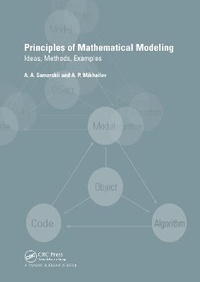
Principles of Mathematical Modelling
Ideas, Methods, Examples
1st Edition
Published on 20. December 2001
Book
Hardback
360 pages
978-0-415-27280-3 (ISBN)
Description
Mathematical modeling is becoming increasingly versatile and multi-disciplinary. This text demonstrates the broadness of this field as the authors consider the principles of model construction and use common approaches to build models from a range of subject areas. The book reflects the interests and experiences of the authors, but it explores mathematical modeling across a wide range of applications, from mechanics to social science. A general approach is adopted, where ideas and examples are favored over rigorous mathematical procedures. This insightful book will be of interest to specialists, teachers, and students across a wide range of disciplines..
More details
Series
Language
English
Place of publication
London
United Kingdom
Publishing group
Taylor & Francis Ltd
Target group
College/higher education
Professional and scholarly
Dimensions
Height: 246 mm
Width: 174 mm
Weight
762 gr
ISBN-13
978-0-415-27280-3 (9780415272803)
Copyright in bibliographic data and cover images is held by Nielsen Book Services Limited or by the publishers or by their respective licensors: all rights reserved.
Schweitzer Classification
Other editions
Additional editions
Alexander A. Samarskii | Alexander P. Mikhailov
Principles of Mathematical Modelling
Ideas, Methods, Examples
Book
12/2001
1st Edition
CRC Press
€207.98
Shipment within 15-20 days
Alexander A. Samarskii | Alexander P. Mikhailov
Principles of Mathematical Modelling
Ideas, Methods, Examples
E-Book
12/2001
1st Edition
CRC Press
€184.99
Available for download
Alexander A. Samarskii | Alexander P. Mikhailov
Principles of Mathematical Modelling
Ideas, Methods, Examples
E-Book
12/2001
CRC Press
€185.99
Available for download
Persons
Professor Alexander A. Samarskii is Director of the Institute of Mathematical Modelling at the Russian Academy of Science and has been the leader of the Russian National Program for Mathematical Modelling in Science and Technology since 1985. He is a world-renowned researcher who has obtained outstanding results and contributed grately to the development of these subjects.
Professor Alexander P Mikhailov is a Head of Department at the Institute of Mathematical Modelling at the Russian Academy of Science and is a Professor of M V Lomonosov Moscow State University. His research interests include mathematical physics, the theory of nonlinear phenomena, mathematical modelling of dissipative structures and mathematical modelling of socio-political processes.
Professor Alexander P Mikhailov is a Head of Department at the Institute of Mathematical Modelling at the Russian Academy of Science and is a Professor of M V Lomonosov Moscow State University. His research interests include mathematical physics, the theory of nonlinear phenomena, mathematical modelling of dissipative structures and mathematical modelling of socio-political processes.
Content
Elementary Mathematical Models. Examples of Models Following from the Fundamental Laws of Nature. Variational Principles and Mathematical Models. Example of the Hierarchy of Models. The Universality of Mathematical Models. Several Models of Elementary Nonlinear Objects. Derivation of Models from the Fundamental Laws of Nature. Conservation of the Mass of Substance. Conservation of Energy. Conservation of the Number of Particles. Joint Application of Several Fundamental Laws. Models Deduced from Variational Principles, Hierarchies of Models. Equations of Motion, Variational Principles and Conservation Laws in Mechanics. Models of Some Mechanical Systems. The Boltzmann Equation and its Derivative Equations. Models of Some Hardly Formalizable Objects. Universality of Mathematical Models. Some Models of Financial and Economic Processes. Some Rivalry Models. Dynamics of Distribution of Power in Hierarchy. Application of Similarity Methods. The Maximum Principle and Comparison Theorems. An Averaging Method. On Transition to Discrete Models. Mathematical Modeling of Complex Objects. Problems of Technology and Ecology. Fundamental Problems of Natural Science. Computing Experiment With Models of Hardly Formalizable Objects. References. Index.