

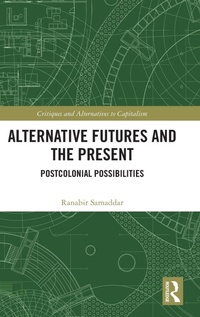
Alternative Futures and the Present
Postcolonial Possibilities
1st Edition
Published on 5. May 2023
Book
Hardback
321 pages
978-1-032-40481-3 (ISBN)
Description
This book explores the idea that alternatives to our present condition are available in the present, such that a search for alternatives must involve rigorous study of some of its central texts, events, and thinkers.
Through engagement with selected modern thinkers, texts, and events, it imagines a different future from the position of the current postcolonial moment, indicating the possibilities that emerge from the present and which shape contemporary radical thinking.
An invitation to imagine a possible future marked with alternative possibilities of conducting struggles, and living through contentions and social restructuring, it will appeal to scholars with interests in social and political theory, political philosophy, colonialism and postcolonialism, and historical materialism.
Through engagement with selected modern thinkers, texts, and events, it imagines a different future from the position of the current postcolonial moment, indicating the possibilities that emerge from the present and which shape contemporary radical thinking.
An invitation to imagine a possible future marked with alternative possibilities of conducting struggles, and living through contentions and social restructuring, it will appeal to scholars with interests in social and political theory, political philosophy, colonialism and postcolonialism, and historical materialism.
More details
Series
Language
English
Place of publication
London
United Kingdom
Publishing group
Taylor & Francis Ltd
Target group
College/higher education
Academic and Postgraduate
Dimensions
Height: 240 mm
Width: 161 mm
Thickness: 22 mm
Weight
663 gr
ISBN-13
978-1-032-40481-3 (9781032404813)
Copyright in bibliographic data and cover images is held by Nielsen Book Services Limited or by the publishers or by their respective licensors: all rights reserved.
Schweitzer Classification
Other editions
Additional editions
Book
10/2024
1st Edition
Routledge
€63.70
Shipment within 10-20 days
E-Book
05/2023
1st Edition
Routledge
€55.49
Available for download
E-Book
05/2023
1st Edition
Routledge
€55.49
Available for download
Person
Ranabir Samaddar is currently the Distinguished Chair in Migration and Forced Migration Studies, Calcutta Research Group, Kolkata, India. He belongs to the critical school of thinking and is considered one of the foremost theorists in the field of migration and forced migration studies. His writings on migration, forms of labour, urbanisation, and political struggles have signalled a new turn in postcolonial thinking. Among his influential works are: The Marginal Nation: Transborder Migration from Bangladesh to West Bengal (1999) and Karl Marx and the Postcolonial Age (2018). His most recent publications are The Postcolonial Age of Migration (2020), and written in the background of the COVID pandemic, A Pandemic and the Politics of Life (2021).
Content
Introduction: Time, and the Politics and Poetics of Alternative Section One: Social Transformation and the Space and Time of Nation 1 Karl Marx: Colonialism, Nation Form, and Social Transformation 2 Home, World, and an Uncertain Nation 3 In the Time of Nations Section Two: The Problematic of Population and Power in Transformative Politics 4 The Problem of Population: Recalling Marx's Critique of Malthus 5 Populations and Populism as a Problematic in Transformative Politics Section Three: Two Universalisms: Imperial Imaginary and Imaginary of the Oppressed 6 Hegel's India and Imperial Imaginary of the Universal 7 Annihilation of Caste and Universalism of the Oppressed Section Four: Contentions and Antagonisms as Template of Alternative Thinking 8 Charles Tilly's Theorising of Contention 9 Genocide: A Most Contentious Word and Concept of Modern time Section Five: Beyond the Political, Imaginaries of Other Kinds 10 The Impossibility of Politics: Brecht, Manto and Two Acts of Literature 11 Memories of the Forgotten Section Six: Event as a Congealed Site of New Possibilities 12 Settling Account with the Point of Origin: Marx, Engels, and the Revolution of 1848 13 October Revolution as an Alternative in the Colonial and Postcolonial Time 14 Occupy College Street, 1967-69 15 Crisis, Biopolitics from Below, and a New Model of Public Power 16 Layers of Solidarity 17 Epilogue