

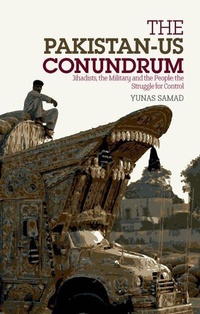
Pakistan-US Conundrum
Jihadists, the Military and the People-the Struggle for Control
Published on 31. October 2011
Book
Hardback
320 pages
978-1-84904-009-9 (ISBN)
Description
Yunas Samad's trenchant analysis of contemporary Pakistan features five main players: the people, the army, the Islamists, the politicians and the Americans. His book explains how a series of alliances borne of political and strategic expediency between the US and the military, between these parties and the Afghan mujahidin, and between various Pakistani politicians and some or all of the above - have continually undermined the state to the extent that its very existence is now in jeopardy. Much of the country is now under the de facto control of an indigenous, 'Pakistani', Taliban, whose writ is extending to Swat, Punjab and Sind along with its traditional bastion in the North West Frontier. Yet even in this parlous situation Pakistan's military and intelligence apparatus continue to be obsessed with waging a proxy war against India, whether in Kashmir or Afghanistan, at the expense of their own state's stability, while some elements now, paradoxically, see American influence in Afghanistan as a greater threat to Pakistan than the traditional foe across its eastern border.
These high stakes contests for strategic and political power have also harmed Pakistan's economy, argues Samad, impoverishing many of its people while the military 'state within a state elite' benefits from American largesse and a tiny business elite enjoys the rich pickings of the of neo-liberal policies enacted at the behest of the World Bank and other international agencies. In conclusion Samad returns to his key themes: explaining how ordinary Pakistanis have been ignored by the country's military and civilian rulers, how their material circumstances have steadily deteriorated over the last twenty or more years and how grand strategic designs fashioned in Islamabad and Washington continue to undermine political life and have ushered in forms of Islamist and sectarian politics that were largely unknown in Pakistan.
These high stakes contests for strategic and political power have also harmed Pakistan's economy, argues Samad, impoverishing many of its people while the military 'state within a state elite' benefits from American largesse and a tiny business elite enjoys the rich pickings of the of neo-liberal policies enacted at the behest of the World Bank and other international agencies. In conclusion Samad returns to his key themes: explaining how ordinary Pakistanis have been ignored by the country's military and civilian rulers, how their material circumstances have steadily deteriorated over the last twenty or more years and how grand strategic designs fashioned in Islamabad and Washington continue to undermine political life and have ushered in forms of Islamist and sectarian politics that were largely unknown in Pakistan.
Reviews / Votes
'This study challenges much of the received wisdom. It takes us through a thicket of complexities and ambiguities with clarity, insight and more than a few surprises. We encounter American misperceptions and counterproductive actions; and an illuminating assessment of the Taliban and Al Qaeda - well rooted in the daunting complications in Afghanistan and Pakistan's border regions, before and after 9/11. This analysis is timely and careful, and will be impossible to ignore.'-Professor James Manor, School of Advanced Study, University of London 'This book will be an important contribution to publications on contemporary Pakistan as a theoretical and contextual discussion of a country that remains only poorly understood by social scientists. It explores issues of central importance to the study of Pakistan, including, especially, in-depth discussions of the rise of Jihadi Islam, the impact of the Afghan war on politics, religion and society, the role of emergent forms of ethnic identity in moments of violent conflict in present-day Pakistan, and the nature of violence in the country more generally.'-Dr Magnus Marsden, SOAS, University of London, author of Living Islam: Muslim Religious Experience in Pakistan's NW FrontierMore details
Language
English
Place of publication
London
United Kingdom
Product notice
sewn/stitched
Cloth over boards
Illustrations
Illustrations
Dimensions
Height: 211 mm
Width: 137 mm
Thickness: 25 mm
Weight
544 gr
ISBN-13
978-1-84904-009-9 (9781849040099)
Copyright in bibliographic data and cover images is held by Nielsen Book Services Limited or by the publishers or by their respective licensors: all rights reserved.
Schweitzer Classification
Person
Yunas Samad is Senior Lecturer in Sociology at the University of Bradford. He is the author of Nation in Turmoil: Nationalism and Ethnicity in Pakistan 1937-58, and co-author, with Gyan Pandey, of Faultlines of Nationhood.