

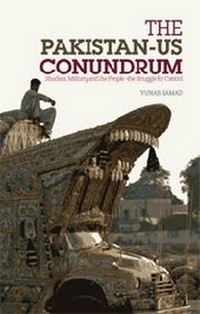
The Pakistan-US Conundrum
Jihadists, the Military and the People - The Struggle for Control
Published on 27. December 2011
Book
Hardback
320 pages
978-0-231-70282-9 (ISBN)
Description
Yunas Samad's trenchant analysis of contemporary Pakistan illuminates five key players: the country's people, army, Islamists, and politicians, and the American forces struggling to maintain Pakistan's social and political stability. Samad describes the alliances borne of political and strategic expediency that continually undermine the legitimacy of the state, and he measures the extent to which the country's existence is now in jeopardy. Much of Pakistan operates under the de facto rule of an indigenous, "Pakistani" Taliban. Yet instead of addressing this precarious situation, Pakistan's remaining military and intelligence apparatus remains focused on a proxy war with India, whether in Kashmir or Afghanistan. This high-stakes contest for strategic and political victory has irreparably harmed Pakistan's economy, impoverishing many of its people while bolstering the military's "state within a state elite." At the same time, a tiny business contingent continues to flourish on the rich pickings of neoliberal policies enacted at the request of international organizations.
Samad follows these provocative issues in detail before returning to his key themes: the mistreatment of ordinary Pakistanis by military and civilian rulers, the steady decline of citizens' material circumstances over the past twenty years or more, and the grand designs of Islamabad and Washington that continue to undermine Pakistani political life while ushering in new forms of Islamist and sectarian politics.
Samad follows these provocative issues in detail before returning to his key themes: the mistreatment of ordinary Pakistanis by military and civilian rulers, the steady decline of citizens' material circumstances over the past twenty years or more, and the grand designs of Islamabad and Washington that continue to undermine Pakistani political life while ushering in new forms of Islamist and sectarian politics.
Reviews / Votes
This book is an important contribution for its theoretical and contextual discussion of a country that remains poorly understood by social scientists. It explores issues of central importance to the study of Pakistan, including--especially--in-depth discussions of the rise of Jihadi Islam; the impact of the Afghan war on politics, religion, and society; the role of emergent forms of ethnic identity in moments of violent conflict in present-day Pakistan; and the nature of violence in the country more generally. -- Magnus Marsden, School of Oriental and African Studies, University of London, author of Living Islam: Muslim Religious Experience in Pakistan's North-West Frontier Yunas Samad's study challenges much received wisdom. It takes us through a thicket of complexities and ambiguities with clarity, insight, and more than a few surprises. We encounter American misperceptions and counterproductive actions, along with an illuminating assessment of the Taliban and al-Qaeda, well rooted in the daunting complications of Afghanistan and Pakistan's border regions before and after 9/11. The analysis of Pakistan is especially rich, covering politics and fraught relations with the United States, under military and elected governments; the army's crucial importance; the economy; the role of religion, ethnicity and regionalism; relations with India; and the problem of Kashmir. Timely and careful, this analysis is impossible to ignore. -- James Manor, School of Advanced Study, University of London Yunas Samad's careful exploration of the relationship between Pakistan and the United States exposes the inconsistencies and wishful thinking that lie behind the strategies of the West in central and South Asia. It reveals the roots of jihadism and explains, precisely, why it has proved so difficult to contain. -- David Washbrook, Trinity College, Cambridge An important book that needs to be read for its deep understanding of Pakistan's history and its analytical brilliance on the country's contemporary social and political situation. It challenges the internationally sponsored security-driven agenda for the region and provokes us to think seriously about Pakistan and its people with empathy and in solidarity. In doing so, this study shows a way out of the current quagmire by encouraging the deepening of democracy and initiating meaningful social and economic reforms that benefit the people of Pakistan. -- Kamran Asdar Ali, South Asia Institute, University of Texas, AustinMore details
Series
Language
English
Place of publication
New York
United States
Target group
Professional and scholarly
College/higher education
Dimensions
Height: 203 mm
Width: 127 mm
Weight
454 gr
ISBN-13
978-0-231-70282-9 (9780231702829)
Copyright in bibliographic data and cover images is held by Nielsen Book Services Limited or by the publishers or by their respective licensors: all rights reserved.
Schweitzer Classification
Person
Yunas Samad is professor of South Asian studies at the University of Bradford, England. He is the author of A Nation in Turmoil: Nationalism and Ethnicity in Pakistan, 1937--1958 and coauthor, with Gyan Pandey, of Fault Lines of Nationhood: Cross Border Talks.