

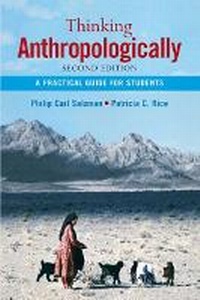
Thinking Anthropologically
A Practical Guide for Students
2nd Edition
Published on 5. September 2007
Book
Paperback/Softback
128 pages
978-0-13-238958-7 (ISBN)
Description
For courses in General Anthropology, Cultural Anthropology, Physical Anthropology, and Archaeology. This supplementary book focuses on twelve themes that are at the heart of anthropology-themes that permeate all fields of anthropology and that prepare students to "think anthropologically" before beginning to study the field in any depth.
More details
Edition
2nd edition
Language
English
Place of publication
United States
Publishing group
Pearson Education (US)
Target group
Professional and scholarly
Dimensions
Height: 229 mm
Width: 152 mm
Weight
177 gr
ISBN-13
978-0-13-238958-7 (9780132389587)
Copyright in bibliographic data and cover images is held by Nielsen Book Services Limited or by the publishers or by their respective licensors: all rights reserved.
Schweitzer Classification
Other editions
New editions
Book
05/2010
3rd Edition
Pearson
€54.71
Article is exhausted; no reprint
Previous edition
Book
01/2004
Pearson
€17.35
Article exhausted; check for reprint
Content
1. Introduction to Thinking Anthropologically
2. What Anthropologists Look For: Patterns
3. Thinking Holistically
4. Thinking Theoretically
5. Using Science to Think Anthropologically
6. Thinking about Change: Biological Evolution, Culture Change, and the Importance of Scale
7. Why Do Anthropological Experts Disagree?
8. Thinking and Acting Ethically in Anthropology
9. Applying Anthropological Knowledge
10. Making Ideas Researchable
11.Thinking Anthropologically About "Race:" Human Variation, Cultural Construction, and Dispelling Myths
12. How to Take Anthropology Tests
2. What Anthropologists Look For: Patterns
3. Thinking Holistically
4. Thinking Theoretically
5. Using Science to Think Anthropologically
6. Thinking about Change: Biological Evolution, Culture Change, and the Importance of Scale
7. Why Do Anthropological Experts Disagree?
8. Thinking and Acting Ethically in Anthropology
9. Applying Anthropological Knowledge
10. Making Ideas Researchable
11.Thinking Anthropologically About "Race:" Human Variation, Cultural Construction, and Dispelling Myths
12. How to Take Anthropology Tests