

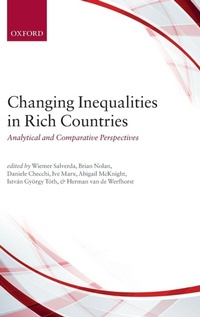
Changing Inequalities in Rich Countries
Analytical and Comparative Perspectives
Published on 30. January 2014
Book
Hardback
432 pages
978-0-19-968743-5 (ISBN)
Description
There has been a remarkable upsurge of debate about increasing inequalities and their societal implications, reinforced by the economic crisis but bubbling to the surface before it. This has been seen in popular discourse, media coverage, political debate, and research in the social sciences. The central questions addressed by this book, and the major research project GINI on which it is based, are:
- Have inequalities in income, wealth and education increased over the past 30 years or so across the rich countries, and if so why?
- What are the social, cultural and political impacts of increasing inequalities in income, wealth and education?
- What are the implications for policy and for the future development of welfare states?
In seeking to answer these questions, this book adopts an interdisciplinary approach that draws on economics, sociology, and political science, and applies this approach to learning from the experiences over the last three decades of European countries together with the USA, Japan, Canada, Australia, and South Korea. It combines comparative research with lessons from specific country experiences, and highlights the challenges in seeking to adequately assess the factors underpinning increasing inequalities and in identify the channels through which these may impact on key social and political outcomes, as well as the importance of framing inequality trends and impacts in the institutional and policy context of the country in question.
- Have inequalities in income, wealth and education increased over the past 30 years or so across the rich countries, and if so why?
- What are the social, cultural and political impacts of increasing inequalities in income, wealth and education?
- What are the implications for policy and for the future development of welfare states?
In seeking to answer these questions, this book adopts an interdisciplinary approach that draws on economics, sociology, and political science, and applies this approach to learning from the experiences over the last three decades of European countries together with the USA, Japan, Canada, Australia, and South Korea. It combines comparative research with lessons from specific country experiences, and highlights the challenges in seeking to adequately assess the factors underpinning increasing inequalities and in identify the channels through which these may impact on key social and political outcomes, as well as the importance of framing inequality trends and impacts in the institutional and policy context of the country in question.
More details
Language
English
Place of publication
Oxford
United Kingdom
Target group
College/higher education
Professional and scholarly
Illustrations
Figures and Tables
Dimensions
Height: 240 mm
Width: 161 mm
Thickness: 28 mm
Weight
810 gr
ISBN-13
978-0-19-968743-5 (9780199687435)
Copyright in bibliographic data and cover images is held by Nielsen Book Services Limited or by the publishers or by their respective licensors: all rights reserved.
Schweitzer Classification
Other editions
Additional editions
Wiemer Salverda | Brian Nolan | Daniele Checchi
Changing Inequalities in Rich Countries
Analytical and Comparative Perspectives
Book
08/2016
Oxford University Press
€51.44
Shipment within 15-20 days
Wiemer Salverda | Brian Nolan | Daniele Checchi
Changing Inequalities in Rich Countries
Analytical and Comparative Perspectives
E-Book
01/2014
1st Edition
OUP eBook
€36.99
Available for download
Persons
The seven editors together have organised and coordinated the three and a half year Growing Inequalities' Impacts GINI project, which has generated the results reported in this volume. They are an international team drawn from different disciplines and with important and complementary expertise in the fields covered by the book. They share a history of joint publications, including edited volumes, and extensive cooperation in research networks such LoWER (European Low-wage Employment Research network, 1996-2008), Equalsoc (Network of Excellence, since 2005), and ImPRovE (Poverty Reduction in Europe: Social Policy and Innovation, since 2012).
Editor
Professor of Labour Market and InequalityProfessor of Labour Market and Inequality, Amsterdam Center for Inequality Studies AMCIS, and Amsterdam Institute for Advanced Labour Studies AIAS, University of Amsterdam
, Director of Employment, Equity and Growth and Professor of Social Policy, Institute for New Economic Thinking, Oxford Martin School, University of Oxford
, University of Milan
Associate ProfessorAssociate Professor, University of Antwerp
Senior Research FellowSenior Research Fellow, Centre for Analysis of Social Exclusion, London School of Economics
DirectorDirector, Tarki Social Research Institute Budapest
Professor of SociologyProfessor of Sociology, University of Amsterdam
Content
Preface ; 1. Introduction ; 2. Increasing Economic Inequalities? ; 3. Earnings, Employment, and Income Inequality ; 4. Wealth Inequality and the Accumulation of Debt ; 5. Increasing Educational Inequalities? ; 6. The Social Impact of Income Inequality: Poverty, Deprivation, and Social Cohesion ; 7. Social Impacts: Health, Housing, and Inter-generational Mobility ; 8. Rising Inequalities: Will Electorates Go for Higher Redistribution? ; 9. Inequality, Legitimacy, and the Political System ; 10. The Policy Response to Inequality: Redistributing Income ; 11. The Policy Response: Employment and Services ; 12. The Policy Response to Educational Inequalities ; 13. Conclusions