

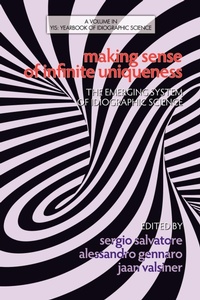
Making Sense of Infinite Uniqueness
The Emerging System of Idiographic Science
Published on 25. October 2012
Book
Paperback/Softback
274 pages
978-1-62396-025-4 (ISBN)
Description
YIS has been thought as an annual series of volumes collecting contributes aimed at developing the integration of idiographic and nomothetic approaches in psychological and more in general social science. At the beginning, 3 years ago, we got an agreement with an Italian publisher (FGP - Firera Publishing Group) interested in the scientific project and therefore willing to help the start up of this scientific enterprise. After publishing the first volume (YIS 2008- yet published in 2009 - the Volume is freely available on the FPG's website) we have had many positive feedbacks and signals of interests, as well as several submissions, from many parts of the world . This has provided an acceleration of the following issues - Above all, this led us to realize that it was time to give an editorial collocation to YIS that can be more consistent with the interest it has raised and that can ulteriorly raise. FPG does not put constraint on this perspective, being aware and agreed of the necessity of a worldwide context for the YIS's development. Moreover, there are no constraints in the possibility of going on in using the label "YIS", starting from Volume 4 The Series addresses a quite large potential public - students and researchers interested to theoretical and methodological development of psychology and, more in general, social science. Persons engaged with qualitative, dynamic informed models of analysis will find YIS a precious tool as well as a context enabling to develop a worlwide network of practices and cultures of research. The first three volumes' TOC witness how large and constantly increasing is the interest around the scientific project.
More details
Series
Language
English
Place of publication
United States
Publishing group
Emerald Publishing Inc
Dimensions
Height: 234 mm
Width: 156 mm
Thickness: 15 mm
Weight
421 gr
ISBN-13
978-1-62396-025-4 (9781623960254)
Copyright in bibliographic data and cover images is held by Nielsen Book Services Limited or by the publishers or by their respective licensors: all rights reserved.
Schweitzer Classification
Other editions
Additional editions
E-Book
01/2013
1st Edition
Information Age Publishing
from
€62.33
Available for download
Persons
Content
Section I. The Puzzle: Language for the Science of Unique Events.
Chapter 1. How Idiographic Science Could Create Its Own Terminology, Jaan Valsiner and Sergio Salvatore.
Chapter 2. Commentary: What Should Idiographic Language Be Like? Carlos Cornejo.
Chapter 3. Commentary: Some Considerations Pertinent to the Language of Idiographic Science, James T. Lamiell.
Chapter 4. Commentary: Explaining Social Behavior In Situ: The Study of Points of View, Gordon Sammut and George Gaskell.
Section II. Communication: Theoretical Obstacle or Innovative Resource?
Chapter 5. The Language as Object: A Tool of Intersubjective Exchange in Clinical Practice, Claudia Venuleo.
Chapter 6. The Singular Patterns of Discourse for a Psycho-Idiographic Analysis of Language, Giuseppe Mininni, Beatrice Ligorio, and Rosa Traversa.
Chapter 7. Metacommunication, Microgenesis, and Idiographic Sciences: The Study of Meaning-Construction Processes, Angela Uchoa Branco.
Chapter 8. Commentary: Idiographic Science: Its Polyphonic Arena and Need for Reflexivity, Giuseppina Marsico.
Section III. Intervention: The General Applied to the Unique.
Chapter 9. Innovative Moments in Psychotherapy: From Narrative Outputs to the Semiotic-Dialogical Processes, Antonio P. Ribeiro, Miguel M. Goncalves and Anita Santos.
Chapter 10. Narration and Discourse in the Clinical Dialogue, Maria Francesca Freda and Fabio Milito Pagliara.
Chapter 11. Commentary: Blind Spots and Laziness: Two Ways of Becoming Stuck, Philip J. Rosenbaum.
Section IV. Methodologies: Growing the Dynamic Analysis.
Chapter 12. Positioning Microanalysis: The Development of a Dialogically Based Method for Idiographic Psychology, Joao Salgado and Carla Cunha.
Chapter 13. The Role of Language in Researcher-Participant Interaction, Andrea Smorti and Elia Cardini.
Chapter 14. Commentary: Some Reflections on the Emergence of Multimodal Assemblages of Meaning, Mariann Maertsin.
Chapter 1. How Idiographic Science Could Create Its Own Terminology, Jaan Valsiner and Sergio Salvatore.
Chapter 2. Commentary: What Should Idiographic Language Be Like? Carlos Cornejo.
Chapter 3. Commentary: Some Considerations Pertinent to the Language of Idiographic Science, James T. Lamiell.
Chapter 4. Commentary: Explaining Social Behavior In Situ: The Study of Points of View, Gordon Sammut and George Gaskell.
Section II. Communication: Theoretical Obstacle or Innovative Resource?
Chapter 5. The Language as Object: A Tool of Intersubjective Exchange in Clinical Practice, Claudia Venuleo.
Chapter 6. The Singular Patterns of Discourse for a Psycho-Idiographic Analysis of Language, Giuseppe Mininni, Beatrice Ligorio, and Rosa Traversa.
Chapter 7. Metacommunication, Microgenesis, and Idiographic Sciences: The Study of Meaning-Construction Processes, Angela Uchoa Branco.
Chapter 8. Commentary: Idiographic Science: Its Polyphonic Arena and Need for Reflexivity, Giuseppina Marsico.
Section III. Intervention: The General Applied to the Unique.
Chapter 9. Innovative Moments in Psychotherapy: From Narrative Outputs to the Semiotic-Dialogical Processes, Antonio P. Ribeiro, Miguel M. Goncalves and Anita Santos.
Chapter 10. Narration and Discourse in the Clinical Dialogue, Maria Francesca Freda and Fabio Milito Pagliara.
Chapter 11. Commentary: Blind Spots and Laziness: Two Ways of Becoming Stuck, Philip J. Rosenbaum.
Section IV. Methodologies: Growing the Dynamic Analysis.
Chapter 12. Positioning Microanalysis: The Development of a Dialogically Based Method for Idiographic Psychology, Joao Salgado and Carla Cunha.
Chapter 13. The Role of Language in Researcher-Participant Interaction, Andrea Smorti and Elia Cardini.
Chapter 14. Commentary: Some Reflections on the Emergence of Multimodal Assemblages of Meaning, Mariann Maertsin.