

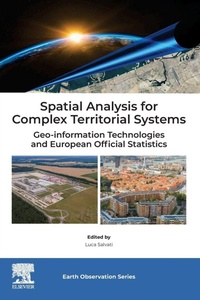
Spatial Analysis for Complex Territorial Systems
Geo-information Technologies and European Official Statistics
Published on 18. February 2026
Book
Paperback/Softback
526 pages
978-0-443-44133-2 (ISBN)
Description
Spatial Analysis for Complex Territorial Systems: Geo-information Technologies and European Official Statistics offers a multidisciplinary exploration of spatial analysis, geo-information technologies, and official statistics, focusing on their applications in environmental, economic, and planning challenges in Europe and the Mediterranean. Comprising 16 insightful chapters authored by leading scholars from Southern and Eastern Europe, Ireland, and the United States, the book delves into the complexities of socio-ecological monitoring through data integration and refined statistical indicators. Key topics include climate monitoring, land degradation, settlement patterns, and disaster resilience, providing a comprehensive understanding of local contexts and policy implications.
The book begins with contributions from a traditional ecological, agronomic, and environmental vision, then continues with a set of studies with stricter socio-demographic and economic focus. It then discusses how other quantitative approaches (e.g., based on big data and primary surveys) may clarify the role of policies and planning, addressing sustainable development goals in the 'kaleidoscopic' European landscapes. Conclusions confirm the urgent need of integrating the vast potential of geo-information techniques, together with spatial analysis and official statistics, into more flexible sustainable development strategies that reflect local conditions and spatially explicit background contexts.
The book begins with contributions from a traditional ecological, agronomic, and environmental vision, then continues with a set of studies with stricter socio-demographic and economic focus. It then discusses how other quantitative approaches (e.g., based on big data and primary surveys) may clarify the role of policies and planning, addressing sustainable development goals in the 'kaleidoscopic' European landscapes. Conclusions confirm the urgent need of integrating the vast potential of geo-information techniques, together with spatial analysis and official statistics, into more flexible sustainable development strategies that reflect local conditions and spatially explicit background contexts.
More details
Series
Language
English
Place of publication
Philadelphia
United States
Target group
College/higher education
Professional and scholarly
Product notice
Paperback (trade)
Dimensions
Height: 229 mm
Width: 152 mm
Thickness: 27 mm
Weight
700 gr
ISBN-13
978-0-443-44133-2 (9780443441332)
Copyright in bibliographic data and cover images is held by Nielsen Book Services Limited or by the publishers or by their respective licensors: all rights reserved.
Schweitzer Classification
Other editions
Additional editions
Luca Salvati
Spatial Analysis for Complex Territorial Systems
Geo-information Technologies and European Official Statistics
E-Book
02/2026
Elsevier
€166.99
Available for download
Person
Luca Salvati is an Associate (staff) professor of applied economics and economic statistics at Sapienza University of Rome, Italy. Since 2001 he has been staff researcher at the National Council for Research in Agriculture and the Analysis of Agricultural Economics (CREA). He is an expert in official statistics, spatial statistics, Geographic Information Systems and Remote sensing applied to socioeconomic and environmental issues. He has conducted studies on topics of economic statistics, urban economics, regional demography, and sustainable development, using exploratory multivariate statistics and geographic information systems for decision support. He has held courses in Economic Statistics (University of Rome Tor Vergata), Basic Mathematics (University of Rome La Sapienza), Multivariate Statistics (University of Roma Tre), Regional Economics (University of Camerino, University of Eastern Piedmont), Strategic Evaluation of environmental impact (University of Roma Tre). He has supervised master's and doctoral theses and has published more than 30 printed books and over 600 scientific publications in English.
Content
Spatial analysis, statistical indicators and the accountability of complex socio-environmental processes: a challenge for sustainable development
Optimal resource management, environmental-economic impact assessment and social dynamics
Climate change and geo-statistical indicators for landscape analysis
Quantifying 'wood capital' through remote sources: a spatial comparison of multiple forest cover indicators
Sampling (infinite) populations in a geo-spatial framework: an operational perspective
Toward 'natural farming systems'? Identifying 'Intensive' and 'Extensive' Agricultural Landscapes in Italy from official statistics
Socio-environmental resilience and applied economics: from theory to indicators
Integrating externalities into economic systems for long-term environmental sustainability
Spatial distribution and settlement patterns of foreign population in Italy and Spain: a comparative multi-scale approach
A Research Design Modeling of the Migrant-Refugee Issue: lessons from an integrated large-scale survey in Greece
Residential mobility of older population: recent dynamics across Italian and Spanish municipalities
Assessing multidimensional influence of social media on consumer behavior using indicators: economic forces, cognitive perceptions, and social mechanisms in the contemporary digital era
Monitoring socio-demographic behaviours through indicators from primary surveys: the attitude of female students towards cohabitation in Greece
Toward a global analysis of wealth concentration: the case of per-land income distribution
Enhancing Disaster Resilience: Hellenic National Civil Protection Mechanism and Local Government Participation in Risk and Disaster Management
The Forest Map of Italy: an innovative tool for comprehensive planning of Italian woods
Insights into Italy's National Recovery and Resilience Plan: a performance index for municipal administrations using spatial data
Monitoring local resilience of health financing systems: Evidence from Covid-19 pandemic in Northern Italy
The complex interplay among land, access, infrastructure, and (sustainable) real estate: a spatial critique
Lights of change: what Nighttime Light data reveal about metropolitan dynamics
Optimal resource management, environmental-economic impact assessment and social dynamics
Climate change and geo-statistical indicators for landscape analysis
Quantifying 'wood capital' through remote sources: a spatial comparison of multiple forest cover indicators
Sampling (infinite) populations in a geo-spatial framework: an operational perspective
Toward 'natural farming systems'? Identifying 'Intensive' and 'Extensive' Agricultural Landscapes in Italy from official statistics
Socio-environmental resilience and applied economics: from theory to indicators
Integrating externalities into economic systems for long-term environmental sustainability
Spatial distribution and settlement patterns of foreign population in Italy and Spain: a comparative multi-scale approach
A Research Design Modeling of the Migrant-Refugee Issue: lessons from an integrated large-scale survey in Greece
Residential mobility of older population: recent dynamics across Italian and Spanish municipalities
Assessing multidimensional influence of social media on consumer behavior using indicators: economic forces, cognitive perceptions, and social mechanisms in the contemporary digital era
Monitoring socio-demographic behaviours through indicators from primary surveys: the attitude of female students towards cohabitation in Greece
Toward a global analysis of wealth concentration: the case of per-land income distribution
Enhancing Disaster Resilience: Hellenic National Civil Protection Mechanism and Local Government Participation in Risk and Disaster Management
The Forest Map of Italy: an innovative tool for comprehensive planning of Italian woods
Insights into Italy's National Recovery and Resilience Plan: a performance index for municipal administrations using spatial data
Monitoring local resilience of health financing systems: Evidence from Covid-19 pandemic in Northern Italy
The complex interplay among land, access, infrastructure, and (sustainable) real estate: a spatial critique
Lights of change: what Nighttime Light data reveal about metropolitan dynamics