

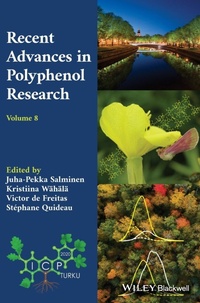
Recent Advances in Polyphenol Research, Volume 8
Published on 23. March 2023
Book
Hardback
350 pages
978-1-119-84476-1 (ISBN)
Description
Plant polyphenols are specialized metabolites that constitute one of the most common and widespread groups of natural products. They are essential plant components for adaptation to the environment and possess a large and diverse range of biological functions that provide many benefits to both plants and humans. Polyphenols, from their structurally simplest forms to their oligo/polymeric versions (i.e. tannins and lignins), are phytoestrogens, plant pigments, antioxidants, and structural components of the plant cell wall. The interactions between tannins and proteins are involved in plant defense against predation, cause astringency in foods and beverages, and affect the nutritional and health properties of human and animal food plants.
This eighth volume of the highly regarded Recent Advances in Polyphenol Research series is edited by Juha-Pekka Salminen, Kristiina Wahala, Victor de Freitas, and Stephane Quideau, and brings together chapters written by some of the leading experts working in the polyphenol sciences today. Topics covered include:
Structure, reactivity and synthesis
Bioactivity and bioavailability
Metabolomics, targeted analysis and big data
Quality control & standardization
Biogenesis and functions in plants and ecosystems
Biomaterials & applied sciences
Distilling the most recent and illuminating data available, this new volume is an invaluable resource for chemists, biochemists, plant scientists, pharmacognosists and pharmacologists, biologists, ecologists, food scientists and nutritionists.
This eighth volume of the highly regarded Recent Advances in Polyphenol Research series is edited by Juha-Pekka Salminen, Kristiina Wahala, Victor de Freitas, and Stephane Quideau, and brings together chapters written by some of the leading experts working in the polyphenol sciences today. Topics covered include:
Structure, reactivity and synthesis
Bioactivity and bioavailability
Metabolomics, targeted analysis and big data
Quality control & standardization
Biogenesis and functions in plants and ecosystems
Biomaterials & applied sciences
Distilling the most recent and illuminating data available, this new volume is an invaluable resource for chemists, biochemists, plant scientists, pharmacognosists and pharmacologists, biologists, ecologists, food scientists and nutritionists.
More details
Edition
Volume 8
Language
English
Place of publication
Hoboken
United States
Publishing group
John Wiley and Sons Ltd
Target group
Professional and scholarly
Dimensions
Height: 244 mm
Width: 170 mm
Thickness: 25 mm
Weight
907 gr
ISBN-13
978-1-119-84476-1 (9781119844761)
Copyright in bibliographic data and cover images is held by Nielsen Book Services Limited or by the publishers or by their respective licensors: all rights reserved.
Schweitzer Classification
Other editions
Additional editions
Juha-Pekka Salminen | Kristiina Wahala | Victor de Freitas
Recent Advances in Polyphenol Research, Volume 8
E-Book
01/2023
1st Edition
Wiley
€142.99
Available for download
Juha-Pekka Salminen | Kristiina Wahala | Victor de Freitas
Recent Advances in Polyphenol Research, Volume 8
E-Book
01/2023
1st Edition
Wiley
€142.99
Available for download
Previous edition
Book
05/2021
1st Edition
Wiley-Blackwell
€184.50
Shipment within 15-20 days
Persons
Juha-Pekka Salminen, current Communication Manager of Groupe Polyphenols (board member since 2018), is Full Professor of Natural Compound Chemistry at the University of Turku, Finland. His research group specializes in analytical chemistry, chemical ecology and bioactivity studies of large polyphenols, with a focus on ellagitannins and proanthocyanidins and their distribution and significance in the plant kingdom.
Kristiina Wahala, current Vice-President of the Groupe Polyphenols (2012-2014, 2018-2020) is Professor of Organic Chemistry at the University of Helsinki, Finland. Her research is focused on synthesis, analysis, and isotopical labelling of plant polyphenols and their metabolites in humans in connection with drug discovery and binding studies to target enzymes. The focus on her chemical synthesis is on environmentally benign methods, green chemistry and biomass utilization.
Victor de Freitas, former President of the Groupe Polyphenols (2016-2021), is Full Professor at the Faculty of Sciences of the University of Porto, Portugal. His research on polyphenols include: structural characterization, chemical transformations in plants and foods during harvest and storage, influence on the sensory properties of foods (color, astringency and bitterness), and other biological properties.
Stephane Quideau, former President of the Groupe Polyphenols (2008-2012), is Full Professor of Organic and Bioorganic Chemistry at the University of Bordeaux, France, and Senior Member of the "Institut Universitaire de France." His laboratory is involved in research on plant polyphenol chemistry and chemical biology, with particular interests in ellagitannin chemical reactivity and synthesis, and in polyphenol-protein interactions.
Kristiina Wahala, current Vice-President of the Groupe Polyphenols (2012-2014, 2018-2020) is Professor of Organic Chemistry at the University of Helsinki, Finland. Her research is focused on synthesis, analysis, and isotopical labelling of plant polyphenols and their metabolites in humans in connection with drug discovery and binding studies to target enzymes. The focus on her chemical synthesis is on environmentally benign methods, green chemistry and biomass utilization.
Victor de Freitas, former President of the Groupe Polyphenols (2016-2021), is Full Professor at the Faculty of Sciences of the University of Porto, Portugal. His research on polyphenols include: structural characterization, chemical transformations in plants and foods during harvest and storage, influence on the sensory properties of foods (color, astringency and bitterness), and other biological properties.
Stephane Quideau, former President of the Groupe Polyphenols (2008-2012), is Full Professor of Organic and Bioorganic Chemistry at the University of Bordeaux, France, and Senior Member of the "Institut Universitaire de France." His laboratory is involved in research on plant polyphenol chemistry and chemical biology, with particular interests in ellagitannin chemical reactivity and synthesis, and in polyphenol-protein interactions.
Content
Contributors x
Preface x
Acknowledgements x
1 Lignins and Lignification: New Developments and Emerging Concepts X
John Ralph, Hoon Kim, Fachuang Lu, Rebecca A. Smith, Steven D. Karlen, Nuoendagula, Koichi Yoshioka, Alexis Eugene, Sarah Liu, Canan Sener, Daisuke Ando, Mingjie Chen, Yanding Li, Leta L. Landucci, Sally A. Ralph, Vitaliy I. Timokhin, Wu Lan, Jorge Rencoret, José C. del Río
1.1 Introduction X
1.2 The monolignol pathway and interacting pathways - New lignins X
1.2.1 Truncated monolignol biosynthesis X
1.2.1.1 CAD deficiency X
1.2.1.2 OMT deficiency X
1.2.2 Phenolics from beyond the monolignol biosynthetic pathway X
1.2.3 Lignin design, and the concept of an ideal lignin X
1.2.3.1 Zip-lignins X
1.2.3.2 The concept of an 'ideal lignin' X
1.2.3.3 Introducing new pathways into lignification, new units into lignins X
1.3 Lignin conjugates, 'clip-offs' - new discoveries, and enhancing levels X
1.3.1 Clip-offs and their elevation X
1.3.2 Exploring monolignol conjugates in compositionally extreme lignins X
1.4 Features of lignification, and the possibility of new polymerization pathways X
1.4.1 Features of lignification X
1.4.1.1 Lignification reminders X
1.4.1.2 Does polymerization have to occur from the phenolic end? X
1.4.1.3 Do new monomers propound possibilities for new polymerization
mechanisms? X
1.5 The value of model studies and synthesis - a reminder X
1.5.1 The value of proper low-molecular-mass model compounds X
1.5.2 Synthetic lignin polymers, dehydrogenation polymers (DHPs) X
1.6 New or improved analytics X
1.7 Conclusions and Opportunities X
Acknowledgments X
References X
2 Synthesis of epigallocatechin gallate, nobiletin and their derivatives for chemical-biology studies X
Tomohiro Asakawa, Makoto Inai and Toshiyuki Kan
2.1 Synthetic investigations of catechin derivatives X
2.2 Synthesis and application of fluorescent catechin probes X
2.3 Generation of catechin antibody X
2.4 PET imaging of biodistribution of catechin X
2.5 Practical synthesis of nobiletin X
2.6 Derivatization of desmethyl nobiletins X
2.7 PET imaging of biodistribution of nobiletin X
2.8 Synthesis and application of fluorescent nobiletin probe X
2.9 Conclusions X
References X
3 Procyanidins in the Onset and Progression of Colorectal Cancer: Recent Advances and Open Questions X
Wei Zhu, Gerardo G. Mackenzie and Patricia I. Oteiza
3.1 Introduction X
3.2 Procyanidins:chemistry and metabolism X
3.3 Procyanidins and CRC: epidemiological evidence X
3.4 Procyanidins and CRC: rodent studies X
3.5 Procyanidins and CRC: mechanisms of actions X
3.5.1 Interactions with cell membrane X
3.5.2 Inflammation and the NF-kappaB pathway X
3.5.2.1 Inflammation X
5.5.2.2 NF-kappaB X
3.5.3 Interactions with cell membrane X
3.6 Conclusions and open questions X
3.7 Acknowledgements X
References X
4 The Potential of Low Molecular Weight (Poly)phenol Metabolites for Attenuating Neuroinflammation and Treatment of Neurodegenerative Diseases X
Daniela Marques, Rafael Carecho, Diogo Carregosa and Cláudia Nunes dos Santos
4.1 Introduction - Neurodegenerative disorders, dietary (poly)phenols and neuroinflammation X
4.2 (Poly)phenols metabolism and distribution X
4.3 (Poly)phenol metabolites and their brain permeability X
4.4 LMW (poly)phenols metabolites as effectors for attenuating neuroinflammation X
4.5 Concluding remarks X
5 Deciphering Complex Natural Mixtures through Metabolome Mining of Mass Spectrometry Data: the Plant Specialized Metabolome as a Case Study X
Justin J.J. van der Hooft, Madeleine Ernst, Daniel Papenberg, Kyo Bin Kang, Iris F. Kappers, Marnix H. Medema, Pieter C. Dorrestein, and Simon Rogers
5.1 Introduction X
5.2 Materials and methods X
5.2.1 Case studies X
5.2.2 Metabolome Mining Tools X
5.2.2.1 Molecular networking X
5.2.2.2 Substructure discovery X
5.2.3 Metabolome annotation tools X
5.2.3.1 Elemental formula assignment - SIRIUS & ZODIAC X
5.2.3.2 Candidate structure finding - library matching X
5.2.3.3 Candidate structure finding - CSI:FingerID X
5.2.3.4 Chemical class assignment - ClassyFire, NPClassifier & CANOPUS X
5.2.3.5 Combining all structural information - MolNetEnhancer X
5.3 Results and discussion X
5.3.1 Rhamnaceae case study X
5.3.2 Euphorbia case study X
5.3.3 Pepper case study X
5.3.4 Other plant metabolomics studies X
5.4 Current limitations X
5.5 Conclusions X
5.6 Outlook X
5.6.1 Extended natural product candidate structure space X
5.6.2 Improved mass spectral similarity scoring X
5.6.3 Combined genome and metabolome analyses X
5.6.4 Linking complementary analytical tools X
5.6.5 Future perspective: chemically informed repository-scale analyses X
5.7 Acknowledgements X
References X
6 Application of MS-based Metabolomics to Investigate Biomarkers of Apple Consumption Resulting from Microbiota and Host Metabolism Interactions X
Fulvio Mattivi and Maria M. Ulaszewska
6.1 Introduction X
6.2 Materials and methods X
6.2.1 Acute intake study
6.2.2 Long-term intake study
6.2.3 Metabolomic analysis X
6.2.3.1 Sample extraction X
6.2.3.2 Chromatography X
6.2.3.3 Mass spectrometry
6.2.4 Data processing and statistical analysis X
6.2.5 Metabolomic data-sharing X
6.3 Results and discussion X
6.3.1 Lessons from the acute study X
6.3.1.1 Two nutrikinetics patterns X
6.3.1.2 Dose-response relationship after apple juices intake X
6.3.1.3 Inter-individual variability of metabolic response and impact on bioavailability X
6.3.1.4 Is our microbiota a multiplier of complexity? X
6.3.1.5 Microbial catabolites of flavanols are persistent in the body and can reach high concentrations X
6.3.1.6 Considerations of bioequivalence studies X
6.3.2 Lessons from the prolonged exposure study X
6.3.2.1 Renetta apples and cardiometabolic biomarkers X
6.3.2.2 Investigating the importance of microbial biodiversity of the human gut X
6.4 Conclusions X
References X
7 Non-extractable polyphenols should be systematically included in polyphenols analysis X
Enrique Báez-García, Sonia G. Sáyago-Ayerdi and Jara Pérez-Jiménez
7.1 Introduction: the concept of non-extractable polyphenols X
7.2 Analysis of non-extractable polyphenols X
7.2.1 Preparation of solutions of non-extractable polyphenols X
7.2.1.1 Alkaline and acid hydrolysis X
7.2.1.2 Enzymatic hydrolysis X
7.2.1.3 Emerging extraction techniques for NEPP X
7.2.2 Analysis of the profile of NEPP X
7.2.2.1 Spectrophotometric methods for analysis of NEPP X
7.2.2.2 Liquid chromatography-mass spectrometry analysis of NEPP X
7.2.3 Determination of the content of non-extractable polyphenols. Why standard ? X
7.2.4 Analysis of dietary fiber: connection with non-extractable polyphenols X
7.3 Why should non-extractable polyphenols be systematically included in polyphenol analysis? X
7.3.1 Intake of NEPP in different populations X
7.3.2 Metabolism of NEPP X
7.3.3 Beneficial effects attributed to NEPP X
7.4 Relevance of the determination of non-extractable polyphenols in quality control X
7.4.1 Comprehensive characterization of vegetal materials X
7.4.2 Identification of new botanical sources with potential applications X
7.4.3 Comparison between varieties X
7.4.4 Evaluation of processing effects X
7.5. Perspectives X
References X
8 Template-mediated engineering of functional metal-phenolic complex coatings X
Steve Spoljaric, J.J. Richardson, Yi Ju, Frank Caruso
8.1 Introduction X
8.2 Template-mediated techniques to deposit MPNs X
8.3 MPN film properties X
8.4 MPN surface interactions and applications X
8.5 Upscaling considerations and challenges X
8.5.1 Reagent considerations X
8.5.2 Engineering controls X
8.5.3 Washing and solvents X
8.5.3.1 Dissolution of reagents and preparation of buffers used in
MPN fabrication X
8.5.3.2 Synthesis of mesoporous templates or functionalized polyphenols X
8.5.3.3 Washing of MPN-coated templates and MPN capsules X
8.5.3.4 Dissolution of particle templates to obtain MPN capsules X
8.5.4 Human resources and training X
8.5.5 Environmental health and safety considerations X
8.6 Method automation: possibilities and outlook X
8.6.1 Automated assembly techniques X
8.6.1.1 Robotic/automated immersive assembly X
8.6.1.2 Robotic/automated spray assembly X
8.6.1.3 Fluidic assembly X
8.6.1.4 Automated washing and filtration techniques X
8.7 Conclusions X
References X
9 Highly Efficient Production of Dihydroflavonol 4-Reductases in Tobacco Cells and Refinement of the BuOH-HCl Enzymatic Assay X
Lingping Zhu, Saku Mattila, Roosa Matomäki, Lorenzo Mollo, Sharmin Ahamed, Sara M. Abdou, Hany Bashandy and Teemu H. Teeri
9.1 Introduction X
9.2 Results X
9.2.1 Transient expression from hypertranslatable vectors X
9.2.2 BuOH-HCl assay revisited X
9.2.3 Substrate profiles of different DFRs X
9.3 Materials and methods X
9.3.1 Plant material and chemicals X
9.3.2 Isolation of DFR encoding sequences and plasmid construction X
9.3.3 Protein extraction and purification X
9.3.4 BuOH-HCl assay X
9.4 Discussion X
Acknowledgements X
References X
10 A long and winding road: the evolution of transcriptional regulation of polyphenol biosynthesis X
Cathie Martin, Jie Li and Nick W. Albert
10.1 Introduction X
10.2 The importance of R2R3Myb transcription factors (TFs) in the regulation of phenylpropanoid metabolism in plants X
10.2.1 R2R3Myb transcription factors regulate specialised branches of polyphenol
metabolism X
10.2.2 R2R3Myb transcriptional repressors controlling phenylpropanoid metabolism X
10.2.3 Stand-alone R2R3Myb transcriptional activators X
10.2.4 R2R3Myb transcription factors working in MBW complexes to regulate
phenylpropanoid metabolism X
10.3 The role of bHLH proteins in the regulation of phenylpropanoid metabolism X
10.3.1 Roles of bHLH-1 and bHLH-2 clades in regulating anthocyanin biosynthesis X
10.3.2 Roles of bHLH-1 and bHLH-2 clades in regulation of proanthocyanidin
biosynthesis X
10.4 The role of the WDR in the MBW complex in the regulation of polyphenol metabolism X
10.5 Additional factors regulating transcriptional control of the MBW complex X
10.6 Conclusions X
10.7 Acknowledgements X
References X
11 Analysis of Proanthocyanidins in Food Ingredients by the 4-(Dimethylamino)cinnamaldehyde Reaction X
Daniel Esquivel-Alvarado, Emilia Alfaro-Viquez, Andrew Birmingham, Abigail Kramschuster, Christian G. Krueger, and Jess D. Reed
11.1. Introduction X
11.2. Background on the 4-(dimethylamino)cinnalmaldehyde (DMAC) reaction with PACs X
11.3. Mechanism of the acid catalyzed DMAC reaction with PACs X
11.4 Absorption and emission spectra of the DMAC reaction products X
11.5 Standards for the DMAC reaction and accuracy of the method X
11.6 Interaction of PAC-DMAC reaction products with Extra-Intestinal Pathogenic Escherichia coli X
11.7 Conclusions X
12 Reactions of Ellagitannins Related to their Metabolism in Higher Plants X
Takashi Tanaka
12.1 Introduction X
12.2 Structural variety of ellagitannin acyl groups X
12.3 Reactions of the DHHDP group X
12.4 Decomposition of 1,4-DHHDP-alpha-D-glucose X
12.5 Amariin as a precursor of geraniin X
12.6 Triterpene HHDP esters in Castanopsis sieboldii X
12.7 Highly-oxidized ellagitannins in Carpinus japonica X
12.8 Similarity of catechin oxidation to oxidation of methyl gallate X
12.9 Production mechanism of DHHDP and HHDP X
12.10 Oxidative degradation of ellagitannins X
12.10.1 Degradation of pedunculagin in the leaves of common Camellia species X
12.10.2 Degradation of vescalagin in the leaves of Japanese blue oak X
12.10.3 Degradation of vescalagin with wood-decaying fungi X
12.11 Conclusions X
References X
Index