

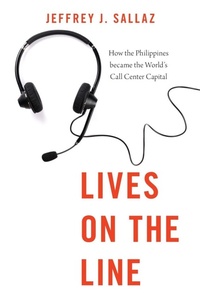
Lives on the Line
How the Philippines became the World's Call Center Capital
Published on 5. September 2019
Book
Paperback/Softback
256 pages
978-0-19-063066-9 (ISBN)
Description
The call center industry is booming in the Philippines. Around the year 2005, the country overtook India as the world's "voice capital," and industry revenues are now the second largest contributor to national GDP. In Lives on the Line, Jeffrey J. Sallaz retraces the assemblage of a global market for voice over the past two decades. Drawing upon case studies of sixty Filipino call center workers and two years of fieldwork in Manila, he illustrates how offshore call center jobs represent a middle path for educated Filipinos, who are faced with the dismaying choice to migrate abroad in search of prosperity versus stay at home as an impoverished professional. A rich ethnographic study, this book challenges existing stereotypes regarding offshore service jobs and sheds light upon the reasons that the Philippines has become the world's favored location for "voice." It looks beyond call centers and beyond India to advance debates concerning global capitalism, the future of work, and the lives of those who labor in offshored jobs.
More details
Series
Language
English
Place of publication
New York
United States
Target group
Professional and scholarly
Illustrations
21 black and white illustrations
Dimensions
Height: 234 mm
Width: 156 mm
Thickness: 14 mm
Weight
395 gr
ISBN-13
978-0-19-063066-9 (9780190630669)
Copyright in bibliographic data and cover images is held by Nielsen Book Services Limited or by the publishers or by their respective licensors: all rights reserved.
Schweitzer Classification
Other editions
Additional editions

Book
09/2019
Oxford University Press Inc
€185.30
Shipment within 15-20 days

E-Book
07/2019
OUP eBook
€18.99
Available for download

E-Book
07/2019
OUP eBook
€18.99
Available for download
Person
Jeffrey J. Sallaz is Associate Professor of Sociology at the University of Arizona. He is an ethnographer of work who has performed fieldwork in automobile factories, casinos, and call centers. For the present project, he spent two years doing fieldwork in the Philippines and the United States.
Content
Part 1 Introduction
1: One Job, Many Lives
2: Assembling a Labor Market
Part 2 Mediators Unpacked
3: Firms: Seeing Like a Call Center
4: The State: Making a Middle Path
5: Labor: Seeking the Philippine Dream
Part 3 Three Archetypes
6: Responsible Women
7: Restless Gays
8: Rooted Men
Part 4 Conclusion
9: Gone Baby Gone
10: The Relativity of Work
Appendix | An Ethnographic Narrative
Acknowledgements
Notes
Index
1: One Job, Many Lives
2: Assembling a Labor Market
Part 2 Mediators Unpacked
3: Firms: Seeing Like a Call Center
4: The State: Making a Middle Path
5: Labor: Seeking the Philippine Dream
Part 3 Three Archetypes
6: Responsible Women
7: Restless Gays
8: Rooted Men
Part 4 Conclusion
9: Gone Baby Gone
10: The Relativity of Work
Appendix | An Ethnographic Narrative
Acknowledgements
Notes
Index