

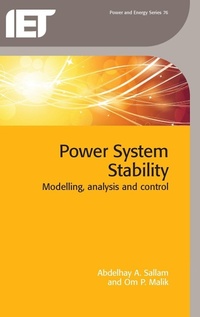
Power System Stability
Modelling, analysis and control
Published on 1. July 2015
Book
Hardback
472 pages
978-1-84919-944-5 (ISBN)
Description
To ensure stable operation of a power system, it is necessary to analyse the power system performance under various operating conditions. Analysis includes studies such as power flow and both steady-state and transient stability. To perform such studies requires knowledge about the models used to represent the various components that constitute an integrated power system. In situations where there is a risk of loss of stability, it is necessary to apply controls that can ensure stable and uninterrupted supply of electricity following a disturbance.
The subject of stability thus encompasses modelling, computation of load flow in the transmission grid, stability analysis under both steady-state and disturbed conditions, and appropriate controls to enhance stability. All these topics are covered in this book, providing a comprehensive treatment of the overall subject of stability of power systems. Topics covered include modelling of the synchronous machine; the synchronous machine connected to power systems; modelling of transformers, transmission lines and loads; power flow analysis; optimal power flow; small signal stability; transient stability; transient energy function methods; artificial intelligent techniques; power system stabilizers; series compensation; shunt compensation; compensation devices; and recent technologies.
The subject matter is covered at a level that is suitable for students, scientists and engineers involved in the study, design, analysis and control of power systems.
The subject of stability thus encompasses modelling, computation of load flow in the transmission grid, stability analysis under both steady-state and disturbed conditions, and appropriate controls to enhance stability. All these topics are covered in this book, providing a comprehensive treatment of the overall subject of stability of power systems. Topics covered include modelling of the synchronous machine; the synchronous machine connected to power systems; modelling of transformers, transmission lines and loads; power flow analysis; optimal power flow; small signal stability; transient stability; transient energy function methods; artificial intelligent techniques; power system stabilizers; series compensation; shunt compensation; compensation devices; and recent technologies.
The subject matter is covered at a level that is suitable for students, scientists and engineers involved in the study, design, analysis and control of power systems.
Reviews / Votes
'The objective of this book is to present not only the most fundamental concepts and ideas in power system stability but also the enhancement and control methods. To this end, a large amount mathematical modelling and calculations are presented in the book as well as a comprehensive introduction to each of the important components of the system. Consequently the book covers a broad spectrum of topics, which are only part of the author's researches. Also, the book presents a lot of references for further understanding and learning the power system stability. The book presents all the content clearly and is easy to be followed. Especially, the inclusion of series and shunt compensation reflects the trends of employment of more power electronic devices, the introduction of various energy technologies shows the emerging energy regulation approaches, and the presentations of PMU/WAMS provide the stability control more choices. All of these demonstrate the state-of-art of the new development of power system analysis and control, which are very valuable.' -- Jie Song, Ph.D, MIEEE, Associate Professor, Peking UniversityMore details
Series
Language
English
Place of publication
Stevenage
United Kingdom
Target group
College/higher education
Professional and scholarly
Dimensions
Height: 240 mm
Width: 161 mm
Thickness: 29 mm
Weight
874 gr
ISBN-13
978-1-84919-944-5 (9781849199445)
Copyright in bibliographic data and cover images is held by Nielsen Book Services Limited or by the publishers or by their respective licensors: all rights reserved.
Schweitzer Classification
Persons
Abdelhay A. Sallam PhD is a life Senior member of the IEEE and Professor Emeritus of Electrical Engineering at the Port-Said University, Egypt. Dr Sallam has taught courses in power systems, computer methods in power system analysis, conventional machines, distribution systems, logic circuits, and microprocessor structure. In addition, he has served as a consultant, advising companies on the design and installation of power networks, substations, and electric distribution systems.
Om P. Malik FIET, LFIEEE has taught and done extensive research in the area of rotating electric machines, adaptive and AI control, and digital protection of power systems. He was a pioneer in the development of adaptive controllers for realtime applications to improve power system stability and such controllers are employed as power system stabilizers on large generating units.
Om P. Malik FIET, LFIEEE has taught and done extensive research in the area of rotating electric machines, adaptive and AI control, and digital protection of power systems. He was a pioneer in the development of adaptive controllers for realtime applications to improve power system stability and such controllers are employed as power system stabilizers on large generating units.
Content
Chapter 1: Power system stability overview
Part I: Modelling
Chapter 2: Modelling of the synchronous machine
Chapter 3: Synchronous machine connected to a power system
Chapter 4: Modelling of transformers, transmission lines and loads
Part II: Power flow
Chapter 5: Power flow analysis
Chapter 6: Optimal power flow
Part III: Stability analysis
Chapter 7: Small signal stability
Chapter 8: Transient stability
Chapter 9: Transient energy function methods
Part IV: Stability enhancement and control
Chapter 10: Artificial intelligence techniques
Chapter 11: Power system stabiliser
Chapter 12: Series compensation
Chapter 13: Shunt compensation
Chapter 14: Compensation devices
Chapter 15: Recent technologies
Appendix I: Calculation of synchronous machine parameters in per unit/normalised form
Appendix II: Nine-bus test system
Appendix III: Numerical integration techniques
Appendix IV: 15-bus, 4-generator system data
Part I: Modelling
Chapter 2: Modelling of the synchronous machine
Chapter 3: Synchronous machine connected to a power system
Chapter 4: Modelling of transformers, transmission lines and loads
Part II: Power flow
Chapter 5: Power flow analysis
Chapter 6: Optimal power flow
Part III: Stability analysis
Chapter 7: Small signal stability
Chapter 8: Transient stability
Chapter 9: Transient energy function methods
Part IV: Stability enhancement and control
Chapter 10: Artificial intelligence techniques
Chapter 11: Power system stabiliser
Chapter 12: Series compensation
Chapter 13: Shunt compensation
Chapter 14: Compensation devices
Chapter 15: Recent technologies
Appendix I: Calculation of synchronous machine parameters in per unit/normalised form
Appendix II: Nine-bus test system
Appendix III: Numerical integration techniques
Appendix IV: 15-bus, 4-generator system data