

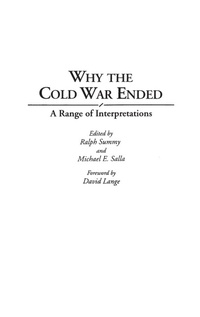
Why the Cold War Ended
A Range of Interpretations
Published on 17. July 1995
Book
Hardback
296 pages
978-0-313-29569-0 (ISBN)
Description
Did the West win the Cold War? Was it a genuine or a contrived conflict? When did it begin? How was its cause related to its end? These are among the questions considered by the contributors of this volume. Asked to assess the combination of socio-political forces and events they attribute to ending the Cold War, they have come up with diverse theories that challenge the self-serving orthodoxy that claims Western military prowess, economic strength, and ideological superiority produced the triumph.
The contributors consider a range of views from the contention that the West's military resolve and economic capacity forced the Soviet Union into submission to arguments focusing on U.S. and West European peace movements and East European dissent movements. Between these diametric positions, they weigh the significance of such factors as the new thinking in the Soviet Union and the intelligentsia of Eastern Europe. Through a range of many views, they provide a broad interpretive framework for understanding the Cold War's end, and suggest how that understanding is related to the solving of future conflicts.
The contributors consider a range of views from the contention that the West's military resolve and economic capacity forced the Soviet Union into submission to arguments focusing on U.S. and West European peace movements and East European dissent movements. Between these diametric positions, they weigh the significance of such factors as the new thinking in the Soviet Union and the intelligentsia of Eastern Europe. Through a range of many views, they provide a broad interpretive framework for understanding the Cold War's end, and suggest how that understanding is related to the solving of future conflicts.
More details
Series
Language
English
Place of publication
United States
Publishing group
Bloomsbury Publishing Plc
Target group
College/higher education
Professional and scholarly
Interest Age: From 7 to 17 years
Dimensions
Height: 240 mm
Width: 161 mm
Thickness: 20 mm
Weight
605 gr
ISBN-13
978-0-313-29569-0 (9780313295690)
Copyright in bibliographic data and cover images is held by Nielsen Book Services Limited or by the publishers or by their respective licensors: all rights reserved.
Schweitzer Classification
Persons
RALPH SUMMY is a Senior Lecturer in Political Science at the University of Queensland. He also coordinates the interdisciplinary Peace and Conflicts Studies program and is a cofounder and member of the editorial collective of the journal Social Alternatives. He is coauthor with Malcolm Saunders of the book The Australian Peace Movement: A Short History.
MICHAEL E. SALLA Professor in the Peace & Conflict Resolution Program at American University. His scholarly interests are in the areas of nonviolence, international relations, peace studies, and ethnic/religious conflict. He is the author of Islamic Radicalism: Muslim Nations and the West (1993) and coeditor of Essay on Peace: Paradigms for Global Order (1995).
MICHAEL E. SALLA Professor in the Peace & Conflict Resolution Program at American University. His scholarly interests are in the areas of nonviolence, international relations, peace studies, and ethnic/religious conflict. He is the author of Islamic Radicalism: Muslim Nations and the West (1993) and coeditor of Essay on Peace: Paradigms for Global Order (1995).
Content
Foreword by David Lange
Acknowledgments
Introduction; Challenging the Emergent Orthodoxy by Ralph Summy
Political Leaders and Their Policies
Did Reagan "Win" the Cold War? by April Carter
Ronald Reaganism Ended the Cold War-In the 1960s by Robert Elias
The End of the Cold War: The Brezhnev Doctrine by Joanne Wright
Mass Movements and "New Thinking"
The Peace Movement Role in Ending the Cold War by David Cortright
Gorbachev, the Peace Movement, and the Death of Lenin by Jennifer Turpin
The Peace Movement's Role in Ending the Cold War by David Cortright
Europe 1989: The Role of Peace Research and the Peace Movement by Johan Galtung
The Erosion of Regime Legitimacy in Eastern European Satellite States: The Case of the German Democratic Republic by Ulf Sundhaussen
Economic Determinants
"Upper Volta With Rockets": Internal vs. External Factors in the Decline of the Soviet Union by Dennis Phillips
Marxism, Capitalism, and Democracy: Some Post-Soviet Dilemmas by Geoff Dow
Whose Cold War? by Rick Kuhn
Systemic Global Changes
Carrots Were More Important Than Sticks in Ending the Cold War by Kevin Clements
How the Cold War Became an Expensive Irrelevance by Keith Suter
Emerging Paradigms & Lessons Learnt
The Continuing Cold War by John Burton
In the Shadow of the Middle Kingdom Syndrome: China in the Post-Cold War World by C. L. Chiou
The Cold War and After: A New Period of Upheaval in World Politics by Joseph Camilleri
Conclusion
The End of the Cold War: A Political, Historical, and Mythological Event by Michael E. Salla
Bibliography
Index
Acknowledgments
Introduction; Challenging the Emergent Orthodoxy by Ralph Summy
Political Leaders and Their Policies
Did Reagan "Win" the Cold War? by April Carter
Ronald Reaganism Ended the Cold War-In the 1960s by Robert Elias
The End of the Cold War: The Brezhnev Doctrine by Joanne Wright
Mass Movements and "New Thinking"
The Peace Movement Role in Ending the Cold War by David Cortright
Gorbachev, the Peace Movement, and the Death of Lenin by Jennifer Turpin
The Peace Movement's Role in Ending the Cold War by David Cortright
Europe 1989: The Role of Peace Research and the Peace Movement by Johan Galtung
The Erosion of Regime Legitimacy in Eastern European Satellite States: The Case of the German Democratic Republic by Ulf Sundhaussen
Economic Determinants
"Upper Volta With Rockets": Internal vs. External Factors in the Decline of the Soviet Union by Dennis Phillips
Marxism, Capitalism, and Democracy: Some Post-Soviet Dilemmas by Geoff Dow
Whose Cold War? by Rick Kuhn
Systemic Global Changes
Carrots Were More Important Than Sticks in Ending the Cold War by Kevin Clements
How the Cold War Became an Expensive Irrelevance by Keith Suter
Emerging Paradigms & Lessons Learnt
The Continuing Cold War by John Burton
In the Shadow of the Middle Kingdom Syndrome: China in the Post-Cold War World by C. L. Chiou
The Cold War and After: A New Period of Upheaval in World Politics by Joseph Camilleri
Conclusion
The End of the Cold War: A Political, Historical, and Mythological Event by Michael E. Salla
Bibliography
Index