

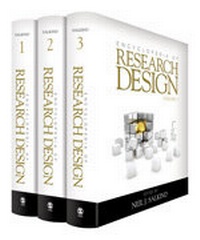
Encyclopedia of Research Design
1st Edition
Published on 25. August 2010
Book
Hardback
1776 pages
978-1-4129-6127-1 (ISBN)
Description
Research design can be daunting for all types of researchers. At its heart it might be described as a formalized approach toward problem solving, thinking, and acquiring knowledge-the success of which depends upon clearly defined objectives and appropriate choice of statistical tools, tests, and analysis to meet a project's objectives.
Comprising more than 500 entries, the Encyclopedia of Research Design explains how to make decisions about research design, undertake research projects in an ethical manner, interpret and draw valid inferences from data, and evaluate experiment design strategies and results. Two additional features carry this encyclopedia far above other works in the field: bibliographic entries devoted to significant articles in the history of research design and reviews of contemporary tools, such as software and statistical procedures, used to analyze results.
Key Features
Covers the spectrum of research design strategies, from material presented in introductory classes to topics necessary in graduate research
Addresses cross- and multidisciplinary research needs, with many examples drawn from the social and behavioral sciences, neurosciences, and biomedical and life sciences
Provides summaries of advantages and disadvantages of often-used strategies
Uses hundreds of sample tables, figures, and equations based on real-life cases
Key Themes
Descriptive Statistics
Distributions
Graphical Displays of Data
Hypothesis Testing
Important Publications
Inferential Statistics
Item Response Theory
Mathematical Concepts
Measurement Concepts
Organizations
Publishing
Qualitative Research
Reliability of Scores
Research Design Concepts
Research Designs
Research Ethics
Research Process
Research Validity Issues
Sampling
Scaling
Software Applications
Statistical Assumptions
Statistical Concepts
Statistical Procedures
Statistical Tests
Theories, Laws, and Principles
Types of Variables
Validity of Scores
The Encyclopedia of Research Design is the perfect instrument for new learners as well as experienced researchers to explore both the original and newest branches of the field.
Comprising more than 500 entries, the Encyclopedia of Research Design explains how to make decisions about research design, undertake research projects in an ethical manner, interpret and draw valid inferences from data, and evaluate experiment design strategies and results. Two additional features carry this encyclopedia far above other works in the field: bibliographic entries devoted to significant articles in the history of research design and reviews of contemporary tools, such as software and statistical procedures, used to analyze results.
Key Features
Covers the spectrum of research design strategies, from material presented in introductory classes to topics necessary in graduate research
Addresses cross- and multidisciplinary research needs, with many examples drawn from the social and behavioral sciences, neurosciences, and biomedical and life sciences
Provides summaries of advantages and disadvantages of often-used strategies
Uses hundreds of sample tables, figures, and equations based on real-life cases
Key Themes
Descriptive Statistics
Distributions
Graphical Displays of Data
Hypothesis Testing
Important Publications
Inferential Statistics
Item Response Theory
Mathematical Concepts
Measurement Concepts
Organizations
Publishing
Qualitative Research
Reliability of Scores
Research Design Concepts
Research Designs
Research Ethics
Research Process
Research Validity Issues
Sampling
Scaling
Software Applications
Statistical Assumptions
Statistical Concepts
Statistical Procedures
Statistical Tests
Theories, Laws, and Principles
Types of Variables
Validity of Scores
The Encyclopedia of Research Design is the perfect instrument for new learners as well as experienced researchers to explore both the original and newest branches of the field.
Reviews / Votes
"....The two things that make this work distinctive are the inclusion of reviews of 15 seminal articles in the field... and reviews of 11 popular research tools.... Entry length was purposely set based on the editors' judgment of each topic's importance.... Bottom line Essential for academic libraries, this is one of a handful of resources that covers such a broad spectrum of research designs. It will also be a useful addition to public library collections..." (starred review) -- Sarah Sutton * Library Journal * "SAGE is to be congratulated for creating an encyclopedia that brings all of this information together and serves multiple needs. Serious researchers will be grateful to have a reference that serves as a practical and useful tool.... Less experienced researchers will be happy to have quick and easy access to definitions of basic concepts and design methods. Four-year college and university libraries are the obvious audience for the Encyclopedia of Research Design, but individual researchers will also benefit from having it on their personal shelves."-Against the Grain -- Against the Grain * Against the Grain November 2010 * "The content is well illustrated when appropriate, and the articles are clear and well written. Most academic and larger public libraries should acquire this modestly priced, valuable reference set. No recent similar sources are available. Summing Up: Highly recommended. *** Lower-level undergraduates and above; general readers." -- CHOICEMore details
Language
English
Place of publication
Thousand Oaks
United States
Target group
College/higher education
Professional and scholarly
Dimensions
Height: 279 mm
Width: 216 mm
Weight
5897 gr
ISBN-13
978-1-4129-6127-1 (9781412961271)
Copyright in bibliographic data and cover images is held by Nielsen Book Services Limited or by the publishers or by their respective licensors: all rights reserved.
Schweitzer Classification
Other editions
New editions
Bruce B. Frey
The SAGE Encyclopedia of Research Design
Book
09/2022
2nd Edition
SAGE Publications Inc
€891.35
Shipment within 15-20 days
Person
Neil J. Salkind received his PhD in human development from the University of Maryland, and after teaching for 35 years at the University of Kansas, he was Professor Emeritus in the Department of Psychology and Research in Education, where he collaborated with colleagues and work with students. His early interests were in the area of children's cognitive development, and after research in the areas of cognitive style and (what was then known as) hyperactivity, he was a postdoctoral fellow at the University of North Carolina's Bush Center for Child and Family Policy. His work then changed direction to focus on child and family policy, specifically the impact of alternative forms of public support on various child and family outcomes. He delivered more than 150 professional papers and presentations; written more than 100 trade and textbooks; and is the author of Statistics for People Who (Think They) Hate Statistics (SAGE), Theories of Human Development (SAGE), and Exploring Research (Prentice Hall). He has edited several encyclopedias, including the Encyclopedia of Human Development, the Encyclopedia of Measurement and Statistics, and the Encyclopedia of Research Design. He was editor of Child Development Abstracts and Bibliography for 13 years. He lived in Lawrence, Kansas, where he liked to read, swim with the River City Sharks, work as the proprietor and sole employee of big boy press, bake brownies (see www.statisticsforpeople.com for the recipe), and poke around old Volvos and old houses.