

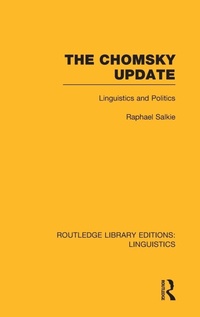
The Chomsky Update (RLE Linguistics A: General Linguistics)
General Linguistics)
1st Edition
Published on 21. November 2013
Book
Hardback
256 pages
978-0-415-71574-4 (ISBN)
Description
Noam Chomsky has been described as 'arguably the most important intellectual alive'. His revolutionary work in linguistics has aroused intense scholarly interest, while his trenchant critique of United States foreign policy and his incisive analysis of the role of intellectuals in modern society have made him a prominent public figure.
Raphael Salkie's timely book introduces the two parts of Chomsky's work and explores the connections between them. He provides an accessible and up-to-date introduction to Chomsky's linguistics, laying out his basic assumptions and aims - in particular, his consistent drive to make linguistics a science - and looking at a sample of Chomsky's recent work. He examines the implications for other fields such as philosophy and psychology, as well as the main challenges to Chomsky's position.
Raphael Salkie also sets out the key themes in Chomsky's political writings and his libertarian socialist views. He contrasts the 'official line' on US foreign policy - the view that the US is a 'well-meaning, blundering giant' - with Chomsky's carefully argued alternative view. By focusing on Chomsky's conception of human nature and human freedom the author draws out the links between the two sides of Chomsky's work, in the belief that both sides raise issues which can profitably be explored. The author also provides a carefully annotated guide to further reading.
As an experienced teacher of linguistics with a commitment to political activism, Raphael Salkie is uniquely qualified to present this introduction to one of the seminal thinkers of our time.
First published in 1990.
Raphael Salkie's timely book introduces the two parts of Chomsky's work and explores the connections between them. He provides an accessible and up-to-date introduction to Chomsky's linguistics, laying out his basic assumptions and aims - in particular, his consistent drive to make linguistics a science - and looking at a sample of Chomsky's recent work. He examines the implications for other fields such as philosophy and psychology, as well as the main challenges to Chomsky's position.
Raphael Salkie also sets out the key themes in Chomsky's political writings and his libertarian socialist views. He contrasts the 'official line' on US foreign policy - the view that the US is a 'well-meaning, blundering giant' - with Chomsky's carefully argued alternative view. By focusing on Chomsky's conception of human nature and human freedom the author draws out the links between the two sides of Chomsky's work, in the belief that both sides raise issues which can profitably be explored. The author also provides a carefully annotated guide to further reading.
As an experienced teacher of linguistics with a commitment to political activism, Raphael Salkie is uniquely qualified to present this introduction to one of the seminal thinkers of our time.
First published in 1990.
More details
Series
Language
English
Place of publication
London
United Kingdom
Publishing group
Taylor & Francis Ltd
Target group
College/higher education
Dimensions
Height: 240 mm
Width: 161 mm
Thickness: 19 mm
Weight
555 gr
ISBN-13
978-0-415-71574-4 (9780415715744)
Copyright in bibliographic data and cover images is held by Nielsen Book Services Limited or by the publishers or by their respective licensors: all rights reserved.
Schweitzer Classification
Other editions
Additional editions
Book
11/2015
1st Edition
Routledge
€48.00
Shipment within 10-20 days
Raphael Salkie
The Chomsky Update (RLE Linguistics A: General Linguistics)
E-Book
01/2014
1st Edition
Routledge
€41.99
Available for download
Raphael Salkie
The Chomsky Update (RLE Linguistics A: General Linguistics)
E-Book
01/2014
1st Edition
Routledge
€41.99
Available for download
Person
Raphael Salkie
Content
Preface; Part 1 Linguistics; Chapter 1 Basics; Chapter 2 Achievements; Chapter 3 Costs; Chapter 4 Implications; Chapter 5 Challenges; Part 2 Politics; Chapter 6 The 'Free World'; Chapter 7 Outside the 'Free World'; Chapter 8 The Way Forward; Chapter 9 Connections; Guide to Further Reading;