

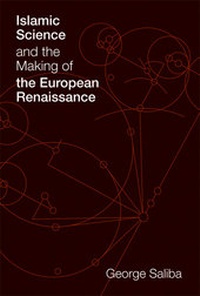
Islamic Science and the Making of the European Renaissance
Published on 2. March 2007
Book
Hardback
360 pages
978-0-262-19557-7 (ISBN)
Description
The Islamic scientific tradition has been described many times in
accounts of Islamic civilization and general histories of science, with most authors
tracing its beginnings to the appropriation of ideas from other ancient
civilizations--the Greeks in particular. In this thought-provoking and original
book, George Saliba argues that, contrary to the generally accepted view, the
foundations of Islamic scientific thought were laid well before Greek sources were
formally translated into Arabic in the ninth century. Drawing on an account by the
tenth-century intellectual historian Ibn al-Nadim [macron over i] that is ignored by
most modern scholars, Saliba suggests that early translations from mainly Persian
and Greek sources outlining elementary scientific ideas for the use of government
departments were the impetus for the development of the Islamic scientific
tradition. He argues further that there was an organic relationship between the
Islamic scientific thought that developed in the later centuries and the science
that came into being in Europe during the Renaissance.Saliba outlines the
conventional accounts of Islamic science, then discusses their shortcomings and
proposes an alternate narrative. Using astronomy as a template for tracing the
progress of science in Islamic civilization, Saliba demonstrates the originality of
Islamic scientific thought. He details the innovations (including new mathematical
tools) made by the Islamic astronomers from the thirteenth to sixteenth centuries,
and offers evidence that Copernicus could have known of and drawn on their work.
Rather than viewing the rise and fall of Islamic science from the often-narrated
perspectives of politics and religion, Saliba focuses on the scientific production
itself and the complex social, economic, and intellectual conditions that made it
possible.
accounts of Islamic civilization and general histories of science, with most authors
tracing its beginnings to the appropriation of ideas from other ancient
civilizations--the Greeks in particular. In this thought-provoking and original
book, George Saliba argues that, contrary to the generally accepted view, the
foundations of Islamic scientific thought were laid well before Greek sources were
formally translated into Arabic in the ninth century. Drawing on an account by the
tenth-century intellectual historian Ibn al-Nadim [macron over i] that is ignored by
most modern scholars, Saliba suggests that early translations from mainly Persian
and Greek sources outlining elementary scientific ideas for the use of government
departments were the impetus for the development of the Islamic scientific
tradition. He argues further that there was an organic relationship between the
Islamic scientific thought that developed in the later centuries and the science
that came into being in Europe during the Renaissance.Saliba outlines the
conventional accounts of Islamic science, then discusses their shortcomings and
proposes an alternate narrative. Using astronomy as a template for tracing the
progress of science in Islamic civilization, Saliba demonstrates the originality of
Islamic scientific thought. He details the innovations (including new mathematical
tools) made by the Islamic astronomers from the thirteenth to sixteenth centuries,
and offers evidence that Copernicus could have known of and drawn on their work.
Rather than viewing the rise and fall of Islamic science from the often-narrated
perspectives of politics and religion, Saliba focuses on the scientific production
itself and the complex social, economic, and intellectual conditions that made it
possible.
More details
Series
Language
English
Place of publication
Cambridge, Mass.
United States
Publishing group
MIT Press Ltd
Target group
Professional and scholarly
Interest Age: From 18 years
Illustrations
17 illus.
Dimensions
Height: 229 mm
Width: 152 mm
Thickness: 0 mm
Weight
590 gr
ISBN-13
978-0-262-19557-7 (9780262195577)
Copyright in bibliographic data and cover images is held by Nielsen Book Services Limited or by the publishers or by their respective licensors: all rights reserved.
Schweitzer Classification
Other editions
Additional editions
E-Book
01/2011
MIT Press
€38.99
Available for download
Person
William Kaizen is currently writing "The Immediate: Early VideoArt
and Mass Media America, 1965--1975," a Ph.D. dissertationin art history at
Columbia University. In the spring of 2003,he helped organize the conference
Communities of Sense:Rethinking Aesthetics in Practice.
George Saliba is Professor of Arabic and Islamic Studies in the
Department of Middle East and Asian Studies at Columbia University. He is the author
or editor of six other books in Arabic and English.
and Mass Media America, 1965--1975," a Ph.D. dissertationin art history at
Columbia University. In the spring of 2003,he helped organize the conference
Communities of Sense:Rethinking Aesthetics in Practice.
George Saliba is Professor of Arabic and Islamic Studies in the
Department of Middle East and Asian Studies at Columbia University. He is the author
or editor of six other books in Arabic and English.