

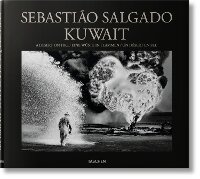
Sebastiao Salgado. Kuwait. A Desert on Fire
Published on 15. October 2016
Book
Hardback
208 pages
978-3-8365-6126-6 (ISBN)
Description
"We must remember that in the brutality of battle another such apocalypse is always just around the corner." -Sebastiao Salgado
In January and February 1991, as the United States-led coalition drove Iraqi forces out of Kuwait, Saddam Hussein's troops retaliated with an inferno. At some 700 oil wells and an unspecified number of oil-filled low-lying areas they ignited vast, raging fires, creating one of the worst environmental disasters in living memory.
As the desperate efforts to contain and extinguish the conflagration progressed, Sebastiao Salgado traveled to Kuwait to witness the crisis firsthand. The conditions were excruciating. The heat was so vicious that Salgado's smallest lens warped. A journalist and another photographer were killed when a slick ignited as they crossed it. Sticking close to the firefighters, and with characteristic sensitivity to both human and environmental impact, Salgado captured the terrifying scale of this "huge theater the size of the planet": the ravaged landscape; the sweltering temperatures; the air choking on charred sand and soot; the blistered remains of camels; the sand still littered with cluster bombs; and the flames and smoke soaring to the skies, blocking out the sunlight, dwarfing the oil-coated firefighters.
Salgado's epic pictures first appeared in the New York Times Magazine in June 1991 and were subsequently awarded the Oskar Barnack Award, recognizing outstanding images on the relationship between man and the environment. Kuwait: A Desert on Fire is the first monograph of this astonishing series. Like Genesis, Exodus, and The Children, it is as much a major document of modern history as an extraordinary body of photographic work.
In January and February 1991, as the United States-led coalition drove Iraqi forces out of Kuwait, Saddam Hussein's troops retaliated with an inferno. At some 700 oil wells and an unspecified number of oil-filled low-lying areas they ignited vast, raging fires, creating one of the worst environmental disasters in living memory.
As the desperate efforts to contain and extinguish the conflagration progressed, Sebastiao Salgado traveled to Kuwait to witness the crisis firsthand. The conditions were excruciating. The heat was so vicious that Salgado's smallest lens warped. A journalist and another photographer were killed when a slick ignited as they crossed it. Sticking close to the firefighters, and with characteristic sensitivity to both human and environmental impact, Salgado captured the terrifying scale of this "huge theater the size of the planet": the ravaged landscape; the sweltering temperatures; the air choking on charred sand and soot; the blistered remains of camels; the sand still littered with cluster bombs; and the flames and smoke soaring to the skies, blocking out the sunlight, dwarfing the oil-coated firefighters.
Salgado's epic pictures first appeared in the New York Times Magazine in June 1991 and were subsequently awarded the Oskar Barnack Award, recognizing outstanding images on the relationship between man and the environment. Kuwait: A Desert on Fire is the first monograph of this astonishing series. Like Genesis, Exodus, and The Children, it is as much a major document of modern history as an extraordinary body of photographic work.
Reviews / Votes
"A collection of 83 hauntingly beautiful black-and-white photographs taken at some risk to Salgado himself." * Morning Star *More details
Edition
Multilingual edition
Language
Spanish
Italian
Other
Place of publication
Cologne
Germany
Edition type
Multilingual edition
Dimensions
Height: 290 mm
Width: 318 mm
Thickness: 29 mm
Weight
2250 gr
ISBN-13
978-3-8365-6126-6 (9783836561266)
Copyright in bibliographic data and cover images is held by Nielsen Book Services Limited or by the publishers or by their respective licensors: all rights reserved.
Schweitzer Classification
Persons
Lelia Wanick Salgado studied architecture and urban planning in Paris. Her interest in photography started in 1970. In the 1980s, she began to conceive and design the majority of Sebastiao Salgado's photography books and all of the exhibitions of his work.
Sebastiao Salgado (1944-2025) began his career as a professional photographer in Paris in 1973 and subsequently worked with the photo agencies Sygma, Gamma, and Magnum Photos. In 1994, he and his wife Lelia Wanick Salgado created Amazonas Images which exclusively handles his work. Salgado's photographic projects have been featured in many exhibitions as well as books, including Sahel. L'Homme en detresse (1986), Other Americas (1986), Terra (1997), Migrations (2000), The Children (2000), Africa (2007), Genesis (2013), The Scent of a Dream (2015), Kuwait. A Desert on Fire (2016), Gold (2019) and Amazonia (2021).
Sebastiao Salgado (1944-2025) began his career as a professional photographer in Paris in 1973 and subsequently worked with the photo agencies Sygma, Gamma, and Magnum Photos. In 1994, he and his wife Lelia Wanick Salgado created Amazonas Images which exclusively handles his work. Salgado's photographic projects have been featured in many exhibitions as well as books, including Sahel. L'Homme en detresse (1986), Other Americas (1986), Terra (1997), Migrations (2000), The Children (2000), Africa (2007), Genesis (2013), The Scent of a Dream (2015), Kuwait. A Desert on Fire (2016), Gold (2019) and Amazonia (2021).