

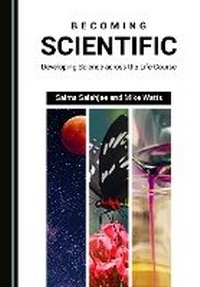
Becoming Scientific
Developing Science across the Life-Course
Published on 1. April 2023
Book
Paperback/Softback
257 pages
978-1-5275-9547-7 (ISBN)
Description
What does it mean to be 'sciencey'? Why do some people of all ages engage avidly with space and astronauts, birds and butterflies, chemicals and equations, while others detest and 'hate' the very ideas? This book develops in-depth analyses of the 'science identities' of very different people-young and old of diverse backgrounds-in order to explore their immersion in, and entanglement with, the processes of learning science. At the centre of the book lies a collection of their 'science life' stories, detailing their engagement with both formal education in schools and colleges, and informal science learning in the culture of everyday life. The text highlights how science educators, teachers, parents and science communicators more generally can foster and support the formation and transformation of people's science identities, providing strategies to support the learning journey of children, adolescents and adults within a broad range of learning environments.
What does it mean to be 'sciencey'? Why do some people of all ages engage avidly with space and astronauts, birds and butterflies, chemicals and equations, while others detest and 'hate' the very ideas? This book develops in-depth analyses of the 'science identities' of very different people-young and old of diverse backgrounds-in order to explore their immersion in, and entanglement with, the processes of learning science. At the centre of the book lies a collection of their 'science life' stories, detailing their engagement with both formal education in schools and colleges, and informal science learning in the culture of everyday life. The text highlights how science educators, teachers, parents and science communicators more generally can foster and support the formation and transformation of people's science identities, providing strategies to support the learning journey of children, adolescents and adults within a broad range of learning environments.
What does it mean to be 'sciencey'? Why do some people of all ages engage avidly with space and astronauts, birds and butterflies, chemicals and equations, while others detest and 'hate' the very ideas? This book develops in-depth analyses of the 'science identities' of very different people-young and old of diverse backgrounds-in order to explore their immersion in, and entanglement with, the processes of learning science. At the centre of the book lies a collection of their 'science life' stories, detailing their engagement with both formal education in schools and colleges, and informal science learning in the culture of everyday life. The text highlights how science educators, teachers, parents and science communicators more generally can foster and support the formation and transformation of people's science identities, providing strategies to support the learning journey of children, adolescents and adults within a broad range of learning environments.
Reviews / Votes
"This book addresses a long debate with a fresh approach. Why is science and science learning important? How can it be promoted? While the relevance and utility of scientific knowledge in people's life is commonly approached by focusing on competences and scientific literacy, the authors of this book engage in a much wider perspective, embracing an ecological view of science identity, where the emotional dimension of each individual along the person's life-course is not dismissed. [...] As a social scientist involved in science teacher education (and with progressive transformative learning trajectory into science, self-diagnosed with the help of this book!) I admit it was not difficult to appreciate the reading. [...] [The] two main messages I take from the book are the relevance of positive emotional loading, repeatedly throughout persons' lives, at all levels of school education and stages of life. Moreover, embracing the richness and complexity of science education involves recognising that there is no single strategy or recipe to develop science identities. There is, indeed, an infinite number of possibilities, waiting to be tasted."Dr Betina Lopes"This book addresses a long debate with a fresh approach. Why is science and science learning important? How can it be promoted? While the relevance and utility of scientific knowledge in people's life is commonly approached by focusing on competences and scientific literacy, the authors of this book engage in a much wider perspective, embracing an ecological view of science identity, where the emotional dimension of each individual along the person's life-course is not dismissed. [...] As a social scientist involved in science teacher education (and with progressive transformative learning trajectory into science, self-diagnosed with the help of this book!) I admit it was not difficult to appreciate the reading. [...] [The] two main messages I take from the book are the relevance of positive emotional loading, repeatedly throughout persons' lives, at all levels of school education and stages of life. Moreover, embracing the richness and complexity of science education involves recognising that there is no single strategy or recipe to develop science identities. There is, indeed, an infinite number of possibilities, waiting to be tasted."Dr Betina Lopes
More details
Edition
Unabridged edition
Language
English
Place of publication
Newcastle upon Tyne
United Kingdom
Target group
Professional and scholarly
Edition type
Unabridged edition
Product notice
With dust jacket
Dimensions
Height: 212 mm
Width: 148 mm
ISBN-13
978-1-5275-9547-7 (9781527595477)
Copyright in bibliographic data and cover images is held by Nielsen Book Services Limited or by the publishers or by their respective licensors: all rights reserved.
Schweitzer Classification
Other editions
Additional editions
Book
08/2020
Cambridge Scholars Publishing
€100.59
Shipment within 15-20 days
Persons
Saima Salehjee is a Lecturer in Education at the University of Strathclyde, UK. Her research and publications focus on science literacy, public understanding of science, science identity, and identity transformations over the lifespan of individuals. She is currently conducting two funded projects to enhance scientific enquiry skills among primary and secondary children and to establish a series of nudges (interventions) to improve research in further and higher education sectors.Mike Watts is Professor of Education at Brunel University London, UK, conducting 'naturalistic' people-orientated research principally in science education and in scholarship in higher education. He has conducted major studies in both formal and informal educational settings in the UK and abroad, and has published widely on his research through numerous books, journal articles and conference papers.
Saima Salehjee is a Lecturer in Education at the University of Strathclyde, UK. Her research and publications focus on science literacy, public understanding of science, science identity, and identity transformations over the lifespan of individuals. She is currently conducting two funded projects to enhance scientific enquiry skills among primary and secondary children and to establish a series of nudges (interventions) to improve research in further and higher education sectors.Mike Watts is Professor of Education at Brunel University London, UK, conducting 'naturalistic' people-orientated research principally in science education and in scholarship in higher education. He has conducted major studies in both formal and informal educational settings in the UK and abroad, and has published widely on his research through numerous books, journal articles and conference papers.
Saima Salehjee is a Lecturer in Education at the University of Strathclyde, UK. Her research and publications focus on science literacy, public understanding of science, science identity, and identity transformations over the lifespan of individuals. She is currently conducting two funded projects to enhance scientific enquiry skills among primary and secondary children and to establish a series of nudges (interventions) to improve research in further and higher education sectors.Mike Watts is Professor of Education at Brunel University London, UK, conducting 'naturalistic' people-orientated research principally in science education and in scholarship in higher education. He has conducted major studies in both formal and informal educational settings in the UK and abroad, and has published widely on his research through numerous books, journal articles and conference papers.