

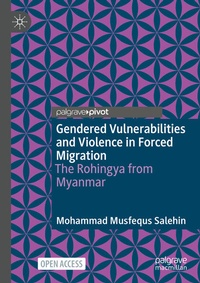
Gendered Vulnerabilities and Violence in Forced Migration
Description
This open access book investigates the gendered violence and vulnerabilities experienced by Rohingya men and women, drawing on qualitative data from refugee camps in Bangladesh. It shows that in Myanmar, men suffered torture and sexual violence, while women experienced physical, mental and sexual violence, legitimized by patriarchal norms. Sexual violence was wielded as a weapon to coerce their exodus from Myanmar and to disrupt the essential facets of Rohingya femininity, motherhood, and reproductive capabilities. Structural, cultural and symbolic violence affected the Rohingya differently across gender lines. A gendered threat narrative and othering cast women as 'ugly' and reproductive threats while men are framed as potential threats to national security and Buddhist nationalism. In Bangladesh, gendered othering continued, with Rohingya men seen as security threats and women as vulnerable victims. This book contributes to peace and conflict studies, gender studies, and migration and refugee studies, by analysing gendered violence.
Reviews / Votes
"The findings of the book emphasize the critical importance of integrating a gender perspective into social work and humanitarian aid. His detailed examination of the intersectionality of violence offers invaluable insights into designing better-targeted interventions that can address the root causes of gendered violence in refugee and displaced communities. . This book is crucial for those involved in peace and conflict studies, gender studies, and migration and refugee studies . ." (Angel Treesa Joseph and Rashmi Rekha Borah, Affilia, April 15, 2025)
More details
Other editions
Additional editions
Person
Mohammad Musfequs Salehin is an Associate Professor at UiT The Arctic University of Norway and a Senior Researcher at Peace Research Institute Oslo (PRIO).
Content
1. Introduction.- 2. Gender, Violence, and Vulnerabilities in Forced Migration: A Multi-dimensional Approach.- 3. The Rohingya Crisis: Background to Myanmar, the Current Conflict, and Relevant Actors.- 4. Gendered and Racialised Vulnerabilities and Violence Against the Rohingya in Myanmar.- 5. Gendered Vulnerabilities and Violence in Rohingya Refugee Camps in Bangladesh.- 6. Conclusion.