

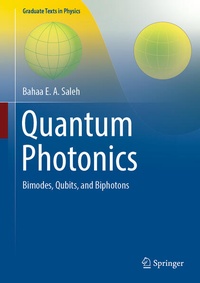
Quantum Photonics
Description
This book introduces classical modal optics and discrete quantum systems using a common mathematical approach based on linear vector spaces. It explores the three key elements of photonic quantum information: the optical bimode , the qubit , and the photon . Both the bimode and qubit are represented as vectors in a two-dimensional linear vector space, but the qubit distinguishes itself through unique properties linked to quantum measurement. While optical bimodes can be mutually coupled, qubits can be entangled, enabling revolutionary quantum information technologies.
A single photon occupying a bimode encodes a qubit, facilitating cryptographic protocols for secure communication. When occupying two bimodes, a photon encodes two qubits, enabling local gates. A photon distributed across spatial modes encodes an image. Entangled photon pairs form two qubits, enabling quantum-state teleportation and quantum networks. Additionally, two photons with spatiotemporal modal entanglement form a biphoton , useful for quantum sensing and imaging with sensitivity surpassing classical limits.
With numerous illustrations, examples, and exercises, the book is ideal for classroom teaching or self-study at the upper-level undergraduate or beginning graduate level. It also serves as an accessible introduction for readers interested in the foundational principles driving the second quantum revolution and its diverse applications in communication, computing, and metrology.
Reviews / Votes
"Few people write and explain technical topics as clearly and enjoyably as Prof. Bahaa Saleh. He is a master teacher, par excellence! This book is a delight from which to learn. Prof. Saleh guides the reader in a highly logical way through complex topics, and he includes numerous physical examples that vividly bring the topic to life. This book is an indispensable addition to any serious person in the field of quantum photonics. The book is replete with topics that are critical to a fundamental understanding of the topic as well as numerous results on recent work involving theory, simulation and experimentation. Quantum photonics is an exciting field that is growing dramatically and having significant impact. Prof. Saleh brings to bear his enormous experience and world-class insight to bring this topic to the reader in a most accessible way." (Alan Willner, Andrew and Erna Viterbi Professorial Chair and Distinguished Professor of Electrical and Computer Engineering, University of Southern California)
"
Quantum Photonics
by Bahaa Saleh presents a timely synthesis of four decades of progress in understanding light and how it can be put to use in optical technology, both classical and quantum. The approach is unique in its well-conceived focus on unifying the mathematical tools relating to light fields that are elegantly described using simple two-dimensional vector spaces, familiar in the study of classical optics and elementary quantum mechanics. As the field of quantum technology is rapidly growing, the book will be valuable to students and instructors in engineering programs, where there is increasing need for familiarity with quantum information science. And students of quantum-optical physics will greatly benefit by learning the relevant tools of classical optics. By developing the two subjects in parallel, Saleh succeeds in making modern quantum theory accessible to those familiar with classical optics and vice versa. I believe this book will become essential for students and beginning researchers in applied quantum optics and photon-based quantum information science and technology." (Michael Raymer, Knight Professor of Liberal Arts and Sciences Emeritus, University of Oregon)
More details
Other editions
Additional editions
Person
Bahaa E. A. Saleh, PhD, is University Distinguished Professor Emeritus at CREOL, The College of Optics and Photonics at the University of Central Florida, where he served as Dean during the period 2009-2019. He is also Professor Emeritus at Boston University. Saleh is the author of Photoelectron Statistics, Fundamentals of Photonics (with M. C. Teich), and Introduction to Subsurface Imaging, and is the Founding Editor of Advances in Optics and Photonics. He is a Fellow of APS, IEEE, OPTICA, SPIE, Guggenheim Foundation, and CAS-PIFI. He is the recipient of the OSA Beller Medal, OSA Mees Medal, OSA Distinguished Service Award, SPIE BACUS Award, and the Kuwait Prize.
Content
Chapter 1: Bimodal Systems.- Chapter 2: Optical Modes.- Chapter 3: Random Optical Modes.- Chapter 4: Quantum Bits.- Chapter 5: Quantum Information Processing.- Chapter 6: Photons.- Chapter 7: Single-Photon Optics.- Chapter 8: Biphoton Optics.- Chapter 9: Quantum Photonic Sensing.