

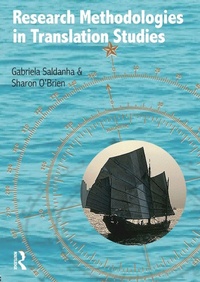
Research Methodologies in Translation Studies
1st Edition
Published on 6. February 2014
Book
Paperback/Softback
292 pages
978-1-909485-00-6 (ISBN)
Description
As an interdisciplinary area of research, translation studies attracts students and scholars with a wide range of backgrounds, who then need to face the challenge of accounting for a complex object of enquiry that does not adapt itself well to traditional methods in other fields of investigation. This book addresses the needs of such scholars - whether they are students doing research at postgraduate level or more experienced researchers who want to familiarize themselves with methods outside their current field of expertise. The book promotes a discerning and critical approach to scholarly investigation by providing the reader not only with the know-how but also with insights into how new questions can be fruitfully explored through the coherent integration of different methods of research. Understanding core principles of reliability, validity and ethics is essential for any researcher no matter what methodology they adopt, and a whole chapter is therefore devoted to these issues.
Research Methodologies in Translation Studies is divided into four different chapters, according to whether the research focuses on the translation product, the process of translation, the participants involved or the context in which translation takes place. An introductory chapter discusses issues of reliability, credibility, validity and ethics. The impact of our research depends not only on its quality but also on successful dissemination, and the final chapter therefore deals with what is also generally the final stage of the research process: producing a research report.
Research Methodologies in Translation Studies is divided into four different chapters, according to whether the research focuses on the translation product, the process of translation, the participants involved or the context in which translation takes place. An introductory chapter discusses issues of reliability, credibility, validity and ethics. The impact of our research depends not only on its quality but also on successful dissemination, and the final chapter therefore deals with what is also generally the final stage of the research process: producing a research report.
More details
Language
English
Place of publication
Manchester
United Kingdom
Target group
College/higher education
Dimensions
Height: 246 mm
Width: 174 mm
Thickness: 16 mm
Weight
525 gr
ISBN-13
978-1-909485-00-6 (9781909485006)
Copyright in bibliographic data and cover images is held by Nielsen Book Services Limited or by the publishers or by their respective licensors: all rights reserved.
Schweitzer Classification
Other editions
Additional editions

Gabriela Saldanha | Sharon O'Brien
Research Methodologies in Translation Studies
Book
09/2015
1st Edition
Routledge
€206.70
Shipment within 10-20 days
Gabriela Saldanha | Sharon O'Brien
Research Methodologies in Translation Studies
E-Book
04/2014
1st Edition
Routledge
€65.99
Available for download
Gabriela Saldanha | Sharon O'Brien
Research Methodologies in Translation Studies
E-Book
04/2014
1st Edition
Routledge
€65.99
Available for download
Persons
Gabriela Saldanha is a Lecturer in Translation Studies at the University of Birmingham, UK. She is co-editor of the second, revised edition of the Routledge Encyclopedia of Translation Studies (2009) and is on the editorial board of InTRAlinea and of Translation Studies Abstracts.
Sharon O'Brien is a Lecturer in Translation Studies at Dublin City University, Ireland. She is co-editor of St. Jerome's Translation Practices Explained series and a track editor for the journal Translation Spaces.
Sharon O'Brien is a Lecturer in Translation Studies at Dublin City University, Ireland. She is co-editor of St. Jerome's Translation Practices Explained series and a track editor for the journal Translation Spaces.
Content
1. Introduction 2. Principles and ethics in research 3. Product-oriented research 4. Process-oriented research 5. Participant-oriented research 6.Context-oriented research: case studies 7. Conclusion: The research report