

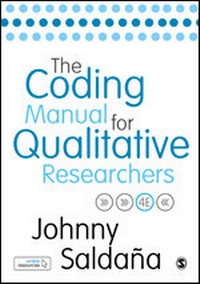
The Coding Manual for Qualitative Researchers
4th Edition
Published on 1. March 2021
Book
Paperback/Softback
440 pages
978-1-5297-3174-3 (ISBN)
Description
This invaluable manual from world-renowned expert Johnny Saldana illuminates the process of qualitative coding and provides clear, insightful guidance for qualitative researchers at all levels. The fourth edition includes a range of updates that build upon the huge success of the previous editions:
A structural reformat has increased accessibility; the 3 sections from the previous edition are now spread over 15 chapters for easier sectional reference
There are two new first cycle coding methods join the 33 others in the collection: Metaphor Coding and Themeing the Data: Categorically
Includes a brand new companion website with links to SAGE journal articles, sample transcripts, links to CAQDAS sites, student exercises, links to video and digital content
Analytic software screenshots and academic references have been updated, alongside several new figures added throughout the manual
It remains the only book that looks specifically at coding qualitative data, as a core but often neglected skill that researchers and students alike need to effectively make sense of their data and to identify patterns, before they can analyse the material.
Saldana presents a range of coding options with advantages and disadvantages to help researchers to choose the most appropriate approach for their project, reinforcing their perspective with real world examples, used to show step-by-step processes and to demonstrate important skills.
A structural reformat has increased accessibility; the 3 sections from the previous edition are now spread over 15 chapters for easier sectional reference
There are two new first cycle coding methods join the 33 others in the collection: Metaphor Coding and Themeing the Data: Categorically
Includes a brand new companion website with links to SAGE journal articles, sample transcripts, links to CAQDAS sites, student exercises, links to video and digital content
Analytic software screenshots and academic references have been updated, alongside several new figures added throughout the manual
It remains the only book that looks specifically at coding qualitative data, as a core but often neglected skill that researchers and students alike need to effectively make sense of their data and to identify patterns, before they can analyse the material.
Saldana presents a range of coding options with advantages and disadvantages to help researchers to choose the most appropriate approach for their project, reinforcing their perspective with real world examples, used to show step-by-step processes and to demonstrate important skills.
Reviews / Votes
This coding manual is the best go-to text for qualitative data analysis, both for a manual approach and for computer-assisted analysis. It offers a range of coding strategies applicable to any research projects, written in accessible language, making this text highly practical as well as theoretically comprehensive. -- Brigitte Smit With this expanded fourth edition of The Coding Manual for Qualitative Researchers, Saldana has proved to be an exemplary archivist of the field of qualitative methods, whilst never losing sight of the practical issues involved in inducting new researchers to the variety of coding methods available to them. His text provides great worked examples which build up understanding, skills and confidence around coding for the new researcher, whilst also enhancing established researchers' grasp of the key principles of coding. -- Margaret Hogg Johnny Saldana's Coding Manual for Qualitative Researchers has been an indispensable resource for students, teachers and practitioners since it was first published in 2009. With its expanded contents, new coding methods and more intuitive structure, the fourth edition deserves a prominent place on every qualitative researcher's bookshelf. -- Steven A. Harvey An essential text for qualitative research training and fieldwork. Along with updated examples and applications, Saldana's fourth edition introduces multiple new coding methods, solidifying this as the most comprehensive, practical qualitative coding guide on the market today. -- Kait Atkins This book really is the coding manual for qualitative researchers, both aspiring and seasoned. The text is well-organized and thorough. With several new methods included in the fourth edition, this is an essential reference text for qualitative analysts. -- Erin CooneyMore details
Edition
4th Revised edition
Language
English
Place of publication
London
United Kingdom
Target group
College/higher education
Edition type
Revised edition
Dimensions
Height: 242 mm
Width: 170 mm
Weight
756 gr
ISBN-13
978-1-5297-3174-3 (9781529731743)
Copyright in bibliographic data and cover images is held by Nielsen Book Services Limited or by the publishers or by their respective licensors: all rights reserved.
Schweitzer Classification
Other editions
New editions
Johnny Saldana
The Coding Manual for Qualitative Researchers
Book
03/2025
5th Edition
SAGE Publications Ltd
€51.00
Available immediately
Additional editions
Johnny Saldana
The Coding Manual for Qualitative Researchers
E-Book
01/2021
4th Edition
SAGE Publications Ltd
€153.99
Available for download
Johnny Saldana
The Coding Manual for Qualitative Researchers
E-Book
01/2021
4th Edition
SAGE Publications Ltd
€153.99
Available for download
Johnny Saldana
The Coding Manual for Qualitative Researchers
E-Book
01/2021
4th Edition
SAGE Publications Ltd
€154.99
Available for download
Previous edition
Johnny Saldana
The Coding Manual for Qualitative Researchers
Book
11/2015
3rd Edition
SAGE Publications Ltd
€63.32
Article exhausted; check for reprint
Person
Johnny Saldana is Professor Emeritus from Arizona State University's (ASU) School of Film, Dance, and Theatre in the Herberger Institute for Design and the Arts, where he taught from 1981 to 2014. He received his BFA in Drama and English Education in 1976, and MFA in Drama Education in 1979 from the University of Texas at Austin.
Saldana is the author of Longitudinal Qualitative Research: Analyzing Change through Time (AltaMira Press, 2003); Fundamentals of Qualitative Research (Oxford University Press, 2011); Ethnotheatre: Research from Page to Stage (Left Coast Press, 2011); Thinking Qualitatively: Methods of Mind (Sage Publications, 2015); a commissioned title for Routledge's World Library of Educationalists Series, Writing Qualitatively: The Selected Works of Johnny Saldana (Routledge, 2018); co-author with the late Matthew B. Miles and A. Michael Huberman for Qualitative Data Analysis: A Methods Sourcebook (4th ed., Sage Publications, 2020); co-author with Matt Omasta for Qualitative Research: Analyzing Life (Sage Publications, 2018); and the editor of Ethnodrama: An Anthology of Reality Theatre (AltaMira Press, 2005). Previous editions of The Coding Manual for Qualitative Researchers have been translated into Korean, Turkish, and Chinese-Simplified.
Saldana's methods works have been cited and referenced in more than 16,000 research studies conducted in over 130 countries in disciplines such as K-12 and higher education, medicine and health care, technology and social media, business and economics, government and social services, the fine arts, the social sciences, human development, and communication. He has published a wide range of research articles in journals such as Research in Drama Education, The Qualitative Report, Multicultural Perspectives, Youth Theatre Journal, Journal of Curriculum and Pedagogy, Teaching Theatre, Research Studies in Music Education, Cultural Studies ? Critical Methodologies, the International Journal of Qualitative Methods, the International Review of Qualitative Research, and Qualitative Inquiry, and has contributed several chapters to research methods handbooks. His most popular journal article, "Blue-Collar Qualitative Research: A Rant" (Qualitative Inquiry, 2014), has been downloaded by over 3,000 readers, according to ResearchGate.
Saldana's research in qualitative inquiry, data analysis, and performance ethnography has received awards from the American Alliance for Theatre & Education, the National Communication Association-Ethnography Division, the American Educational Research Association's Qualitative Research Special Interest Group, New York University's Program in Educational Theatre, the Children's Theatre Foundation of America, and the ASU Herberger Institute for Design and the Arts.
Saldana is the author of Longitudinal Qualitative Research: Analyzing Change through Time (AltaMira Press, 2003); Fundamentals of Qualitative Research (Oxford University Press, 2011); Ethnotheatre: Research from Page to Stage (Left Coast Press, 2011); Thinking Qualitatively: Methods of Mind (Sage Publications, 2015); a commissioned title for Routledge's World Library of Educationalists Series, Writing Qualitatively: The Selected Works of Johnny Saldana (Routledge, 2018); co-author with the late Matthew B. Miles and A. Michael Huberman for Qualitative Data Analysis: A Methods Sourcebook (4th ed., Sage Publications, 2020); co-author with Matt Omasta for Qualitative Research: Analyzing Life (Sage Publications, 2018); and the editor of Ethnodrama: An Anthology of Reality Theatre (AltaMira Press, 2005). Previous editions of The Coding Manual for Qualitative Researchers have been translated into Korean, Turkish, and Chinese-Simplified.
Saldana's methods works have been cited and referenced in more than 16,000 research studies conducted in over 130 countries in disciplines such as K-12 and higher education, medicine and health care, technology and social media, business and economics, government and social services, the fine arts, the social sciences, human development, and communication. He has published a wide range of research articles in journals such as Research in Drama Education, The Qualitative Report, Multicultural Perspectives, Youth Theatre Journal, Journal of Curriculum and Pedagogy, Teaching Theatre, Research Studies in Music Education, Cultural Studies ? Critical Methodologies, the International Journal of Qualitative Methods, the International Review of Qualitative Research, and Qualitative Inquiry, and has contributed several chapters to research methods handbooks. His most popular journal article, "Blue-Collar Qualitative Research: A Rant" (Qualitative Inquiry, 2014), has been downloaded by over 3,000 readers, according to ResearchGate.
Saldana's research in qualitative inquiry, data analysis, and performance ethnography has received awards from the American Alliance for Theatre & Education, the National Communication Association-Ethnography Division, the American Educational Research Association's Qualitative Research Special Interest Group, New York University's Program in Educational Theatre, the Children's Theatre Foundation of America, and the ASU Herberger Institute for Design and the Arts.
Content
Part I: Coding Foundations
Chapter 1: An Introduction to Codes and Coding
Chapter 2: Fundamental Coding Methods and Techniques
Chapter 3: Writing Analytic Memos about Narrative and Visual Data
Part II: First Cycle Coding Methods
Chapter 4: Selecting First Cycle Coding Methods
Chapter 5: Grammatical Coding Methods
Chapter 6: Elemental Coding Methods
Chapter 7: Affective Coding Methods
Chapter 8: Literary and Language Coding Methods
Chapter 9: Exploratory Coding Methods
Chapter 10: Procedural Coding Methods
Chapter 11: Methods of Themeing the Data
Part III: Second Cycle Coding Methods
Chapter 12: Transitioning from First to Second Cycle Coding Methods
Chapter 13: Second Cycle Grounded Theory Coding Methods
Chapter 14: Second Cycle Cumulative Coding Methods
Chapter 15: After First and Second Cycle Coding Methods
Chapter 1: An Introduction to Codes and Coding
Chapter 2: Fundamental Coding Methods and Techniques
Chapter 3: Writing Analytic Memos about Narrative and Visual Data
Part II: First Cycle Coding Methods
Chapter 4: Selecting First Cycle Coding Methods
Chapter 5: Grammatical Coding Methods
Chapter 6: Elemental Coding Methods
Chapter 7: Affective Coding Methods
Chapter 8: Literary and Language Coding Methods
Chapter 9: Exploratory Coding Methods
Chapter 10: Procedural Coding Methods
Chapter 11: Methods of Themeing the Data
Part III: Second Cycle Coding Methods
Chapter 12: Transitioning from First to Second Cycle Coding Methods
Chapter 13: Second Cycle Grounded Theory Coding Methods
Chapter 14: Second Cycle Cumulative Coding Methods
Chapter 15: After First and Second Cycle Coding Methods