

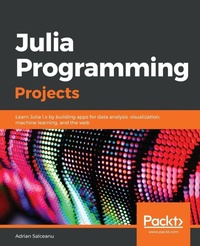
Julia Programming Projects
Learn Julia 1.x by building apps for data analysis, visualization, machine learning, and the web
Published on 26. December 2018
Book
Paperback/Softback
500 pages
978-1-78829-274-0 (ISBN)
Description
A step-by-step guide that demonstrates how to build simple-to-advanced applications through examples in Julia Lang 1.x using modern tools
Key Features
Work with powerful open-source libraries for data wrangling, analysis, and visualization
Develop full-featured, full-stack web applications
Learn to perform supervised and unsupervised machine learning and time series analysis with Julia
Book DescriptionJulia is a new programming language that offers a unique combination of performance and productivity. Its powerful features, friendly syntax, and speed are attracting a growing number of adopters from Python, R, and Matlab, effectively raising the bar for modern general and scientific computing.
After six years in the making, Julia has reached version 1.0. Now is the perfect time to learn it, due to its large-scale adoption across a wide range of domains, including fintech, biotech, education, and AI.
Beginning with an introduction to the language, Julia Programming Projects goes on to illustrate how to analyze the Iris dataset using DataFrames. You will explore functions and the type system, methods, and multiple dispatch while building a web scraper and a web app. Next, you'll delve into machine learning, where you'll build a books recommender system. You will also see how to apply unsupervised machine learning to perform clustering on the San Francisco business database. After metaprogramming, the final chapters will discuss dates and time, time series analysis, visualization, and forecasting.
We'll close with package development, documenting, testing and benchmarking.
By the end of the book, you will have gained the practical knowledge to build real-world applications in Julia.What you will learn
Leverage Julia s strengths, its top packages, and main IDE options
Analyze and manipulate datasets using Julia and DataFrames
Write complex code while building real-life Julia applications
Develop and run a web app using Julia and the HTTP package
Build a recommender system using supervised machine learning
Perform exploratory data analysis
Apply unsupervised machine learning algorithms
Perform time series data analysis, visualization, and forecasting
Who this book is forData scientists, statisticians, business analysts, and developers who are interested in learning how to use Julia to crunch numbers, analyze data and build apps will find this book useful. A basic knowledge of programming is assumed.
Key Features
Work with powerful open-source libraries for data wrangling, analysis, and visualization
Develop full-featured, full-stack web applications
Learn to perform supervised and unsupervised machine learning and time series analysis with Julia
Book DescriptionJulia is a new programming language that offers a unique combination of performance and productivity. Its powerful features, friendly syntax, and speed are attracting a growing number of adopters from Python, R, and Matlab, effectively raising the bar for modern general and scientific computing.
After six years in the making, Julia has reached version 1.0. Now is the perfect time to learn it, due to its large-scale adoption across a wide range of domains, including fintech, biotech, education, and AI.
Beginning with an introduction to the language, Julia Programming Projects goes on to illustrate how to analyze the Iris dataset using DataFrames. You will explore functions and the type system, methods, and multiple dispatch while building a web scraper and a web app. Next, you'll delve into machine learning, where you'll build a books recommender system. You will also see how to apply unsupervised machine learning to perform clustering on the San Francisco business database. After metaprogramming, the final chapters will discuss dates and time, time series analysis, visualization, and forecasting.
We'll close with package development, documenting, testing and benchmarking.
By the end of the book, you will have gained the practical knowledge to build real-world applications in Julia.What you will learn
Leverage Julia s strengths, its top packages, and main IDE options
Analyze and manipulate datasets using Julia and DataFrames
Write complex code while building real-life Julia applications
Develop and run a web app using Julia and the HTTP package
Build a recommender system using supervised machine learning
Perform exploratory data analysis
Apply unsupervised machine learning algorithms
Perform time series data analysis, visualization, and forecasting
Who this book is forData scientists, statisticians, business analysts, and developers who are interested in learning how to use Julia to crunch numbers, analyze data and build apps will find this book useful. A basic knowledge of programming is assumed.
More details
Language
English
Place of publication
Birmingham
United Kingdom
Target group
Professional and scholarly
Dimensions
Height: 235 mm
Width: 191 mm
Thickness: 27 mm
Weight
924 gr
ISBN-13
978-1-78829-274-0 (9781788292740)
Copyright in bibliographic data and cover images is held by Nielsen Book Services Limited or by the publishers or by their respective licensors: all rights reserved.
Schweitzer Classification
Other editions
Additional editions
Adrian Salceanu
Julia Programming Projects
Learn Julia 1.x by building apps for data analysis, visualization, machine learning, and the web
E-Book
09/2024
1st Edition
Packt Publishing Limited
€41.49
Available for download
Person
Adrian Salceanu has been a professional software developer for over 15 years. For the last 10 years, he has been leading agile teams in developing real-time, data-intensive web and mobile products. Adrian is a public speaker and an enthusiastic contributor to the open source community, focusing on high-performance web development. He is the organizer of the Barcelona Julia Users group and the creator of Genie, a high-performance, highly productive Julia web framework. Adrian has a master's degree in computing and a postgraduate degree in advanced computer science.
Content
Table of Contents
Getting started with Julia Programming
Creating Our First Julia App
Setting Up the Wiki Game
Building the Wiki Game Web Crawler
Adding a Web UI for the Wiki Game
Implementing Recommender Sytems with Julia
Machine Learning For Recommender Systems
Leveraging Unsupervised Learning Techniques
Working with Dates, Time, and Time Series
Time Series Forecasting
Creating Julia Packages
Getting started with Julia Programming
Creating Our First Julia App
Setting Up the Wiki Game
Building the Wiki Game Web Crawler
Adding a Web UI for the Wiki Game
Implementing Recommender Sytems with Julia
Machine Learning For Recommender Systems
Leveraging Unsupervised Learning Techniques
Working with Dates, Time, and Time Series
Time Series Forecasting
Creating Julia Packages