

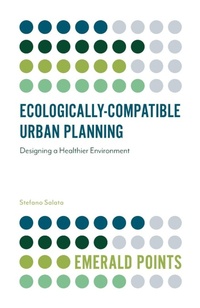
Ecologically-Compatible Urban Planning
Designing a Healthier Environment
Published on 18. October 2019
Book
Paperback/Softback
184 pages
978-1-78973-784-4 (ISBN)
Description
Ecosystem service mapping is a fundamental part of developing healthier cities and ensuring environmentally-oriented land use.
Ecologically-Compatible Urban Planning: Designing a Healthier Environment demonstrates that renewed collaboration between environmental scientists and urban planners is essential in reforming the traditional method of urban planning to meet the emerging issues posed by contemporary living in urban areas affected by climate change. The first part introduces the reader to the main challenges in urban planning by explaining how changing conditions require a new approach to spatial policies and a more ecological-oriented approach to the city. Part two demonstrates how the traditional approach to the ecological study of urban systems should be integrated with new competences to aid the decision-making phase during urban planning. Part three presents case studies that demonstrate how urban areas are vulnerable to climate conditions and how changing scenarios affect quality of life.
This book demonstrates how to bridge the gap between the theoretical assessment of ecosystem service and its real utilization for land use planning practices.
Ecologically-Compatible Urban Planning: Designing a Healthier Environment demonstrates that renewed collaboration between environmental scientists and urban planners is essential in reforming the traditional method of urban planning to meet the emerging issues posed by contemporary living in urban areas affected by climate change. The first part introduces the reader to the main challenges in urban planning by explaining how changing conditions require a new approach to spatial policies and a more ecological-oriented approach to the city. Part two demonstrates how the traditional approach to the ecological study of urban systems should be integrated with new competences to aid the decision-making phase during urban planning. Part three presents case studies that demonstrate how urban areas are vulnerable to climate conditions and how changing scenarios affect quality of life.
This book demonstrates how to bridge the gap between the theoretical assessment of ecosystem service and its real utilization for land use planning practices.
Reviews / Votes
This pocket-size overview of environmental planning for urban land use offers plain language, bullets, and numbered lists to explain a framework for mapping ecosystem services in land use plans, using InVEST, an open-source software model. The framework seeks to promote collaboration between environmental scientists and urban planners and to promote ecological approaches to spatial policies and urban planning. After an introduction to challenges in urban planning, the book describes how to integrate the new methods for planning and decision-making in urban planning and presents two case studies: mapping air quality in urban areas, and indicators of sustainability and resilience in urban ecosystem services. Distributed in North America by Turpin Distribution. -- Annotation (c)2019 * (protoview.com) *More details
Series
Language
English
Place of publication
Bingley
United Kingdom
Target group
Professional and scholarly
Dimensions
Height: 198 mm
Width: 129 mm
Thickness: 10 mm
Weight
203 gr
ISBN-13
978-1-78973-784-4 (9781789737844)
Copyright in bibliographic data and cover images is held by Nielsen Book Services Limited or by the publishers or by their respective licensors: all rights reserved.
Schweitzer Classification
Other editions
Additional editions
E-Book
10/2019
1st Edition
Emerald Publishing Limited
€36.99
Available for download
Person
Stefano Salata is a Research Technologist in the Inter-University Department of Regional and Urban Studies and Planning, Politecnico di Torino, Italy. His research interests include land-use change analysis and its environmental effects.
Content
Part 1. Planning in the Contemporary City: Do Urban Plans Still Matter? Chapter 1. The Contemporary City
Chapter 2. Towards the Paradigm of 'Eco-Systemic Planning'
Chapter 3. Eco-Systemic Planning Reform
Part 2. Acquiring New Competencies
Chapter 4. Ecosystem Service Mapping in Land Use Plans: Modelling with InVEST
Part 3. Case Studies
Chapter 5. Case Study One
Chapter 6. Case Study Two: Resilience is Not Sustainability
Chapter 7. General Conclusions
Chapter 2. Towards the Paradigm of 'Eco-Systemic Planning'
Chapter 3. Eco-Systemic Planning Reform
Part 2. Acquiring New Competencies
Chapter 4. Ecosystem Service Mapping in Land Use Plans: Modelling with InVEST
Part 3. Case Studies
Chapter 5. Case Study One
Chapter 6. Case Study Two: Resilience is Not Sustainability
Chapter 7. General Conclusions