

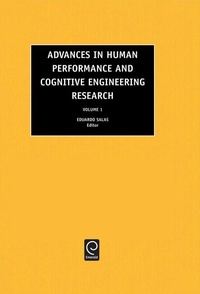
Advances in Human Performance and Cognitive Engineering Research
Published on 10. May 2001
Book
Hardback
352 pages
978-0-7623-0748-7 (ISBN)
Description
This volume launches a series that will focus on providing chapters that advance our understanding of human performance in organizational systems as cognitive engineering principles are applied. Topics addressed in this volume include: a historical review of a cognitive engineering research at a national laboratory; an adaptive learning system approach to designing an integrated-embedded training system; application of PRONET, a method that provides a useful representation of sequences of behaviour in a human-machine interaction; application of CTA, a method to explain the mental processes involved in performing a task; application of human performance modelling technologies in system design and evaluation; a review of training critical thinking skills that individuals and teams require in changing environments; a review of commercial simulations for team research; and research paradigms for human performance research in complex systems.
More details
Series
Language
English
Place of publication
United States
Publishing group
Emerald Publishing Limited
Target group
Professional and scholarly
Dimensions
Height: 231 mm
Width: 155 mm
Thickness: 23 mm
Weight
638 gr
ISBN-13
978-0-7623-0748-7 (9780762307487)
Copyright in bibliographic data and cover images is held by Nielsen Book Services Limited or by the publishers or by their respective licensors: all rights reserved.
Schweitzer Classification
Person
Content
Preface. Cognitive engineering research at Riso from 1962-1979 (K.J. Vicente). Developing adaptability: a theory for the design of integrated-embedded training systems (S.W.J. Kozlowski et al.). Using pathfinder networks to analyze procedural knowledge in interactions with advanced technology (D.J. Gillan, N.J. Cooke). Some guidelines for conducting a cognitive task analysis (G. Klein, L. Militello). The application of human modeling technology to the design, evaluation and operation of complex systems (W. Zachary et al.). Training teams to take initiative: critical thinking in novel situations (M.S. Cohen, B.B. Thompson). Use of commercial, off-the-shelf, simulations for team research (C.A. Bowers, F. Jentsch). Understanding human performance in complex environments: research paradigms and emerging application areas (J.M. Hitt II, et al.).