

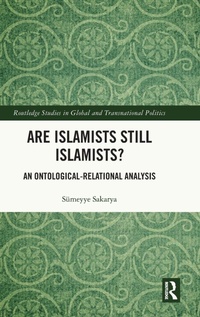
Are Islamists Still Islamists?
An Ontological-Relational Analysis
1st Edition
Published on 18. September 2025
Book
Hardback
184 pages
978-1-032-91249-3 (ISBN)
Description
This book offers an ontological study of Islamism and its transformation with a specific focus on Tuerkiye, Bangladesh, and Senegal.
The dominant reading of the transformation of Islamism from a discernibly Islamist, then anti-systemic discourse to a more systemic one has been through the arguments of post-Islamism, which claim the failure and end of Islamism. However, this assumes that Islamists are still Islamists, which is an oxymoron. This book suggests that this scholarship fails to recognise the political, ontological nature of Islamism. It argues that under-theorisation of the political, accompanied by Eurocentrism and positivism, hinders a proper understanding of Islamism by engendering methodological nationalism and state-centrism and obstructing Islamists as political actors by denying them political agency to undertake transformation. This shows the need for an ontological analysis to surmount the mentioned problems and comprehend Islamists as political actors by disarticulating any necessary relationship between the political and any fixed entity, such as the state, a specific rhetoric or form. The book, as an exercise in political theory, offers such an analysis, articulated through the tools provided by post-foundationalist political theory, particularly the works of Martin Heidegger, Antonio Gramsci, Hannah Arendt, and Salman Sayyid, who mobilises Carl Schmitt and post-Marxist discourse theory to read Islamism.
This book will appeal to scholars and students of Politics, International Relations, Area Studies, and Sociology, especially those specialising in Islam and Islamism.
The dominant reading of the transformation of Islamism from a discernibly Islamist, then anti-systemic discourse to a more systemic one has been through the arguments of post-Islamism, which claim the failure and end of Islamism. However, this assumes that Islamists are still Islamists, which is an oxymoron. This book suggests that this scholarship fails to recognise the political, ontological nature of Islamism. It argues that under-theorisation of the political, accompanied by Eurocentrism and positivism, hinders a proper understanding of Islamism by engendering methodological nationalism and state-centrism and obstructing Islamists as political actors by denying them political agency to undertake transformation. This shows the need for an ontological analysis to surmount the mentioned problems and comprehend Islamists as political actors by disarticulating any necessary relationship between the political and any fixed entity, such as the state, a specific rhetoric or form. The book, as an exercise in political theory, offers such an analysis, articulated through the tools provided by post-foundationalist political theory, particularly the works of Martin Heidegger, Antonio Gramsci, Hannah Arendt, and Salman Sayyid, who mobilises Carl Schmitt and post-Marxist discourse theory to read Islamism.
This book will appeal to scholars and students of Politics, International Relations, Area Studies, and Sociology, especially those specialising in Islam and Islamism.
More details
Series
Language
English
Place of publication
London
United Kingdom
Publishing group
Taylor & Francis Ltd
Target group
College/higher education
Professional and scholarly
Academic, Postgraduate, and Undergraduate Advanced
Dimensions
Height: 240 mm
Width: 161 mm
Thickness: 15 mm
Weight
464 gr
ISBN-13
978-1-032-91249-3 (9781032912493)
Copyright in bibliographic data and cover images is held by Nielsen Book Services Limited or by the publishers or by their respective licensors: all rights reserved.
Schweitzer Classification
Other editions
Additional editions
E-Book
09/2025
1st Edition
Routledge
€60.99
Available for download
E-Book
09/2025
1st Edition
Routledge
€60.99
Available for download
Person
Suemeyye Sakarya is an assistant professor in the Department of Political Science and Public Administration in the Faculty of Political Sciences at Ankara University, Tuerkiye.
Content
Introduction Chapter 1- An Odyssey of Oblivion: Ontology, Islamism and the Political Chapter 2 - Politics: Post-Islamism Chapter 3 - Almost Political: Weak Orientalism Chapter 4 - The Political Chapter 5 - Relationality as a Way Out from Methodological Nationalism Chapter 6 - Transnational Kemalism: A Ghost Haunting the Muslim World Chapter 7 - Islamisation as Passive Revolution Chapter 8 - Kemalism Strikes Back Conclusion