

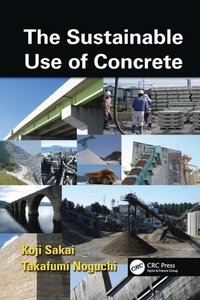
The Sustainable Use of Concrete
1st Edition
Published on 31. March 2017
Book
Paperback/Softback
188 pages
978-1-138-07588-7 (ISBN)
Description
Cement-based concrete has excellent properties as a construction material, and the raw materials of cement-rocks, and limestone and clay-are bountiful. Yet its production generates high quantities of CO2, making it a potentially unsustainable material. However, there are no alternatives to concrete and steel as basic methods for development of socioeconomic infrastructure at this time. Highlighting sustainability issues in the construction industry, The Sustainable Use of Concrete presents guidelines on how to move toward sustainable concrete construction.
The book begins by clarifying the historic background and meaning of sustainability, after which it outlines areas that need to be considered in connection with sustainability in the concrete and construction field. It examines environmental, social and cultural, and economic aspects, then considers an evaluation system of sustainability. The authors include various tools and ISO standards, and then explore technologies for sustainability, with case studies and examples that promote understanding of current technologies.
Although the construction sector, in the broadest sense, has come to recognize that infrastructure development over the past two centuries has been unsustainable, it has been slow to adjust. Comprehensive information and relevant practical guidance are very scarce. This book lays out a roadmap for creating a human-friendly and safe environment with low environmental burden.
The book begins by clarifying the historic background and meaning of sustainability, after which it outlines areas that need to be considered in connection with sustainability in the concrete and construction field. It examines environmental, social and cultural, and economic aspects, then considers an evaluation system of sustainability. The authors include various tools and ISO standards, and then explore technologies for sustainability, with case studies and examples that promote understanding of current technologies.
Although the construction sector, in the broadest sense, has come to recognize that infrastructure development over the past two centuries has been unsustainable, it has been slow to adjust. Comprehensive information and relevant practical guidance are very scarce. This book lays out a roadmap for creating a human-friendly and safe environment with low environmental burden.
Reviews / Votes
"It is a useful reference book [and] gives a good overview of the subject. The level of writing is suitable for an undergraduate materials or civil engineering student."-Dr. Jacqueline Glass, Senior Lecturer in Architecture and Sustainable Construction, Loughborough University, UK
"... a logical approach ... would definitely buy it - authoritative and forward looking ... A rigorous approach to best practice ... an excellent book with plenty of useful info and well conducted research and analysis ..."
-Martin Clarke, Chief Executive, British Precast Concrete Federation
"... presents guidelines on how to move toward sustainable concrete construction. ... Ultimately, it provides guidance for creating a world that is safe for both humans and the environment."
-Concrete international, June 2013 "It is a useful reference book [and] gives a good overview of the subject. The level of writing is suitable for an undergraduate materials or civil engineering student."
-Dr. Jacqueline Glass, Senior Lecturer in Architecture and Sustainable Construction, Loughborough University, UK
"... a logical approach ... would definitely buy it - authoritative and forward looking ... A rigorous approach to best practice ... an excellent book with plenty of useful info and well conducted research and analysis ..."
-Martin Clarke, Chief Executive, British Precast Concrete Federation
"... presents guidelines on how to move toward sustainable concrete construction. ... Ultimately, it provides guidance for creating a world that is safe for both humans and the environment."
-Concrete international, June 2013
More details
Language
English
Place of publication
London
United Kingdom
Publishing group
Taylor & Francis Ltd
Target group
College/higher education
Professional and scholarly
Postgraduate and Professional
Illustrations
128 s/w Abbildungen, 38 s/w Tabellen
38 Tables, black and white; 128 Illustrations, black and white
Dimensions
Height: 234 mm
Width: 156 mm
Thickness: 10 mm
Weight
298 gr
ISBN-13
978-1-138-07588-7 (9781138075887)
Copyright in bibliographic data and cover images is held by Nielsen Book Services Limited or by the publishers or by their respective licensors: all rights reserved.
Schweitzer Classification
Other editions
Additional editions
Koji Sakai | Takafumi Noguchi
The Sustainable Use of Concrete
E-Book
08/2012
1st Edition
CRC Press
€119.99
Available for download
Koji Sakai | Takafumi Noguchi
The Sustainable Use of Concrete
Book
08/2012
1st Edition
CRC Press
€297.20
Shipment within 15-20 days
Koji Sakai | Takafumi Noguchi
The Sustainable Use of Concrete
E-Book
08/2012
1st Edition
CRC Press
€119.99
Available for download
Persons
Koji Sakai is a Professor at Kagawa University, Japan. He chairs ISO/TC71/SC8 on environmental management for concrete and concrete structures, fib commission 3 on environmental aspects of design and construction, and the Japan Concrete Institute Technical Committee on sustainability.
Takafumi Noguchi is an Associate Professor at the University of Tokyo, Japan and secretary of ISO/TC71/SC8, fib commission 3, and the Japan Concrete Institute Technical Committee on sustainability
Takafumi Noguchi is an Associate Professor at the University of Tokyo, Japan and secretary of ISO/TC71/SC8, fib commission 3, and the Japan Concrete Institute Technical Committee on sustainability
Content
1. Sustainability 2. Sustainability in Concrete and Construction 3. Evaluation System of Sustainability 4. Technologies for Sustainability 5. Case Studies 6. Future Perspectives