


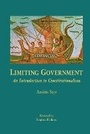
Limiting Government
An Introduction to Constitutionalism
Published on 1. January 1999
Book
Hardback
308 pages
978-963-9116-25-2 (ISBN)
Description
Until the previous decade, constitutionalism in Eastern Europe was considered to be an outmoded concept of the nineteenth century. Changes in the region, however, have brought back the fundamental question of the need to restrict government power through social self-binding.
This book discusses the mechanisms of such restriction, including different forms of the separation of powers and constitutional review. It relates the theoretical and practical importance of the issue to the present world-wide discontent with majoritarian democracy and the growing disrepute of parliaments. Increasing executive efficiency is, however, a threat to fundamental rights, and the battlecry of efficiency is often only a means to new despotism and inefficiency. A careful re-evaluation of the concept of constitutionalism assists in the search for a useful balance between majoritarianism and rights, and in the avoidance of all forms of public tyranny.
Written in non-technical language and using the most important English, American, French, and German examples of constitutional history, the book also examines East European (in particular, Russian) and Latin American examples, in part to illustrate certain dead-ends in constitutional development. It is intended to be an introduction for all those concerned with liberty.
This book discusses the mechanisms of such restriction, including different forms of the separation of powers and constitutional review. It relates the theoretical and practical importance of the issue to the present world-wide discontent with majoritarian democracy and the growing disrepute of parliaments. Increasing executive efficiency is, however, a threat to fundamental rights, and the battlecry of efficiency is often only a means to new despotism and inefficiency. A careful re-evaluation of the concept of constitutionalism assists in the search for a useful balance between majoritarianism and rights, and in the avoidance of all forms of public tyranny.
Written in non-technical language and using the most important English, American, French, and German examples of constitutional history, the book also examines East European (in particular, Russian) and Latin American examples, in part to illustrate certain dead-ends in constitutional development. It is intended to be an introduction for all those concerned with liberty.
More details
Edition
Bilingual edition
Language
English
Other
Place of publication
Amsterdam
Hungary
Target group
College/higher education
Professional and scholarly
Edition type
Bilingual edition
Product notice
sewn/stitched
Dimensions
Height: 236 mm
Width: 161 mm
Thickness: 31 mm
Weight
617 gr
ISBN-13
978-963-9116-25-2 (9789639116252)
Copyright in bibliographic data and cover images is held by Nielsen Book Services Limited or by the publishers or by their respective licensors: all rights reserved.
Schweitzer Classification
Other editions
Additional editions
Book
01/1999
Central European University Press
€56.95
Article not available at the moment
E-Book
01/1999
Central European University Press
€27.99
Available for download
Person
Andras Sajo is Professor of Comparative Constitutional Law at Central European University, Budapest. He participated in half a dozen constitutional reforms in Eastern Europe. He has published extensively on the theory of rights, judicial review and social change.
Content
Introduction
Chapter 1: The constitution as fear and acceptance
Chapter 2: The taming of democracy
Chapter 3: Dangerous liaisons: checks and balances and the separation of powers
Chapter 4: Parliamentarism and the legislative branch
Chapter 5: The executive power
Chapter 6: The rule-of-law state and its executors
Chapter 7: Constitutional adjudication
Chapter 8: Fundamental rights
Chapter 1: The constitution as fear and acceptance
Chapter 2: The taming of democracy
Chapter 3: Dangerous liaisons: checks and balances and the separation of powers
Chapter 4: Parliamentarism and the legislative branch
Chapter 5: The executive power
Chapter 6: The rule-of-law state and its executors
Chapter 7: Constitutional adjudication
Chapter 8: Fundamental rights