

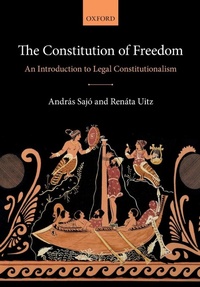
The Constitution of Freedom
An Introduction to Legal Constitutionalism
Published on 26. September 2019
Book
Paperback/Softback
504 pages
978-0-19-873218-1 (ISBN)
Description
Constitutional democracy is more fragile and less 'natural' than autocracy. While this may sound surprising to complacent democrats, more and more people find autocracy attractive, because they were never forced to understand or imagine what despotism is. Generations who have lived in stable democracies with the promise that their enviable world will become the global 'normal' find government rule without constitutionalism difficult to conceive. It is difficult, but never too late, to see one's own constitutional system as something that is fragile, or up for grabs and in need of constant attention and care. In this book, Andras Sajo and Renata Uitz explore how constitutionalism protects us and how it might be undone by its own means.
Sajo and Uitz's intellectual history of the constitutional ideal is rich in contextual detail and informed by case studies that give an overview of both the theory and practice of constitutionalism worldwide. Classic constitutions are contrasted with twentieth-century and contemporary endeavours, and experimentations in checks and balances. Their endeavour is neither apologetic (and certainly not celebratory), nor purely defensive: this book demonstrates why constitutionalism should continue to matter. Between the rise of populist, anti-constitutional sentiment and the normalization of the apparatus of counter-terrorism, it is imperative that the political communities who seek to sustain democracy as freedom understand the importance of constitutionalism. This book is essential reading for students of law and general readers without prior knowledge of the field, as well as those in politics who believe they know how government works. It shows what is at stake in the debate on constitutionalism.
Sajo and Uitz's intellectual history of the constitutional ideal is rich in contextual detail and informed by case studies that give an overview of both the theory and practice of constitutionalism worldwide. Classic constitutions are contrasted with twentieth-century and contemporary endeavours, and experimentations in checks and balances. Their endeavour is neither apologetic (and certainly not celebratory), nor purely defensive: this book demonstrates why constitutionalism should continue to matter. Between the rise of populist, anti-constitutional sentiment and the normalization of the apparatus of counter-terrorism, it is imperative that the political communities who seek to sustain democracy as freedom understand the importance of constitutionalism. This book is essential reading for students of law and general readers without prior knowledge of the field, as well as those in politics who believe they know how government works. It shows what is at stake in the debate on constitutionalism.
Reviews / Votes
The book's strength - both as an accessible explanation and a passionate defense of liberal constitutionalism - is undeniable, and as such it deserves the attention of students of law and many a constitutional scholar alike * Julian Scholtes, International Journal of Constitutional Law * Against the backdrop of democratic retrogression worldwide, this introductory book to legal constitutionalism makes a timely and significant contribution to the study of contemporary constitutions. With their deep understanding of liberal democratic constitutionalism, the authors rightly remind us that 'limiting majority rule in democracy helps democracy', and 'curbing majority sentiment serves objects which are at the core of constitutionalism'. * Wen-Chen Chang, National Taiwan University * A brilliantly probing inquiry into the fragility of constitutionalism in an illiberal age. With enviable erudition and a delicious wit, Sajo and Uitz have mined the history of constitutional theory and practice to illuminate the challenges we face in struggling to preserve our threatened liberties today. * Stephen Holmes, Walter E. Meyer Professor of Law, New York University School of Law * We live in an age of disillusionment with constitutionalism. This book is just right for that age: Sajo and Uitz provide a comprehensive defence of constitutionalist principles and practices that moves beyond the naive enthusiasm of the last two decades and that is deeply informed by comparisons of different legal experiences around the globe. In a unique way, they take seriously the new scepticism about constitutions as political panaceas and yet make a sound case as to why they remain indispensable for enabling modern freedom. * Jan-Werner Mueller, Professor, Department of Politics, Princeton University *More details
Language
English
Place of publication
Oxford
United Kingdom
Target group
College/higher education
Dimensions
Height: 244 mm
Width: 170 mm
Thickness: 27 mm
Weight
854 gr
ISBN-13
978-0-19-873218-1 (9780198732181)
Copyright in bibliographic data and cover images is held by Nielsen Book Services Limited or by the publishers or by their respective licensors: all rights reserved.
Schweitzer Classification
Persons
Andras Sajo is a judge (2008) and past vice-president (2015-2017) of the European Court of Human Rights. He is also a University Professor at the Central European University and Global Visiting Professor of Law at New York University Law School. He is the author and editor of numerous books on comparative constitutional law, including the Oxford Handbook of Comparative Constitutional Law, with Michel Rosenfeld.
Renata Uitz is professor and chair of the comparative constitutional law program at the Central European University.
Renata Uitz is professor and chair of the comparative constitutional law program at the Central European University.
Content
- Introduction
- 1: Constitutions and Constitutionalism
- 2: Conditions for a Constitution
- 3: Democracy, or Taming an Unruly Friend
- 4: Dangerous Liaisons: Separation of Powers and Checks and Balances
- 5: Federalism
- 6: Parliamentarism and the Legislative Branch
- 7: The Executive Power
- 8: The Rule of Law and Its Executors
- 9: Who Guards the Guardians? Constitutional Adjudication
- 10: Rights
- 11: Constitutions Under Stress
- 12: Multi-layered Constitutionalism, Globalization and the Revival of the Nation State