

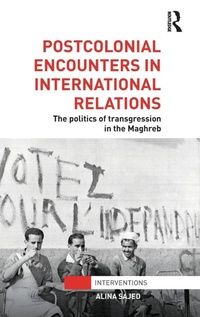
Postcolonial Encounters in International Relations
The Politics of Transgression in the Maghreb
1st Edition
Published on 27. June 2013
Book
Hardback
256 pages
978-0-415-78172-5 (ISBN)
Description
Postcolonial Encounters in International Relations examines the social and cultural aspects of the political violence that underpinned the French colonial project in the Maghreb, and the multi-layered postcolonial realities that ensued.
This book explores the reality of the lives of North African migrants in postcolonial France, with a particular focus on their access to political entitlements such as citizenship and rights. This reality is complicated even further by complex practices of memory undertaken by Franco-Maghrebian intellectuals, who negotiate, in their writings, between the violent memory of the French colonial project in the Maghreb, and the contemporary conundrums of postcolonial migration.
The book pursues thus the politics of (post)colonial memory by tracing its representations in literary, political, and visual narratives belonging to various Franco-Maghrebian intellectuals, who see themselves as living and writing between France and the Maghreb. By adopting a postcolonial perspective, a perspective quite marginal in International Relations, the book investigates a different international relations, which emerges via narratives of migration. A postcolonial standpoint is instrumental in understanding the relations between class, gender, and race, which interrogate and reflect more generally on the shared (post)colonial violence between North Africa and France, and on the politics of mediating violence through complex practices of memory.
This book explores the reality of the lives of North African migrants in postcolonial France, with a particular focus on their access to political entitlements such as citizenship and rights. This reality is complicated even further by complex practices of memory undertaken by Franco-Maghrebian intellectuals, who negotiate, in their writings, between the violent memory of the French colonial project in the Maghreb, and the contemporary conundrums of postcolonial migration.
The book pursues thus the politics of (post)colonial memory by tracing its representations in literary, political, and visual narratives belonging to various Franco-Maghrebian intellectuals, who see themselves as living and writing between France and the Maghreb. By adopting a postcolonial perspective, a perspective quite marginal in International Relations, the book investigates a different international relations, which emerges via narratives of migration. A postcolonial standpoint is instrumental in understanding the relations between class, gender, and race, which interrogate and reflect more generally on the shared (post)colonial violence between North Africa and France, and on the politics of mediating violence through complex practices of memory.
Reviews / Votes
With a beautifully written argument flowing seamlessly from social theory to literature to visual arts, this book opens a critical dialogue between poststructural and postcolonial approaches to International Relations.Robbie Shilliam, Senior Lecturer in International Relations, Queen Mary, University of London, UK.
Alina Sajed reveals the colonial roots of post-structuralism, offers fresh conceptualizations of the "translocal," and demonstrates how to decolonize international relations. Focusing on Franco-Maghreb encounters, she locates lost and forgotten themes that both resist and constitute the West. With precision, creativity, and poetic compassion, she retrieves the nuances of the actual world. I am sure this inspiring book will become required reading.
Naeem Inayatullah, Professor of Politics, Ithaca College, USA.
Alina Sajed's brilliant work represents a stunning advance in our understandings of International Relations, Postcolonial Studies, immigration, exile, diaspora, violence and memory. Weaving a richly contrapuntal tapestry of the Franco-Maghrebian encounter, Sajed deftly demonstrates the inextricability of poststructuralist thought from its origins in the French colonial project - and its postcolonial legacy that so enduringly divides the ever-subaltern immigre of the banlieues from the neo-cosmopolitan exile of the academy. This is one of those rare works that goes beyond recognizing an extant world of international relations - it radically alters our ways of seeing and understanding the world we live in.
Sankaran Krishna, University of Hawai`i at Manoa, USA.
Alina Sajed's innovative and compelling engagement with France's colonial legacy challenges both conventional and poststructural scholars for their inability to overcome a Eurocentric vision of the world.
Roland Bleiker, Professor of International Relations, University of Queensland, Australia.
More details
Series
Language
English
Place of publication
London
United Kingdom
Publishing group
Taylor & Francis Ltd
Target group
College/higher education
Dimensions
Height: 240 mm
Width: 161 mm
Thickness: 18 mm
Weight
552 gr
ISBN-13
978-0-415-78172-5 (9780415781725)
Copyright in bibliographic data and cover images is held by Nielsen Book Services Limited or by the publishers or by their respective licensors: all rights reserved.
Schweitzer Classification
Other editions
Additional editions
Alina Sajed
Postcolonial Encounters in International Relations
The Politics of Transgression in the Maghreb
Book
10/2016
1st Edition
Routledge
€63.40
Shipment within 10-20 days
Alina Sajed
Postcolonial Encounters in International Relations
The Politics of Transgression in the Maghreb
E-Book
07/2013
1st Edition
Routledge
€55.49
Available for download
Alina Sajed
Postcolonial Encounters in International Relations
The Politics of Transgression in the Maghreb
E-Book
07/2013
Routledge
€55.49
Available for download
Person
Alina Sajed is Assistant Professor of International Relations in the Department of Political Science at McMaster University. She researches on decolonial/postcolonial approaches to International Relations, with a special focus on Third Wordlism as an intellectual and political project, and on political violence in the context of colonialism/decolonization. Her research has been published in Review of International Studies, Third World Quarterly, International Studies Review, Globalizations, Citizenship Studies, Cambridge Review of International Affairs, and Postcolonial Studies. She is also the co-author (with William D. Coleman) of Fifty Key Thinkers on Globalization, published by Routledge in 2012.?
Content
1.'IR and the world: the politics of encounters' 2.'The Post Always Rings Twice? The Algerian War, Post-Structuralism and the Postcolonial in IR theory'3. 'Exile and immigre: the politics of exile and diaspora in the Franco-Maghrebian borderland '4. 'Where have all the natives gone? Spectral Presences and Authenticity in Photographic and Literary Narratives'5. 'The Franco-Maghrebian Borderland as Cinematic Space: Memory, Trauma, and Authenticity'6. 'Fanon, Camus and colonial difference: possibilities and limits for decolonial thought and action' 7. 'Postcolonial strangers in a cosmopolitan world: postcolonial hybridity and beyond'8. 'Diasporic identifications, translocal webs, and international relations' Conclusion. Transgressing International Relations.