

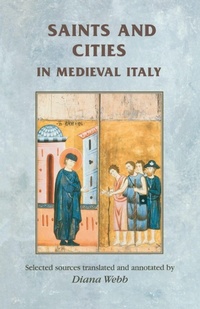
Saints and Cities in Medieval Italy
Manchester University Press
Published on 31. January 2007
Book
Paperback/Softback
272 pages
978-0-7190-7293-2 (ISBN)
Description
The saints' Lives in this book were written in Italy in the thirteenth and fourteenth centuries. Here translated into English and in full for the first time, they shed light on the ways in which both lay men and women sought God in the urban environment, and how they were understood and described by contemporaries.
Only one of these saints (Homobonus of Cremona) was formally canonised by the Pope: the others were locally venerated within the communities which had nurtured them. Raimondo Palmario of Piacenza, contemporary with Homobonus, was remembered as both pilgrim and a vigorous exponent of practical charity. The nobleman Andrea Gallerani of Siena turned from a life of violence to good works, while another Sienese, the holy comb-seller Pier Pettinaio, exemplified the godly business man who insisted on the just price and on paying his taxes. Two very different women are included: Umiliana de'Cerchi of Florence, a widow with children, and the 'servant-saint' Zita of Lucca. The last of the Lives contains a bishop's account of how the cult of the humble Rigo was launched in Treviso in 1315.
The book will welcomed by students and other readers interested in medieval Italian cities during this period of growth and vitality, and in how the religious life was lived in urban settings. -- .
Only one of these saints (Homobonus of Cremona) was formally canonised by the Pope: the others were locally venerated within the communities which had nurtured them. Raimondo Palmario of Piacenza, contemporary with Homobonus, was remembered as both pilgrim and a vigorous exponent of practical charity. The nobleman Andrea Gallerani of Siena turned from a life of violence to good works, while another Sienese, the holy comb-seller Pier Pettinaio, exemplified the godly business man who insisted on the just price and on paying his taxes. Two very different women are included: Umiliana de'Cerchi of Florence, a widow with children, and the 'servant-saint' Zita of Lucca. The last of the Lives contains a bishop's account of how the cult of the humble Rigo was launched in Treviso in 1315.
The book will welcomed by students and other readers interested in medieval Italian cities during this period of growth and vitality, and in how the religious life was lived in urban settings. -- .
More details
Series
Language
English
Place of publication
Manchester
United Kingdom
Target group
College/higher education
Professional and scholarly
Dimensions
Height: 216 mm
Width: 140 mm
Thickness: 15 mm
Weight
346 gr
ISBN-13
978-0-7190-7293-2 (9780719072932)
Copyright in bibliographic data and cover images is held by Nielsen Book Services Limited or by the publishers or by their respective licensors: all rights reserved.
Schweitzer Classification
Other editions
Additional editions
E-Book
01/2013
1st Edition
Manchester University Press
from
€36.99
Available for download
Person
Content
Acknowledgements
Introduction
1. Homobonus of Cremona (d. 1197)
2. Raimondo 'Palmario' of Piacenza (d.1200)
3. Umiliana de' Cerchi of Florence (d.1246)
4. Andrea Gallerani of Siena (d. 1251)
5. Zita of Lucca (d. 1278)
6. Pier Pettinaio of Siena (d.1289)
7. Enrico ('Rigo') of Bolzano (d. 1315)
Select Bibliography -- .
Introduction
1. Homobonus of Cremona (d. 1197)
2. Raimondo 'Palmario' of Piacenza (d.1200)
3. Umiliana de' Cerchi of Florence (d.1246)
4. Andrea Gallerani of Siena (d. 1251)
5. Zita of Lucca (d. 1278)
6. Pier Pettinaio of Siena (d.1289)
7. Enrico ('Rigo') of Bolzano (d. 1315)
Select Bibliography -- .