

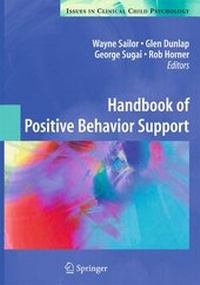
Handbook of Positive Behavior Support
Description
With its origins and conceptual underpinnings in the applied behavior analysis arm of psychology, positive behavior support (PBS) emerged during the 1980s as a comprehensive approach to addressing the need for community support for persons with disabilities who engage in challenging behavior. As a field of endeavor, PBS has experienced phenomenal growth over a span of 25 years and is now an integral component of public education in many schools in practically every state in the United States.
As an applied science of human behavior, PBS brings together the precision of a careful, analytical examination of the functions of problem behavior and relies on a broader framework of person-centered values to guide support through teaching alternative skill repetoires. Therefore, PBS involves a conceptual shift in addressing challenges presented by difficult behavior associated with disabilities - this shift is away from a direct and focused effort to simply reduce the occurrence of such behavior (sometimes with the use of punishing consequences) to a comprehensive values-based approach that eschews highly aversive consequences in favor of a teaching model focused on both the person and the person's total life span or ecology.
Currently, the field of positive behavior support offers a significant and expanding scientific basis for the functional analysis of problem behavior - that is, behavior that impedes learning and development and that, if not addressed, may result in a seriously diminished quality of life for those affected. PBS is now conceptualized as a risk-prevention system applicable at three levels of intervention:
|Universal, or primary applications, directed to all members of a specialized social ecology (e.g., a school).
- Universal, or primary applications, directed to all members of a specialized social ecology (e.g., a school).
- Group, or secondary intervention, directed to a specific group or aspect of the total ecology, (e.g., a classroom).
- Individual, or tertiary interventions, directed to individual supports.
At all three levels, the process begins with a systematic examination of the total context in which behavior of interest is manifest and addresses interventions that are concerned with each individual's well-being and overall quality of life rather than directing efforts to make individuals "fit in" to existing systems. At teritary levels of intervention, the process begins with a systematic examination of the total context in which problem behavior occurs, including preceding "setting events", biological factors, antecedent occurrences, environmental arrangements, learning styles and histories, and immediate as well as long-range consequences for problem behavior. The science of delineating functions of behavior is called functional behaviorial assessment (FBA).
Results of FBA are then directed to a set of teaching interventions with a system focus which may include multiple persons in a variety of settings, and which are carefully delineated in a document called a positive behavior support plan. Progress on implementation of the plan is carefully monitored and the resultant data periodically reviewed for progress and for any needed modifications. Tertiary interventions are considered to be terminated when an individual has successfully replaced aberrant and antisocial behavior with newly learned skills that are life affirming and socially desirable.
The sum of the three-level system of intervention of positive behavior support affords a comprehensive approach to preventing the emergence of life-restricting behavior through increasing degrees of support, as needed, to build a positive behavioral repetoire with entire social systems. As such, PBS respresents a scientifically validated, applied body of knowledge that spans all ages from early childhood through adulthood. It enables educational and other service providers to fully integrate a technology of sociobehavioral development with other pedagogical efforts to enhance the quality of life of recipients. It does so within a framework of expressed values that emphasize positive interactions directed to sustained lifestyle changes that enable recipients to participate fully in day-to-day community life.
Reviews / Votes
From the reviews:
"Provides a fascinating insight into ways in which positive behaviour support has been, and could be, developed and applied. . if you want to see the potential range of application of positive behaviour support, and the various components which may be involved, then you will find this fascinating. And if you are interested in the theoretical trajectory which has been followed by behaviourism, this book will give you plenty of food for thought." (Jenny Webb, International Journal of Positive Behavioural Support, Vol. 2 (1), Spring, 2012)
More details
Other editions
New editions
Additional editions
Persons
George Sugai, Ph.D., is Carole J. Neag Endowed Professor in Special Education in the Neag School of Education at the University of Connecticut, with expertise in behavior analysis, classroom and behavior management, schoolwide discipline, function-based behavior support, positive behavior support, and educating students with emotional and behavioral disorders. He has been a teacher in the public schools, treatment director in a residential program, and program administrator. Dr. Sugai conducts applied school and classroom research and works with schools to translate research into practice. He is currently codirector of the Center on Positive Behavioral Interventions and Supports at the University of Connecticut and University of Oregon.
Rob Horner, Ph.D., is professor of special education at the University of Oregon. Dr. Horner brings a 25-year history of research, grants management, and systems change efforts related to school reform and positive behavior support. Dr. Horner has published more than 150 professional papers and 6 texts. He has directed more than $20 million dollars in federal grants, and currently codirects the OSEP Technical Assistance Center on Positive Behavioral Interventions and Supports and the OSEP Research and Demonstration Center on Schoolwide Behavior Support. Dr. Horner also codirects the Positive Behavior Research and Support research unit at the University of Oregon. During the past 10 years Dr. Horner has directed projects working directly with schools and school administrators in the development of systems for embedding schoolwide systems of positive behavior support.
Glen Dunlap, Ph.D., is a research professor in the Division of Applied Research and Educational Support at the University of South Florida, where he works on several research, training, and demonstration projects in the areas of positive behavior support, child protection, early intervention, developmental disabilities and family support. Dr. Dunlap has been involved with individuals with disabilities for more than 30 years and has served as a teacher, administrator, researcher, and university faculty member. He has directed numerous research and training projects and has been awarded dozens of federal and state grants to pursue this work. He has authored more than 175 articles and book chapters, coedited four books, and served on 15 editorial boards. Dr. Dunlapwas a founding editor of the Journal of Positive Behavior Interventions and was recently named the editor of Topics in Early Childhood Special Education. In 2005, he moved to Reno, Nevada, where he continues to work on research and training projects as a member of the faculty at the University of South Florida.
Wayne Sailor, Ph.D., is a Professor in the Department of Special Education, School of Education, University of Kansas; a Senior Scientist with the Beach Center on Disability, Life Span Institute, University of Kansas; and a Courtesy Professor with the Department of Applied Behavioral Science, University of Kansas. Dr. Sailor's focus of interests are full integration of students with severe disabilities through school restructuring processes; and service integration strategies for health, social, and educational services for all children at the school site. He has done extensive research on schoolwide applications of positive behavior support and, in particular, uses of empowerment evaluation in whole school reform. His most recent research is focused on a structural school reform model call the schoolwide applications model (SAM), which is being field tested in the Ravenswood City School District, East Palo Alto, California, and in the New Orleans, Louisiana Recovery School District.