

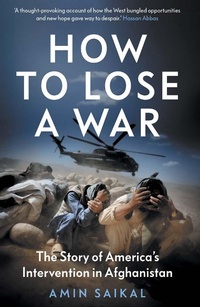
How to Lose a War
The Story of America's Intervention in Afghanistan
Published on 11. June 2024
Book
Hardback
320 pages
978-0-300-26624-5 (ISBN)
Description
An incisive, authoritative account of the West's failures in Afghanistan, from 9/11 to the fall of Kabul
In 1958, Richard Nixon described Afghanistan as "unconquerable." On 15 August 2021, he was proven right. After twenty years of intervention, US and NATO forces retreated, enabling the Taliban to return to power. Tens of thousands were killed in the long, unwinnable war, and millions more were displaced-leaving the future of Afghanistan hanging in the balance.
Leading expert Amin Saikal traces the full story of America's intervention, from 9/11 to the present crisis. After an initial swift military strike, the US became embroiled in a drawn-out struggle to change Afghanistan but failed to achieve its aims. Saikal shows how this failure was underlined by protracted attempts to capture Osama bin Laden, an inability to secure a viable government via "democracy promotion" efforts, and lack of wider strategy in the "war on terror."
How to Lose a War offers an insightful account of one of the US's most significant foreign policy failures-and considers its dire consequences for the people of Afghanistan.
In 1958, Richard Nixon described Afghanistan as "unconquerable." On 15 August 2021, he was proven right. After twenty years of intervention, US and NATO forces retreated, enabling the Taliban to return to power. Tens of thousands were killed in the long, unwinnable war, and millions more were displaced-leaving the future of Afghanistan hanging in the balance.
Leading expert Amin Saikal traces the full story of America's intervention, from 9/11 to the present crisis. After an initial swift military strike, the US became embroiled in a drawn-out struggle to change Afghanistan but failed to achieve its aims. Saikal shows how this failure was underlined by protracted attempts to capture Osama bin Laden, an inability to secure a viable government via "democracy promotion" efforts, and lack of wider strategy in the "war on terror."
How to Lose a War offers an insightful account of one of the US's most significant foreign policy failures-and considers its dire consequences for the people of Afghanistan.
Reviews / Votes
"Saikal's central argument is a persuasive one: that the Americans' twin messianic obsessions, promoting democracy and 'destroying' terror, condemned the American enterprise from the start."-Suzy Hansen, New York Review of Books"Complex, unique, enlightening. . . . Saikal's book is channeling the reformist, pluralistic and democratic governmental and societal elements who wanted to serve their country . . . but found themselves on the fringes, frustrated about the direction Afghanistan is taking but void of resources and opportunities to make corrective differences."-Cipher Brief
"Accessible and of interest to both the expert and general reader, this important book provides a fresh and illuminating look at one of this century's major conflicts."-Ian Parmeter, Australian Book Review
"A compelling critique of America's longest war . . . essential reading for scholars, policy-makers and anyone interested in interventionism."-Marika Theros, International Affairs
"Amin Saikal provides a detailed and authoritative analysis of how, after 20 years of occupation, the West withdrew in disarray."-JS, History of War
"How to Lose a War provides a timely warning for Western policy makers seeking to reshape non-Western and tribal countries in their own image . . . a methodically documented and very detailed account."-Robert Dixon, RUSI - Victoria
"A clear overview of the conflict's strategic failures. It sets the stage well before diving into more focused personal or cultural accounts."-Bookauthority
"A compelling and meticulously documented analysis, with much new eyewitness material, of the abject policy and governance failures of successive US administrations and their Afghan leadership proteges. One of the most depressing chapters of modern world history, and Saikal clearly articulates the lessons to be learned from it."-Gareth Evans, former Australian Foreign Minister and president emeritus of the International Crisis Group
"Amin Saikal is a leading scholar of international relations and the Middle East. He has provided a great public service by turning scholarly attention to his country of origin. This insightful and tragic account of failed U.S. intervention in Afghanistan is essential reading, especially for Western policy makers seeking to reshape far away lands in their own image."-Atul Kohli, David Bruce Professor of International Relations, Princeton University
"Saikal offers us a credible and accessible perspective on how the outsiders' failure of imagination, coupled with the incompetence and corruption of the Afghan political elite, brought us to where we stand today. The lessons Saikal draws are as insightful as they are intriguing, worth everyone's attention."-Hassan Abbas, author of The Return of the Taliban: Afghanistan after the Americans Left ?
"An excellent analysis of the failures of US policy in Afghanistan. It incisively explains how America's ambitions exceeded its grasp and, despite lofty ideals, became embroiled in frictions that it poorly understood and tragically compounded."-James Piscatori, coauthor of Muslim Politics
"Relying on well-placed insider sources, Amin Saikal offers a rigorous and gripping narrative of why the U.S. lost the war in Afghanistan. The book delves deep into the complex reasons for the U.S. policy failure and provides a sobering assessment of the lessons learned."-Anne Likuski, author of Al-Qaida in Afghanistan
More details
Language
English
Place of publication
United States
Target group
Professional and scholarly
Product notice
Cloth over boards
Illustrations
1 map
Dimensions
Height: 238 mm
Width: 155 mm
Thickness: 34 mm
Weight
557 gr
ISBN-13
978-0-300-26624-5 (9780300266245)
Copyright in bibliographic data and cover images is held by Nielsen Book Services Limited or by the publishers or by their respective licensors: all rights reserved.
Schweitzer Classification
Person
Amin Saikal is emeritus professor and founding director of the Centre for Arab and Islamic Studies at the Australian National University, and adjunct professor at the University of Western Australia. He is an Afghanistan and Middle East specialist, and the author of Iran Rising, Zone of Crisis, and Modern Afghanistan.