

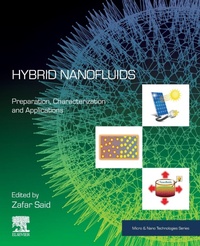
Hybrid Nanofluids
Preparation, Characterization and Applications
Published on 28. January 2022
Book
Paperback/Softback
278 pages
978-0-323-85836-6 (ISBN)
Description
Hybrid Nanofluids: Preparation, Characterization and Applications presents the history of hybrid nanofluids, preparation techniques, thermoelectrical properties, rheological behaviors, optical properties, theoretical modeling and correlations, and the effect of all these factors on potential applications, such as solar energy, electronics cooling, heat exchangers, machining, and refrigeration. Future challenges and future work scope have also been included. The information from this book enables readers to discover novel techniques, resolve existing research limitations, and create novel hybrid nanofluids which can be implemented for heat transfer applications.
More details
Series
Language
English
Place of publication
Philadelphia
United States
Target group
Professional and scholarly
Materials scientists and engineers
Product notice
Paperback (trade)
Illustrations
45 illustrations (45 in full color); Illustrations
Dimensions
Height: 235 mm
Width: 191 mm
Thickness: 15 mm
Weight
487 gr
ISBN-13
978-0-323-85836-6 (9780323858366)
Copyright in bibliographic data and cover images is held by Nielsen Book Services Limited or by the publishers or by their respective licensors: all rights reserved.
Schweitzer Classification
Other editions
Additional editions
E-Book
01/2022
Elsevier
€193.00
Available for download
Person
Dr. Zafar Said is currently working as a Distinguished Associate Professor in the
Department of Mechanical and Aerospace Engineering at the United Arab Emirates
University, UAE. He received his doctoral degree in Mechanical Engineering from
the University of Malaya, Malaysia, and completed his postdoctoral research at
Khalifa University, UAE. Dr. Said is a recognized leader in energy technology,
nanofluids, and sustainable energy. His major areas of interest include heat
transfer, solar energy systems, and advanced thermofluids. His research focuses on
battery thermal management, enhancement of solar collectors using nanofluids
and turbulators, and the development of stable nanorefrigerants and
nanolubricants. He also applies artificial intelligence and machine learning to
predict thermophysical properties and optimize energy systems. He is the recipient
of several prestigious awards, including the Khalifa Award for Education as
Distinguished University Professor (2025), the Future Pioneer Award in
Sustainability (2025), and Best Academic Research at the 13th Dubai Award for
Sustainable Transport (2024). He has also received the Research and Innovation
Award from the UAE Ministry of Energy and Infrastructure (2022) and First Place in
Scientific Research at the Excellence and Creative Engineering Award (2023) by the
Society of Engineers, UAE. In recognition of his contributions, he has been
consistently ranked among the world's top 2% of scientists in the field of energy by
Elsevier BV and Stanford University. In addition to his academic duties, he actively
serves in editorial roles for several international journals and is a frequent keynote
speaker at global conferences.
Department of Mechanical and Aerospace Engineering at the United Arab Emirates
University, UAE. He received his doctoral degree in Mechanical Engineering from
the University of Malaya, Malaysia, and completed his postdoctoral research at
Khalifa University, UAE. Dr. Said is a recognized leader in energy technology,
nanofluids, and sustainable energy. His major areas of interest include heat
transfer, solar energy systems, and advanced thermofluids. His research focuses on
battery thermal management, enhancement of solar collectors using nanofluids
and turbulators, and the development of stable nanorefrigerants and
nanolubricants. He also applies artificial intelligence and machine learning to
predict thermophysical properties and optimize energy systems. He is the recipient
of several prestigious awards, including the Khalifa Award for Education as
Distinguished University Professor (2025), the Future Pioneer Award in
Sustainability (2025), and Best Academic Research at the 13th Dubai Award for
Sustainable Transport (2024). He has also received the Research and Innovation
Award from the UAE Ministry of Energy and Infrastructure (2022) and First Place in
Scientific Research at the Excellence and Creative Engineering Award (2023) by the
Society of Engineers, UAE. In recognition of his contributions, he has been
consistently ranked among the world's top 2% of scientists in the field of energy by
Elsevier BV and Stanford University. In addition to his academic duties, he actively
serves in editorial roles for several international journals and is a frequent keynote
speaker at global conferences.
Content
1. Introduction to hybrid nanofluids
2. Preparation and stability of hybrid nanofluids
3. Thermophysical, electrical, magnetic, and dielectric properties of hybrid nanofluids
4. Hydrothermal properties of hybrid nanofluids
5. Rheological behavior of hybrid nanofluids
6. Radiative transport of hybrid nanofluid
7. Theoretical analysis and correlations for predicting properties of hybrid nanofluids
8. Brief overview of the applications of hybrid nanofluids
9. Recent advances in the prediction of thermophysical properties of nanofluids using artificial intelligence
10. Challenges and difficulties in developing hybrid nanofluids and way forward
2. Preparation and stability of hybrid nanofluids
3. Thermophysical, electrical, magnetic, and dielectric properties of hybrid nanofluids
4. Hydrothermal properties of hybrid nanofluids
5. Rheological behavior of hybrid nanofluids
6. Radiative transport of hybrid nanofluid
7. Theoretical analysis and correlations for predicting properties of hybrid nanofluids
8. Brief overview of the applications of hybrid nanofluids
9. Recent advances in the prediction of thermophysical properties of nanofluids using artificial intelligence
10. Challenges and difficulties in developing hybrid nanofluids and way forward