

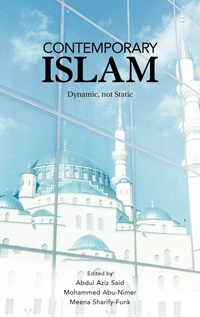
Contemporary Islam
Dynamic, not Static
1st Edition
Published on 3. July 2006
Book
Hardback
274 pages
978-0-415-77011-8 (ISBN)
Description
Contemporary Islam provides a counterweight to the prevailing opinions of Islamic thought as conservative and static with a preference for violence over dialogue. It gathers together a collection of eminent scholars from around the world who tackle issues such as intellectual pluralism, gender, the ethics of political participation, human rights, non-violence and religious harmony. This is a highly topical and important study which gives a progressive outlook for Islam's role in modern politics and society.
Reviews / Votes
'I think this is an exceptionally important collection' - Ira Lapidus, BerkeleyMore details
Language
English
Place of publication
London
United Kingdom
Publishing group
Taylor & Francis Ltd
Target group
College/higher education
Illustrations
1 s/w Zeichnung
1 Line drawings, black and white
Dimensions
Height: 240 mm
Width: 161 mm
Thickness: 20 mm
Weight
599 gr
ISBN-13
978-0-415-77011-8 (9780415770118)
Copyright in bibliographic data and cover images is held by Nielsen Book Services Limited or by the publishers or by their respective licensors: all rights reserved.
Schweitzer Classification
Other editions
Additional editions
E-Book
09/2006
Routledge
€64.49
Available for download
E-Book
09/2006
Routledge
€64.49
Available for download
Book
06/2006
1st Edition
Routledge
€71.70
Shipment within 15-20 days
Persons
Abdul Aziz Said is the senior ranking Professor of International Relations and also occupies the Mohammed Said Farsi Chair of Islamic Peace at American University (Washington, DC). Some of Said's books include: Concepts of International Politics in Global Perspective and Peace and Conflict Resolution in Islam.
Mohammed Abu-Nimer is a Professor of International Peace and Conflict Resolution Studies at American University (Washington, DC). Abu-Nimer has published many articles on the application of conflict resolution models in non-Western contexts. His latest publication is Nonviolence and Peacebuilding in Islam: Theory and Practice.
Meena Sharify-Funk is currently an Adjunct Lecturer on Islam at the University of Waterloo in Ontario, Canada. She has written and presented a number of articles and papers on women, Islam and the politics of interpretation. She also has co-edited the book, Cultural Diversity and Islam.
Mohammed Abu-Nimer is a Professor of International Peace and Conflict Resolution Studies at American University (Washington, DC). Abu-Nimer has published many articles on the application of conflict resolution models in non-Western contexts. His latest publication is Nonviolence and Peacebuilding in Islam: Theory and Practice.
Meena Sharify-Funk is currently an Adjunct Lecturer on Islam at the University of Waterloo in Ontario, Canada. She has written and presented a number of articles and papers on women, Islam and the politics of interpretation. She also has co-edited the book, Cultural Diversity and Islam.
Content
Introduction Part 1: The Many Voices of Islam: Cultivating Intellectual Pluralism 1. Reflections on Current Developments in Debates on Islam, Feminism and Sexuality 2. The Many Voices of Islam: Cultivating Intellectual Pluralism 3. Religion and Changing Solidarity: A Sociological Perspective on Islam Part 2: Applied Ethics of Political Participation 4. When Silence is not Golden: Muslim Women Speak Out 5. The Contemporary Democracy and the Human Rights Project for Muslim Societies: Challenges for the Progressive Muslim Intellectual 6. A'dab in Modern Turkish Islam 7. Public Religion, Ethics of Participation and Cultural Dialogue: Islam in Europe 8. Sociology of Rights: Human Rights in Islam between Communal and Universal Perspectives Part 3: Applied Ethics of Peace and Nonviolence in Islam 9. Framework for Nonviolence and Peacebuilding in Islam 10. The Missing Logic in Discourses of Violence and Peace in Islam 11. Transforming Terrorism with Muslim Nonviolent Alternatives Part 4: Coexistence and Reconciliation: An Enduring Responsibility of the Muslim Ummah 12. Coexistence and Reconciliation within the Limits of Western Historical Boundaries 13. Pluralism, Coexistence and Religious Harmony in Southeast Asia: Indonesian Experience in the Middle Path 14. Reviving Islamic Universalism: Easts, Wests and Coexistence