

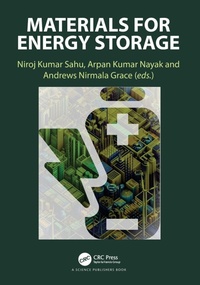
Materials for Energy Storage
1st Edition
Published on 21. May 2026
Book
Paperback/Softback
312 pages
978-1-032-80576-4 (ISBN)
Description
Materials for Energy Storage offers a combinatorial understanding of materials science and electrochemistry in electrochemical energy storage devices with a holistic overview of the status, research gaps, and future opportunities. Rooted in a profound understanding of contemporary energy utilization, aligned with the sustainable development goals, this book delves deep into the several device chemistries, impact of nanomaterials, and critical factors related to the device performance. It discusses electrode-electrolyte interaction, device fabrication, and commercial aspects. This book will offer value to the graduate and postgraduate students, researchers, and industry professionals related to materials science and energy technology.
More details
Language
English
Place of publication
London
United Kingdom
Publishing group
Taylor & Francis Ltd
Target group
Professional and scholarly
Academic
Product notice
Paperback (trade)
Illustrations
20 s/w Tabellen, 23 farbige Abbildungen, 118 s/w Abbildungen
20 Tables, black and white; 23 Illustrations, color; 118 Illustrations, black and white
Dimensions
Height: 254 mm
Width: 178 mm
Thickness: 17 mm
Weight
559 gr
ISBN-13
978-1-032-80576-4 (9781032805764)
Copyright in bibliographic data and cover images is held by Nielsen Book Services Limited or by the publishers or by their respective licensors: all rights reserved.
Schweitzer Classification
Other editions
Additional editions
Niroj Kumar Sahu | Arpan Kumar Nayak | Andrews Nirmala Grace
Materials for Energy Storage
E-Book
07/2024
1st Edition
CRC Press
€218.99
Available for download
Niroj Kumar Sahu | Arpan Kumar Nayak | Andrews Nirmala Grace
Materials for Energy Storage
E-Book
07/2024
1st Edition
CRC Press
€218.99
Available for download
Niroj Kumar Sahu | Arpan Kumar Nayak | Andrews Nirmala Grace
Materials for Energy Storage
Book
07/2024
1st Edition
CRC Press
€255.50
Shipment within 15-20 days
Persons
Niroj Kumar Sahu is Professor at the Centre for Nanotechnology Research, VIT, Vellore, India. He received his Ph.D. degree from IIT Bombay and is the recipient of the Award for Excellence in Thesis Work. He has published more than 50 research articles in peer reviewed journals, edited two books and published 15 book chapters. His research area focuses on the fabrication and surface functionalization of ferrites and composite nanostructured materials for biomedical and energy storage applications.
Arpan Kumar Nayak is Assistant Professor in the School of Advanced Sciences, VIT, Vellore, India. He received his Ph.D. degree from IIT Kharagpur, India. He worked as a post-doctoral fellow at Hanyang University, Seoul, South Korea. His research interests are synthesis of nanostructured materials for environment and energy applications which includes fabrication of high-performance energy storage devices, photocatalysis and water splitting.
Andrews Nirmala Grace is Professor and Director at the Centre for Nanotechnology Research, VIT, Vellore, India. She received her Ph.D. degree from the University of Madras, India, and worked as post-doctoral fellow at the Korea Institute of Energy Research, South Korea, on Renewable Energy. She is a fellow of the Royal Society of Chemistry, Academy of Sciences and FASCh. Her current research interests include energy materials, design and fabrication of electrodes for supercapacitors.
Arpan Kumar Nayak is Assistant Professor in the School of Advanced Sciences, VIT, Vellore, India. He received his Ph.D. degree from IIT Kharagpur, India. He worked as a post-doctoral fellow at Hanyang University, Seoul, South Korea. His research interests are synthesis of nanostructured materials for environment and energy applications which includes fabrication of high-performance energy storage devices, photocatalysis and water splitting.
Andrews Nirmala Grace is Professor and Director at the Centre for Nanotechnology Research, VIT, Vellore, India. She received her Ph.D. degree from the University of Madras, India, and worked as post-doctoral fellow at the Korea Institute of Energy Research, South Korea, on Renewable Energy. She is a fellow of the Royal Society of Chemistry, Academy of Sciences and FASCh. Her current research interests include energy materials, design and fabrication of electrodes for supercapacitors.
Content
Preface. Fundamental Principle of Electrochemical Energy Storage. Electrode-Electrolyte Interface for Energy Storage. Carbon Based Nanomaterials for Energy Storage. Transition Metal Oxide Nanomaterials for Sodium-Ion Batteries and Hybrid Capacitors. Metal Carbides and Nitrides for Energy Storage Application. Ferrite Nanomaterials for Energy Storage Applications. Polymers for Efficient Electrochemical Energy Storage. Hybrid Materials for Energy Storage. Role of Defects in Nanomaterials and Their Effect on Energy Storage. 0D, 1D and 2D Materials for Energy Storage. Fabrication of Supercapacitor Devices and Their Applications. All Solid State Flexible Supercapacitors: Materials Synthesis and Fabrication. State of Art Comprising Nanomaterials for Asymmetric Solid State Supercapacitors. Current Status, Research Gaps, and Future Scope for Nanomaterials in Energy Storage Technologies. Index.