

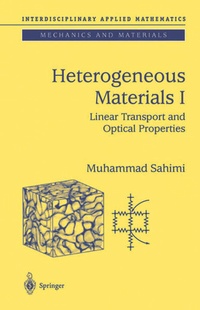
Heterogeneous Materials I
Linear Transport and Optical Properties
Published on 15. May 2003
Book
Hardback
XX, 692 pages
978-0-387-00167-8 (ISBN)
Description
8. Rigidity and Elastic Properties: The Discrete Approach 8. 0 Introduction 8. 1 Elastic Networks in Biological Materials 8. 2 Number of Elastic Moduli of a Lattice 8. 3 Numerical Simulation and Finite-Size Scaling 8. 4 Derivation of Elastic Networks from Continuum Elasticity 8. 4. 1 The Born model 8. 4. 2 Shortcomings of the Born model 8. 5 The Central-Force Network 8. 6 Rigidity Percolation 8. 6. 1 Static and dynamic rigidity and ?oppiness of networks 8. 6. 2 The correlation length of rigidity percolation 8. 6. 3 The force distribution 8. 6. 4 Determination of the percolation threshold 8. 6. 4. 1 Moments of the force distribution 8. 6. 4. 2 The pebble game 8. 6. 4. 3 Constraint-counting method 8. 6. 5 Mapping between rigidity percolation and resistor networks 8. 6. 6 Nature of phase transition in rigidity percolation 8. 6. 7 Scaling properties of the elastic moduli 8. 7 Green Function Formulation and Perturbation Expansion 8. 7. 1 E?ective-medium approximation 8. 7. 2 The Born model 8. 7. 3 Rigidity percolation 8. 8 The Critical Path Method 8. 9 Central-Force Networks at Non-zero Temperature and under Stress 8. 10 Shortcomings of the Central-Force Networks 8. 11 Elastic Percolation Networks with Bond-Bending Forces 8. 11. 1 The Kirkwood-Keating model xiv 8. 11. 2 The bond-bending model 8. 11. 3 The percolation thresholds 8. 11. 4 The force distribution 8. 11. 5 Comparison of the central-force and bond-bending networks 8. 11.
Reviews / Votes
From the reviews:
"This work represents the first part of an impressive two-volume book that describes various theoretical and computational approaches related to effective macroscopic properties of heterogeneous materials. . A main goal is to compare two fundamental directions used to study the heterogeneous materials properties, namely the continuum mechanics approach and the discrete model approach. . This multidisciplinary book is recommended to materials scientists, chemical and mechanical engineers, and applied physicists and mathematicians." (Olivian Simionescu, Zentralblatt MATH, Vol. 1028, 2004)
More details
Series
Edition
2003 ed.
Language
English
Place of publication
New York
United States
Target group
Professional and scholarly
Research
Product notice
sewn/stitched
Cloth over boards
Illustrations
XX, 692 p.
Dimensions
Height: 241 mm
Width: 160 mm
Thickness: 44 mm
Weight
1226 gr
ISBN-13
978-0-387-00167-8 (9780387001678)
DOI
10.1007/b97507
Schweitzer Classification
Other editions
Additional editions
Book
03/2013
Springer
€106.99
Shipment within 15-20 days
E-Book
05/2006
Springer
€96.29
Available for download
Content
Characterization and Modelling of the Morphology.- Characterization of Connectivity and Clustering.- Characterization and Modelling of the Morphology.- Linear Transport and Optical Properties.- Effective Conductivity, Dielectric Constant and Optical Properties: The Continuum Approach.- Effective Conductivity and Dielectric Constant: The Discrete Approach.- Frequency-Dependent Properties: The Discrete Approach.- Rigidity and Elastic Properties: The Continuum Approach.- Rigidity and Elastic Properties: The Discrete Approach.- Rigidity and Elastic Properties of Network Glasses, Prolymers, and Composite Solids: the Discrete Approach.