

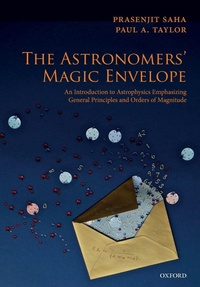
The Astronomers' Magic Envelope
An Introduction to Astrophysics Emphasizing General Principles and Orders of Magnitude
Published on 6. June 2018
Book
Paperback/Softback
144 pages
978-0-19-881647-8 (ISBN)
Description
Working physicists, and especially astrophysicists, value a good `back-of-the-envelope' calculation, meaning a short, elegant computation or argument that starts from general principles and leads to an interesting result. This book guides students on how to understand astrophysics using general principles and concise calculations -- endeavouring to be elegant where possible and using short computer programs where necessary.
The material proceeds in approximate historical order. The book begins with the Enlightenment-era insight that the orbits of the planets is easy, but the orbit of the Moon is a real headache, and continues to deterministic chaos. This is followed by a chapter on spacetime and black holes. Four chapters reveal how microphysics, especially quantum mechanics, allow us to understand how stars work. The last two chapters are about cosmology, bringing us to 21st-century developments on the microwave background and gravitational waves.
The material proceeds in approximate historical order. The book begins with the Enlightenment-era insight that the orbits of the planets is easy, but the orbit of the Moon is a real headache, and continues to deterministic chaos. This is followed by a chapter on spacetime and black holes. Four chapters reveal how microphysics, especially quantum mechanics, allow us to understand how stars work. The last two chapters are about cosmology, bringing us to 21st-century developments on the microwave background and gravitational waves.
Reviews / Votes
This is a delightful small book... It will be a good resource for lecturers, showing some nice examples of applications of the physical principles, and of especial interest to advanced undergraduates and postgraduates. The reader is encouraged to write computer codes to find solutions, and the student with a thirst to learn and the motivation to engage fully with the book will be amply rewarded. * Alan Heavens, The Observatory * Astronomers like the concept of back-of-the-envelope calculations. Such calculations help us get a handle on very complex problems that would otherwise require far more time and effort to solve properly. Prasenjit Saha and Paul A. Taylor build an introductory guide to astronomy on exactly this premise. * Nature Astronomy * A sophisticated text that will bring physical intuition for astronomy for mathematically able students. The computationally based problems are a welcome addition to better empower student learning. * Brian Schmidt, Nobel Laureate in Physics, 2011, Australian National University *More details
Language
English
Place of publication
Oxford
United Kingdom
Target group
College/higher education
Illustrations
14 line figures
Dimensions
Height: 244 mm
Width: 170 mm
Thickness: 7 mm
Weight
242 gr
ISBN-13
978-0-19-881647-8 (9780198816478)
Copyright in bibliographic data and cover images is held by Nielsen Book Services Limited or by the publishers or by their respective licensors: all rights reserved.
Schweitzer Classification
Other editions
Additional editions
Prasenjit Saha | Paul A. Taylor
The Astronomers' Magic Envelope
An Introduction to Astrophysics Emphasizing General Principles and Orders of Magnitude
Book
06/2018
Oxford University Press
€79.50
Shipment within 15-20 days
Prasenjit Saha | Paul A. Taylor
The Astronomers' Magic Envelope
An Introduction to Astrophysics Emphasizing General Principles and Orders of Magnitude
E-Book
05/2018
1st Edition
OUP eBook
€27.49
Available for download
Persons
Prasenjit Saha is an astrophysicist working mainly on various aspects of gravitational dynamics, including gravitational lenses. He has also contributed to the literature on Bayesian inference, intensity interferometers, and literate programming. He got hooked on astrophysics from books like George Gamow's, and loves books that present a subject in an interesting and slightly subversive way.
Paul A. Taylor completed his doctorate in the area of stellar astrophysics at the University of Oxford. He has subsequently been a tutor, visiting researcher and lecturer in the African Institute for Mathematical Sciences (AIMS) network in Cameroon, Ghana, Rwanda, Senegal, South Africa and Tanzania. He continues to teach programming and signal processing within the AIMS network, and is also a staff scientist in the Scientific and Statistical Computing Core at the National Institutes of Health in Bethesda, USA.
Paul A. Taylor completed his doctorate in the area of stellar astrophysics at the University of Oxford. He has subsequently been a tutor, visiting researcher and lecturer in the African Institute for Mathematical Sciences (AIMS) network in Cameroon, Ghana, Rwanda, Senegal, South Africa and Tanzania. He continues to teach programming and signal processing within the AIMS network, and is also a staff scientist in the Scientific and Statistical Computing Core at the National Institutes of Health in Bethesda, USA.
Content
1: Orbits
2: Celestial Mechanics
3: Schwarzschild's spacetime
4: Interlude: Quantum ideal gases
5: Gravity versus pressure
6: Nuclear fusion in stars
7: The main sequence of stars
8: The expanding Universe
9: The cosmic microwave background
2: Celestial Mechanics
3: Schwarzschild's spacetime
4: Interlude: Quantum ideal gases
5: Gravity versus pressure
6: Nuclear fusion in stars
7: The main sequence of stars
8: The expanding Universe
9: The cosmic microwave background