

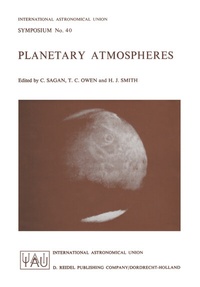
Planetary Atmospheres
Will be published approx. on 31. March 1971
Book
Hardback
425 pages
978-90-277-0165-7 (ISBN)
Description
Proceedings of the IAU Symposium No. 40, held in Marfa, Texas, U.S.A., October 26-31, 1969
More details
Series
Edition
1971 ed.
Language
English
Place of publication
Dordrecht
Netherlands
Publishing group
Springer
Target group
Professional and scholarly
Research
Product notice
sewn/stitched
Cloth over boards
Illustrations
425 p.
Dimensions
Height: 0 mm
Width: 0 mm
Weight
1100 gr
ISBN-13
978-90-277-0165-7 (9789027701657)
DOI
10.1007/978-94-010-3063-2
Schweitzer Classification
Other editions
Additional editions
C. Sagan | Tobias Owen | H.J. Smith
Planetary Atmospheres
E-Book
12/2012
1st Edition
Springer
€53.49
Available for download
C. Sagan | Tobias Owen | H.J. Smith
Planetary Atmospheres
Book
10/2011
Springer
€53.49
Shipment within 15-20 days
Content
I / Venus.- The chemical composition of the atmosphere of Venus.- Exospheric temperature of Venus from Mariner 5.- Models of the Venus ionosphere.- Venus: Determination of atmospheric parameters from the microwave spectrum.- Peculiarities of mm and cm radiowave propagation in the Venus atmosphere.- Some consequences of critical refraction in the Venus atmosphere.- A two-parameter theory for Venus spectra.- A new short-wavelength carbon dioxide band in the spectrum of Venus.- Calculations of CO2 energy levels: The Ã1B2 state.- High spectral resolution interferometric planetary observations in the 7-25 ? region.- Limb darkening observations of Venus from 5 ? to 18 ?.- Water on Venus?.- Vegetative life on Venus ? Or investigations with algae which grow under pure CO2 in hot acid media and at elevated pressures.- Venus cloud contrasts.- On the nature of the Venus clouds.- Geochemical problems in the production of the Venus clouds.- The trouble with Venus.- II / Mars.- A. Optical Properties.- Colorimetry of Martian features by means of area scanning.- Longitudinal variations, the opposition effect, and monochromatic albedos for Mars.- Mie scattering and the Martian atmosphere.- The contribution of atmospheric aerosols to the Martian opposition effect.- Ultraviolet polarization measurements of Mars and the opacity of the Martian atmosphere.- Some problems of anisotropic scattering in planetary atmospheres.- B. CO2 Absorption.- An interpretation of the Mars spectrum taken by the Connes.- Observations of the Martian 1.2 ? CO2 bands.- Variations of the Martian CO2 abundance with Martian season.- Relative elevation differences revealed by near infrared CO2 bands on Mars.- Spectroscopic determination of surface pressure and elevation differences on Mars.- C. Water VaporAbsorption.- The spectroscopic search for water on Mars: A history.- The latitude variation of water vapor on Mars.- A report on Martian atmospheric water vapor near opposition, 1969.- High altitude interferometer spectra of Mars.- Mars: Occurrence of liquid water.- D. Mariner Results.- Mariner 6: Ultraviolet spectrum of Mars upper atmosphere.- Mariner Mars '69 celestial mechanics experiment.- Mariner 1969: Results of the infrared radiometer experiment.- Mariner 6 and 7 television pictures: Preliminary analysis.- E. Cloud Motions and Atmospheric Dynamics.- Estimates of boundary layer parameters in the atmospheres of the terrestrial planets.- The theory of similarity for large-scale motions in planetary atmospheres.- Cloud activity on Mars near the equinox: Comparison of the 1937 and 1969 oppositions.- Cloud motions on Mars.- F. Upper Atmospheres.- The effect of atmospheric dynamics on the upper atmosphere phenomena of Mars and Venus.- CO2+ dayglow on Mars and Venus.- III / Outer Planets.- Variations in the color of Jupiter.- The effective temperature of Jupiter's equatorial belt during the 1965 apparition.- Observations of Jupiter's cloud structure near 8.5 ?.- Phase behavior of light gas mixtures at high pressures.- Atmospheric depths of Jupiter, Saturn, and Uranus.- The spectral characteristics and probable structure of the cloud layer of Saturn.- Estimate of the H2 abundance in the atmosphere of Uranus from the pressure induced spectrum.- The spectrum of Uranus in the region 4800-7500 Å.- Upper limit of hydrogen and helium concentrations on Titan.- IV / Scientific Dedication of the 107-Inch Reflector.- Remarks made at the scientific dedication of the 107-inch reflector, October 30, 1969.