

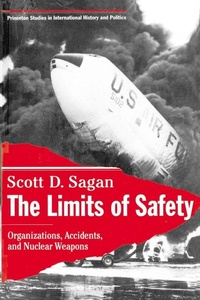
The Limits of Safety
Organizations, Accidents, and Nuclear Weapons
Published on 29. January 1995
Book
Paperback/Softback
302 pages
978-0-691-02101-0 (ISBN)
Description
Environmental tragedies such as Chernobyl and the Exxon Valdez remind us that catastrophic accidents are always possible in a world full of hazardous technologies. Yet, the apparently excellent safety record with nuclear weapons has led scholars, policy-makers, and the public alike to believe that nuclear arsenals can serve as a secure deterrent for the foreseeable future. In this provocative book, Scott Sagan challenges such optimism. Sagan's research into formerly classified archives penetrates the veil of safety that has surrounded U.S. nuclear weapons and reveals a hidden history of frightening "close calls" to disaster.
Reviews / Votes
Winner of the 1993 Best Book Award, Science, Technology, and Environmental Studies Section of the American Political Science Association "An extraordinary book... Normal accidents theory and high reliability theory took the theory of accidents out of the hands of economists and engineers and put it into the hands of organization theorists; Sagan has brought that theory of accidents much closer to maturity."--Charles Perrow, Journal of Contingencies and Crisis Management "Scott Sagan's book is nothing less than a tour de force... It is by far the most carefully researched and painstaking study of nuclear weapons safety ever written."--Bruce G. Blair, Security Studies "Sagan's stories also drive a wooden stake through the heart of rational choice nuclear deterrence theory. This book will make you scared ... will make you hold your children a little tighter at the end of the day."--Lee Clarke, Sociological Forum "Sagan shows, both explicitly for nuclear weapons and implicitly for intellectual systems, that neither learning nor disasters are essentially matters of improving O-rings, safety procedures, or t-tests, as participants within those systems would like to believe. The primary adaptive action is offstage--in the background framework itself. And at that level, through sheer volume of its data, Sagan's book will shape the way that policymakers and we (with a little less confidence) understand the nuclear world."--Contemporary Sociology "Grounded in original research in U.S. national security archives, [Limits of Safety] reveals a disturbing history of near-catastrophes in the handling of nuclear weapons and bombers... This book is a significant contribution to ... international security studies, organizational theory, and risk analysis."--American Political Science ReviewMore details
Series
Language
English
Place of publication
New Jersey
United States
Target group
Professional and scholarly
College/higher education
Product notice
Paperback (trade)
Illustrations
8 figs. 5 tables
Dimensions
Height: 229 mm
Width: 152 mm
Thickness: 19 mm
Weight
496 gr
ISBN-13
978-0-691-02101-0 (9780691021010)
Copyright in bibliographic data and cover images is held by Nielsen Book Services Limited or by the publishers or by their respective licensors: all rights reserved.
Schweitzer Classification
Other editions
Additional editions
E-Book
05/2020
1st Edition
Princeton University Press
€56.99
Available for download
Person
Scott D. Sagan, Assistant Professor of Political Science at Stanford University, is the author of Moving Targets: Nuclear Strategy and National Security (Princeton).
Content
List of Figures and TablesAcknowledgmentsList of AcronymsIntroduction: Expecting the Unexpected3Ch. 1The Origins of Accidents11Ch. 2Nuclear Weapons Safety during the Cuban Missile Crisis53Ch. 3Intelligence and Warning during the Cuban Missile Crisis117Ch. 4Redundancy and Reliability: The 1968 Thule Bomber Accident156Ch. 5Learning by Trial and Terror204Ch. 6The Limits of Safety250Index281