

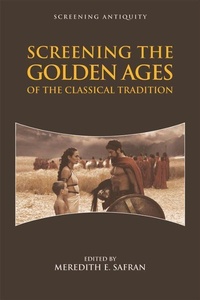
Screening the Golden Ages of the Classical Tradition
Published on 17. September 2020
Book
Paperback/Softback
352 pages
978-1-4744-4085-1 (ISBN)
Description
This collection of fourteen essays explores how the dominant media of our time - film and television - have engaged with the golden age as formulated in the Western classical tradition.
Drawing on ancient Greek and Roman literature and culture, from Hesiod to Suetonius, these essays assess the far-reaching influence of the golden age concept on screen texts ranging from prestige projects like Gladiator and HBO's Rome, to cult classics Xanadu and Hercules: The Legendary Journeys, made by auteurs including Jules Dassin and the Coen Brothers. The book also looks at fantasy (Game of Thrones), science fiction (Serenity), horror (The Walking Dead), war/combat (the 300 franchise; Centurion), and the American Western.
Drawing on ancient Greek and Roman literature and culture, from Hesiod to Suetonius, these essays assess the far-reaching influence of the golden age concept on screen texts ranging from prestige projects like Gladiator and HBO's Rome, to cult classics Xanadu and Hercules: The Legendary Journeys, made by auteurs including Jules Dassin and the Coen Brothers. The book also looks at fantasy (Game of Thrones), science fiction (Serenity), horror (The Walking Dead), war/combat (the 300 franchise; Centurion), and the American Western.
Reviews / Votes
The intersection between the idea of a lost Golden Age and on-screen invocations of ancient Greece and Rome is intriguing. This should be compulsory reading for students of film, Classical reception, and anyone interested in modern popular culture's appropriation of the past to articulate concerns very much of the present. -- Emma Stafford, University of LeedsMore details
Series
Language
English
Place of publication
Edinburgh
United Kingdom
Target group
Professional and scholarly
Product notice
Paperback (trade)
Unsewn / adhesive bound
Illustrations
28 black and white illustrations
Dimensions
Height: 229 mm
Width: 155 mm
Thickness: 23 mm
Weight
499 gr
ISBN-13
978-1-4744-4085-1 (9781474440851)
Copyright in bibliographic data and cover images is held by Nielsen Book Services Limited or by the publishers or by their respective licensors: all rights reserved.
Schweitzer Classification
Person
Meredith E. Safran is Associate Professor of Classical Studies at Trinity College in Hartford, Connecticut (USA). She has written multiple papers for journals and edited collections. She is the co-editor of Roman Comedy: Performance, Pedagogy, Research and of Classical Myth on Screen (both 2015). Her work has also appeared in Screening Love and Sex in the Ancient World (2013) and Blackwell's Companion to the Ancient Greek and Roman World on Screen (2017). She earned her PhD in Classics from Princeton University.
Content
Series Editors' preface, Editor's Acknowledgments, List of Contributors, List of Illustrations
Introduction: Searching for Gold in an Age of Iron, Meredith E. Safran
Part I: The Glory That Was Greece
1. Re-(en)gendering Heroism: Reflective Nostalgia for Peplum's Golden Age of Heroes in Hercules: The Legendary Journeys 2.14 (1996), Vincent Tomasso
2. Kissed by the Muse of Roller-disco: Utopia versus the Golden Ages of America, Hollywood, and Classical Myth in Xanadu (1980), Meredith E. Safran
3. Gilding American History through Song Culture in O Brother, Where Art Thou? (2000), Ryan Platte
4. A Leonidas for the Golden Age of Superhero Films: The Thermopylae Tradition in 300 (2006), Eric Ross
5. The Dueling Greek Golden Ages of 300: Rise of an Empire (2014), Sean Easton
6. Confronting the Ancient Greek Golden Age in Jules Dassin's Phaedra (1962), Emma Scioli
7. Pericles, Cincinnatus, and Zombies: Classicizing Nostalgia in The Walking Dead (2010-), Laura Gawlinski
Part II: The Grandeur That Was Rome
8. "All That Glitters...": Problematizing Golden-Age Narratives in Vergil's Aeneid and the Western Film Genre, Kirsten Day
9. The Golden Age and Imperial Dominance in the Aeneid and Serenity (2005), Jennifer A. Rea
10. Turning Gold into Lead: Sexual Pathology and the De-mythologizing of Augustus in HBO's Rome (2005-2007), Thomas J. West III
11. The Dux Femina Ends Westeros' Golden Age: Cersei Lannister as Agrippina the Younger in HBO's Game of Thrones (2011 - ), Meredith D. Prince
12. The Golden Aspects of Roman Imperialism in Film, 1914-2015, Anise K. Strong
13. Broken Eagles: The Iron Age of Imperial Roman Warfare in Post-9/11 Film, Alex McAuley
14. Dreaming of Rome with Ridley Scott's Gladiator (2000), Matthew Taylor
Filmography, Bibliography, Index
Introduction: Searching for Gold in an Age of Iron, Meredith E. Safran
Part I: The Glory That Was Greece
1. Re-(en)gendering Heroism: Reflective Nostalgia for Peplum's Golden Age of Heroes in Hercules: The Legendary Journeys 2.14 (1996), Vincent Tomasso
2. Kissed by the Muse of Roller-disco: Utopia versus the Golden Ages of America, Hollywood, and Classical Myth in Xanadu (1980), Meredith E. Safran
3. Gilding American History through Song Culture in O Brother, Where Art Thou? (2000), Ryan Platte
4. A Leonidas for the Golden Age of Superhero Films: The Thermopylae Tradition in 300 (2006), Eric Ross
5. The Dueling Greek Golden Ages of 300: Rise of an Empire (2014), Sean Easton
6. Confronting the Ancient Greek Golden Age in Jules Dassin's Phaedra (1962), Emma Scioli
7. Pericles, Cincinnatus, and Zombies: Classicizing Nostalgia in The Walking Dead (2010-), Laura Gawlinski
Part II: The Grandeur That Was Rome
8. "All That Glitters...": Problematizing Golden-Age Narratives in Vergil's Aeneid and the Western Film Genre, Kirsten Day
9. The Golden Age and Imperial Dominance in the Aeneid and Serenity (2005), Jennifer A. Rea
10. Turning Gold into Lead: Sexual Pathology and the De-mythologizing of Augustus in HBO's Rome (2005-2007), Thomas J. West III
11. The Dux Femina Ends Westeros' Golden Age: Cersei Lannister as Agrippina the Younger in HBO's Game of Thrones (2011 - ), Meredith D. Prince
12. The Golden Aspects of Roman Imperialism in Film, 1914-2015, Anise K. Strong
13. Broken Eagles: The Iron Age of Imperial Roman Warfare in Post-9/11 Film, Alex McAuley
14. Dreaming of Rome with Ridley Scott's Gladiator (2000), Matthew Taylor
Filmography, Bibliography, Index