

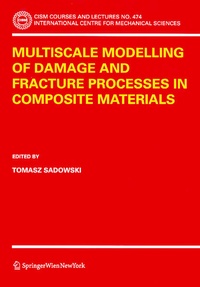
Multiscale Modelling of Damage and Fracture Processes in Composite Materials
Published on 24. November 2004
Book
Paperback/Softback
VII, 309 pages
978-3-211-29558-8 (ISBN)
Description
Various types of composites are used in engineering practice. The most important are fibrous compositesy laminates and materials with a more complicated geometry of reinforcement in the form of short fibres and particles of various properties^ shapes and sizes. The aim of course was to understand the basic principles of damage growth and fracture processes in ceramic, polymer and metal matrix composites. Nowadays, it is widely recognized that important macroscopic properties like the macroscopic stiffness and strength, are governed by processes that occur at one to several scales below the level of observation. Understanding how these processes infiuence the reduction of stiffness and strength is essential for the analysis of existing and the design of improved composite materials. The study of how these various length scales can be linked together or taken into account simultaneously is particular attractive for composite materials, since they have a well-defined structure at the micro and meso-levels. Moreover, the microstructural and mesostructural levels are well-defined: the microstructural level can be associated with small particles or fibres, while the individual laminae can be indentified at the mesoscopic level. For this reason, advances in multiscale modelling and analysis made here, pertain directly to classes of materials which either have a range of relevant microstructural scales, such as metals, or do not have a very we- defined microstructure, e.g. cementitious composites. In particular, the fracture mechanics and optimization techniques for the design of polymer composite laminates against the delamination type of failure was discussed.
More details
Series
Edition
2005 ed.
Language
English
Place of publication
Vienna
Austria
Publishing group
Springer Wien
Target group
Professional and scholarly
Research
Illustrations
VII, 309 p.
Dimensions
Height: 240 mm
Width: 170 mm
Thickness: 18 mm
Weight
546 gr
ISBN-13
978-3-211-29558-8 (9783211295588)
DOI
10.1007/3-211-38102-3
Schweitzer Classification
Other editions
Additional editions
E-Book
03/2007
1st Edition
Springer
€96.29
Available for download
Content
Modelling of anisotropic behavior in fiber and particle reinforced composites.- Computational Mechanics of Failure in Composites at Multiple Scales.- Micromechanical modelling of strain hardening and tension softening in cementitious composites.- Optimum Composite Laminates Least Prone to Delamination under Mechanical and Thermal Loads.- Multiscale Computational Damage Modelling of Laminate Composites.- Damage Modelling at Material Interfaces.- Modelling of Damage and Fracture Processes of Ceramic Matrix Composites.