

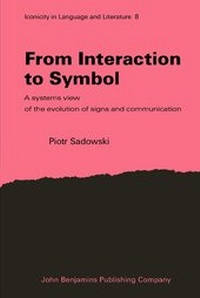
From Interaction to Symbol
A systems view of the evolution of signs and communication
Published on 23. September 2009
Book
Hardback
300 pages
978-90-272-4344-7 (ISBN)
Description
Against the background of jargon-ridden and often obscure semiotic literature Sadowski's book offers a reader-friendly yet rigorous account of human communication and its evolution from animal and primate behaviour. What is specifically human about the way we exchange information with other people, and to what extent are our facial expressions, body language, and even emotive elements of speech still indebted to our pre-human ancestors? Why can the chimpanzees, smart as they are, not interpret animal tracks in the ground; why did religions often ban representational art; why is photography perceptually more powerful than painting; how have human syntactic speech and combinatorial grammar enabled the "explosion" of culture; and why do otherwise rational humans often strongly believe in the objective existence of unempirical, virtual entities such as religious and philosophic concepts? These and many other fascinating questions are addressed in the book within the methodological framework of systems theory and evolutionary psychology.
More details
Series
Language
English
Place of publication
Amsterdam
Netherlands
Target group
College/higher education
Professional and scholarly
Dimensions
Height: 245 mm
Width: 164 mm
Weight
735 gr
ISBN-13
978-90-272-4344-7 (9789027243447)
Copyright in bibliographic data and cover images is held by Nielsen Book Services Limited or by the publishers or by their respective licensors: all rights reserved.
Schweitzer Classification
Other editions
Additional editions
E-Book
09/2009
1st Edition
John Benjamins Publishing Company
€130.99
Available for download
Content
1. List of figures; 2. Acknowledgements; 3. Preface; 4. Chapter 1. Systems theory: Between philosophy and science, but more science than philosophy; 5. Chapter 2. Towards a systems model of communication; 6. Chapter 3. Needs as motivators of behaviour; 7. Chapter 4. From emotive vocalizations to bodily adornments: The origins of referentiality; 8. Chapter 5. Photography, or the magic of iconic indexicality; 9. Chapter 6. Photography plus movement, or even more magic; 10. Chapter 7. From mimicry to metaphor: The origins of art; 11. Chapter 9. The thrills of visual realism; 12. Chapter 10. Linguistic iconicity and the limits of arbitrariness; 13. Chapter 11. The origins of language and the advantages of arbitrariness; 14. Chapter 12. Language and the symbolic compulsion; 15. References; 16. Index